Imagine you are trying to explain to a Chinese friend why a knight in a European story is going to kill a dragon, and they look at you in horror. Why would he kill the dragon? In China the dragon brings the rain. A knight who killed one would be about as popular as a man who burned down the village well. The two creatures share an English word, but they come from very different imaginations, and they do not do the same things.
The Chinese long
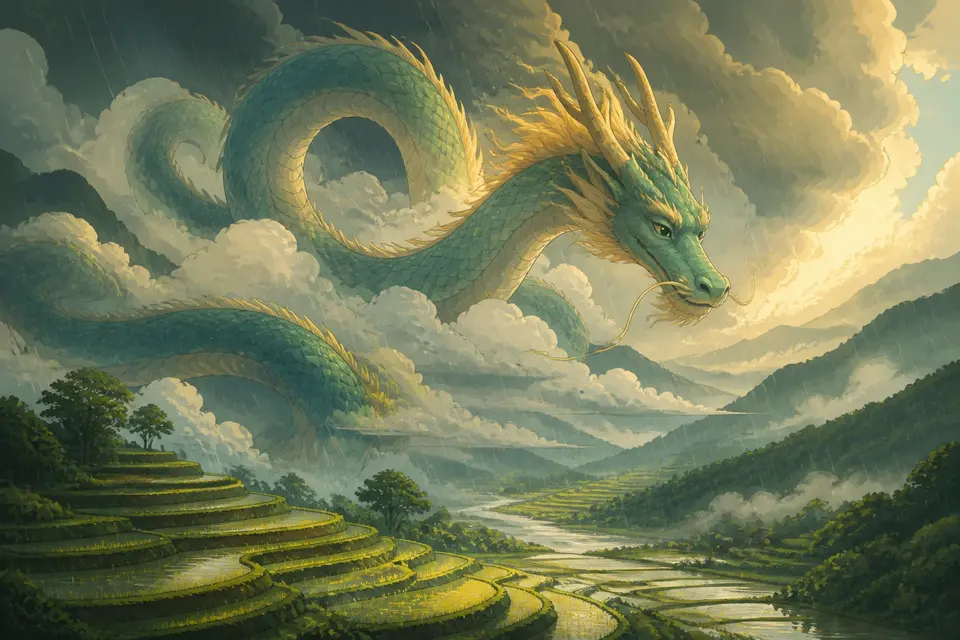
The Chinese word for the creature is lóng (龙). The earliest images are from the Neolithic period: a coiled shape in jade, found at Hongshan sites in the north of China, about 5,000 years old. In the Han dynasty, the writer Wang Fu described the dragon as having nine resemblances: the head of a camel, the horns of a deer, the eyes of a rabbit, the ears of an ox, the neck of a snake, the belly of a clam, the scales of a carp, the claws of an eagle and the paws of a tiger. It is a composite, a creature that gathers the best features of many animals.
It is long, sinuous, wingless, and it flies by magic. It lives in rivers, lakes, seas and clouds. Above all, it is connected with water. Dragons control rain, rivers and floods. In times of drought, communities held ceremonies and prayed to dragons for rain. A thunderstorm could be the dragon moving across the sky.
An imperial symbol
Because of its power, the dragon became the emblem of the emperor. In later dynasties, the emperor’s robes were embroidered with dragons, and the five-clawed dragon was reserved for the emperor alone. Lower officials and nobles could use dragons with four or three claws. The throne was called the Dragon Throne, and the emperor’s face the “dragon face.”
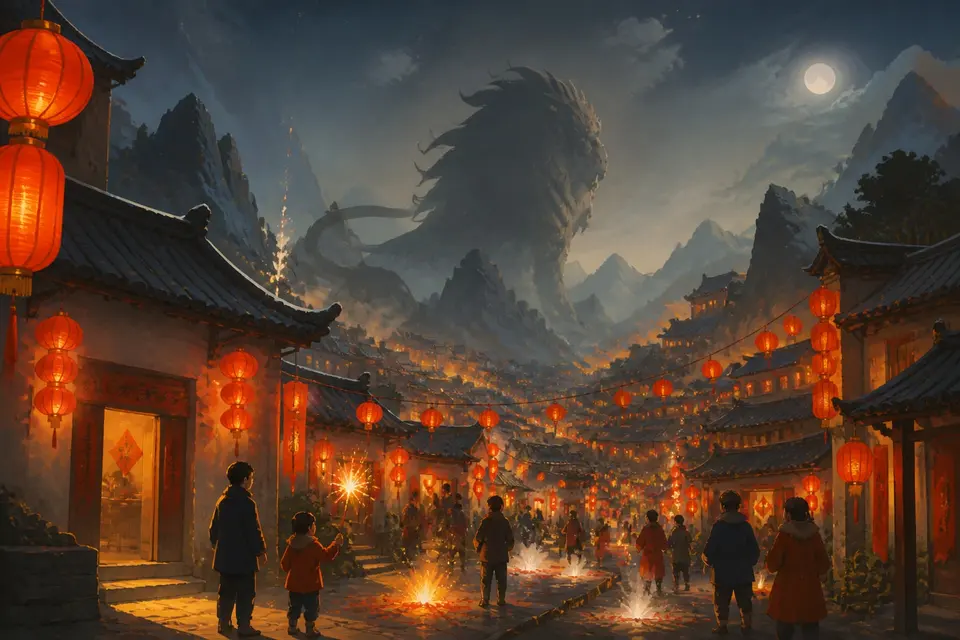
But the dragon was not just for rulers. It was also a popular symbol of good fortune, strength and vitality. It appears on temple roofs, in New Year dances, on lanterns and in names. The dragon dance, in which a team of performers lifts a long, brightly colored dragon on poles and makes it weave and leap through the streets, is a feature of Lunar New Year celebrations in China and Chinese communities around the world. And there are dragon boat races, held on the Dragon Boat Festival, in which teams paddle in long, narrow boats with carved dragon heads.
The Western dragon
Compare that with the European tradition. The Western dragon is a different creature, a winged, four-legged reptile that breathes fire. It tends to live in a cave, sleep on a hoard of gold and terrorize the neighborhood. Its job in the stories is to be killed. In the Old English poem Beowulf, the hero dies after fighting a dragon that guards a treasure. In the Norse legend of Sigurd, he kills the dragon Fafnir, who had turned into a monster out of greed. In the legend of Saint George, which became popular in the Middle Ages through a book called The Golden Legend, the saint kills a dragon that is menacing a town and demanding the sacrifice of its children.
In Christian tradition, the dragon also became a symbol of the devil. The Book of Revelation describes “the great dragon... that ancient serpent, who is called the Devil.” So, in the West, the dragon stood for chaos, greed and evil. In China, it stood for power, luck and abundance.
The nine sons
A fun legend in China says that the dragon had nine sons, none of whom turned out to be a dragon, and each had its own peculiarities. One of them, Bixi, resembles a turtle and likes to carry heavy loads, so he is carved at the base of stone monuments. Chiwen likes to look into the distance, so he sits on roof ridges. Pulao loves to roar, and so he decorates bells. The list of names, and which son does what, varies from source to source, and the legend seems to date from the Ming dynasty, but it is a good example of how the dragon family is associated with architecture.
Carp and dragon
Another well-loved story is the legend of the Dragon Gate. On the Yellow River, there is a waterfall called the Dragon Gate. Carp swim upstream every spring, but only a few of them manage to leap up the falls. Those that succeed turn into dragons. The image became a metaphor for success: for students who passed the imperial examinations, and for anyone who triumphed over hardship. It is still used today in encouraging messages to students.
A translation problem
The English word “dragon” is a poor fit for the Chinese lóng. Some scholars and writers have suggested using the romanization long or even loong to mark the difference. In recent years some Chinese organizations and writers have promoted the term “loong” as an alternative, arguing that the Western association of dragons with evil is misleading. The debate is ongoing.
A creature of hope
In 2024, the Year of the Dragon, wishes for good luck and good fortune filled the Lunar New Year greetings. Parents hoped for babies born in the dragon year, which is traditionally thought to be especially lucky, and the number of births in China ticked up.
If you want to remember the difference, think of it this way. The Western dragon sits on a pile of gold and keeps everyone away. The Chinese dragon rides the clouds and makes it rain on the fields.