Who was the first writer in history whose name we know? Not Homer, who is a name attached to poems of uncertain authorship. Not Hesiod. Not a Greek philosopher or a Hebrew prophet. The first author to put their name on their work was a woman who lived around 2300 BCE, in a city in what is now southern Iraq, and she was a princess, a priestess and a poet.
A daughter of an emperor
Her name was Enheduanna. It is not quite a personal name: it is a title, en-hedu-anna, which means something like “high priestess, ornament of heaven.” She was the daughter of Sargon of Akkad, who rose from obscurity to conquer the city-states of Sumer and created what is generally regarded as the first empire. The Sumerians spoke a language that was unrelated to the Akkadian spoken by Sargon, and a key problem for the new ruler was to make his rule acceptable.
He solved part of it by appointing his daughter as the high priestess of Nanna, the moon god, in the city of Ur. It was a position of great religious, economic and political importance. The temple controlled land, workshops and storehouses. She held the office for decades, under Sargon and under his sons.
What she wrote
Enheduanna’s poems, in Sumerian, survive in copies made centuries after her death. The best known are hymns to the goddess Inanna, the goddess of love, war and the morning and evening star, known later as Ishtar. One, usually called Nin-me-šara, “Lady of All the Divine Powers,” is a long, passionate poem of 153 lines. It praises Inanna as a fearsome, storm-like figure, a deity of terrifying power, who rains fire on the land and who is greater than An, the sky god.
She also wrote a collection of forty-two short hymns, the Sumerian Temple Hymns, each devoted to the temple of a different city and its god. Together they form a kind of religious map of Sumer, stitching the many city-states into a single family of gods. It was, among other things, a political act.
The first-person voice
What makes Enheduanna special is the voice. In Nin-me-šara, the poem is not a general praise of the goddess. It is a personal appeal. Midway through, Enheduanna describes how a rebellion broke out in Sumer, led by a man named Lugal-ane, who drove her out of her temple. She says she was cast out and forced to wander “like a swallow,” and she calls on Inanna for help.
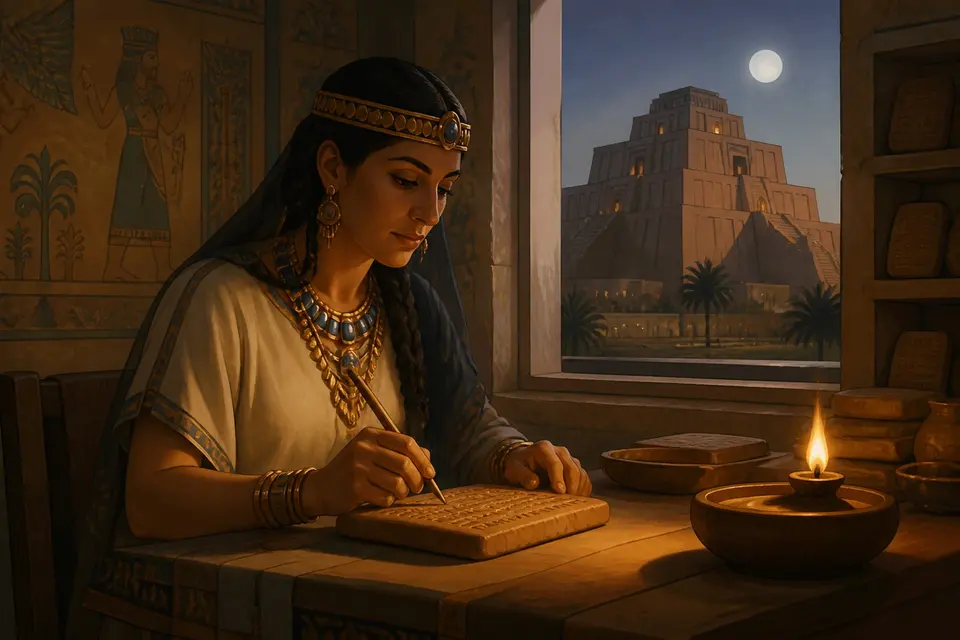
She says, in effect, “I, Enheduanna, the high priestess, carried the offering basket and sang the hymn.” She gives her name. She talks about her own emotions and her own role. She describes the night when she composed the poem, and says that she gave birth to it, “as a woman.” It is the first time in recorded history that an author says “I made this.”
The disc
In 1927, the British archaeologist Leonard Woolley was excavating at Ur, alongside a team from the British Museum and the University of Pennsylvania. In the ruins of a building near the temple complex, he found a round alabaster disc, about 25 centimeters across, broken into two pieces. One side was carved in relief. It shows a ceremony, with a priest pouring a libation, and, at the left, a woman in a flounced robe wearing a round cap, a bit larger than the others. On the back was an inscription in cuneiform saying that the image was of Enheduanna, daughter of King Sargon, wife of the god Nanna. The disc is now in the Penn Museum in Philadelphia.
Remembered for a long time
Her poems had an enormous afterlife. They were copied by scribes in Babylonian schools for about five hundred years, up to the Old Babylonian period, around 1800 BCE. Students practiced writing Sumerian by copying her hymns. Texts from this period include many tablets of Nin-me-šara, which is why the poem survives at all.
Scholars have debated how much of what is attributed to Enheduanna she actually wrote, as there were later additions. But most accept that the core of the poems comes from her. The question of whether she was a real person is not a serious doubt.
An author at the beginning
It is a small, striking fact. The first person in history to claim authorship was a woman, a poet who was also a political figure and who wrote about her own exile. In Mesopotamia, writing was not a male monopoly in the earliest periods, and women worked as scribes and priestesses.
More than forty centuries later, readers still find her work surprisingly direct. She is writing from a different world, with different gods, but she is trying, as writers still do, to be heard.