When the young composer Igor Stravinsky wrote his first big ballet in 1910, The Firebird, for the Ballets Russes in Paris, he needed a villain. He chose Kashchei, a figure straight out of Russian folktales, and gave him one of the most memorable pieces of music in the score, a frantic, jagged “Infernal Dance.” The audience in Paris, who did not know the folklore, did not need to. They could hear that something wicked had stepped on stage. But what made Kashchei, or Koschei as the name is more often spelled in English, so dangerous in the original stories was not strength or magic. It was that he could not be killed.
Who Koschei is
Koschei the Deathless, in Russian Koshchei Bessmertny, is a recurring figure in East Slavic folktales. He is usually a gaunt old man, skeletal and rich, who lives in a castle full of gold. The name seems to be related to the Russian word kost’, “bone,” and could mean “bony,” though some scholars suggest a Turkic origin, and it is not certain. He is a sorcerer who kidnaps beautiful women, especially a princess, and keeps them in his palace. He rides a magical horse and can turn into various creatures.
The hero who goes to rescue the princess is usually Ivan Tsarevich, a prince, who is helped by animals he has been kind to, a wise princess or a magic horse.
Marya Morevna
The best-known story is “Marya Morevna.” In it, Prince Ivan has three sisters who are married to a falcon, an eagle and a raven. When his parents die, he goes to visit them and, on the road, meets and marries a warrior queen, Marya Morevna. She leads armies. Before going to war, she warns him never to open a door in the palace. Naturally, he does. Inside, hanging in twelve iron chains, is Koschei, who begs for a drink of water. Ivan, being kind, gives him three buckets. With each one, Koschei grows stronger, until he bursts the chains, flies away and carries off Marya Morevna.
Ivan goes after her. Koschei’s magic horse is faster than anything Ivan has, and twice the sorcerer lets him go, remembering the water. The third time, he does not. He hacks Ivan to pieces and stuffs them into a barrel. Ivan’s brothers-in-law, the falcon, the eagle and the raven, fetch the water of life and the water of death and bring him back. And in this version, it is a horse, one that Baba Yaga gives Ivan, that finally tramples Koschei to death.
The hiding place
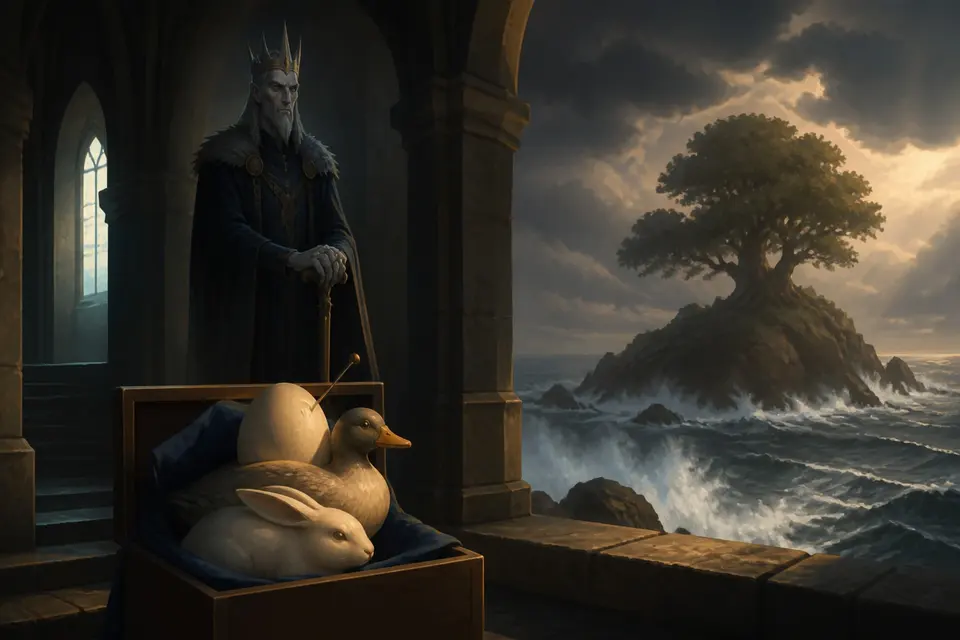
The needle comes from other tales about the same villain, and it is the most famous detail of all. In these versions, the princess he has captured pretends to love him, and coaxes out of him where his death is kept. It is far away, he tells her, in the middle of the ocean. On an island called Buyan stands a green oak. Under the oak is an iron chest. In the chest is a hare. Inside the hare, a duck. Inside the duck, an egg. And inside the egg, a needle. His death is at the end of the needle.
The hero sets out for the island, and in many versions the animals he was kind to earlier do the work for him: a bear tears up the oak, a hare is caught by a wolf, a duck by a hawk, and the egg that falls into the sea is brought back by a pike. When Ivan holds the egg, Koschei can feel it. He squeezes it, and the sorcerer weakens. He breaks the needle, and Koschei falls dead. The details change from teller to teller, and the animals vary, but the nesting stays the same.
A very old idea
Koschei is a prime example of what folklorists call the “external soul,” the idea that a person’s life can be kept outside the body, in a hidden object. It is a very widespread motif. An ancient Egyptian story from about 1200 BCE, “The Tale of Two Brothers,” has a man who puts his heart in the blossom of an acacia tree. The Scottish folklorist James Frazer collected dozens of examples in The Golden Bough (1890). In Russia, it takes the form of Koschei’s needle in a series of nested containers, each one a little harder to get at than the last.
Readers of modern fantasy may notice that the idea has been recycled. Dark lords who can only be defeated by finding and destroying some hidden object are common in fiction. The Slavic version has a gleefully absurd structure: each layer is an animal, so the hero has to deal with each of them in turn.
Why the structure matters
On the face of it, a villain who hides his life in so many layers is a way of saying that he cannot be beaten by strength. The hero has to be patient, kind to others and clever. In the story, Ivan loses twice because he is trusting and impulsive. He wins when he stops fighting Koschei head-on and starts listening to the people who know his secret.
It also has a kind of grim humor. A man so afraid of dying that he hides his life in an egg inside a duck inside a hare inside a chest inside an oak on an island at the end of the world is a man who has lost the ability to live. The needle is almost beside the point. The real punishment is the life he has chosen.
In music and beyond
Besides Stravinsky, the composer Nikolai Rimsky-Korsakov wrote an opera in 1902 called Kashchey the Deathless. The character has appeared in novels, comics and video games, including Marvel comics and a long line of role-playing games. He is the archetype of the villain who cannot be killed, and who will not stay dead.