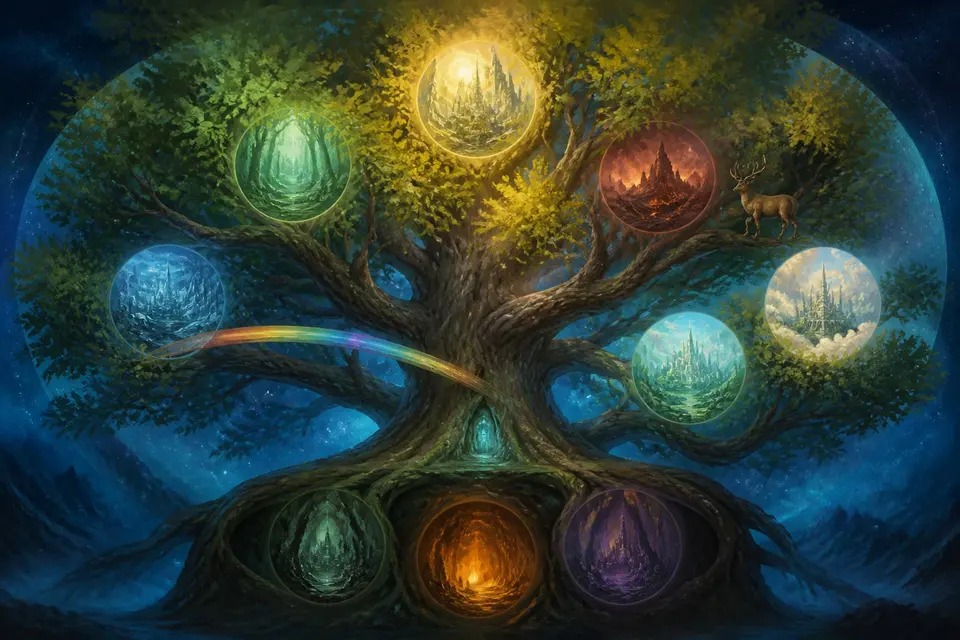
Search for “nine realms” and you will find tidy maps with nine labeled bubbles on a big tree. They look very official. But the Norse sources are not that organized. The Völuspá says, in one verse, that the seeress remembers “nine worlds, nine in the tree, the mighty tree beneath the ground.” She does not give a list. Other poems mention more worlds or names. The tidy diagram you see online is a modern reconstruction, a puzzle assembled from scattered clues. That is not a flaw. It is part of the fun.
The tree
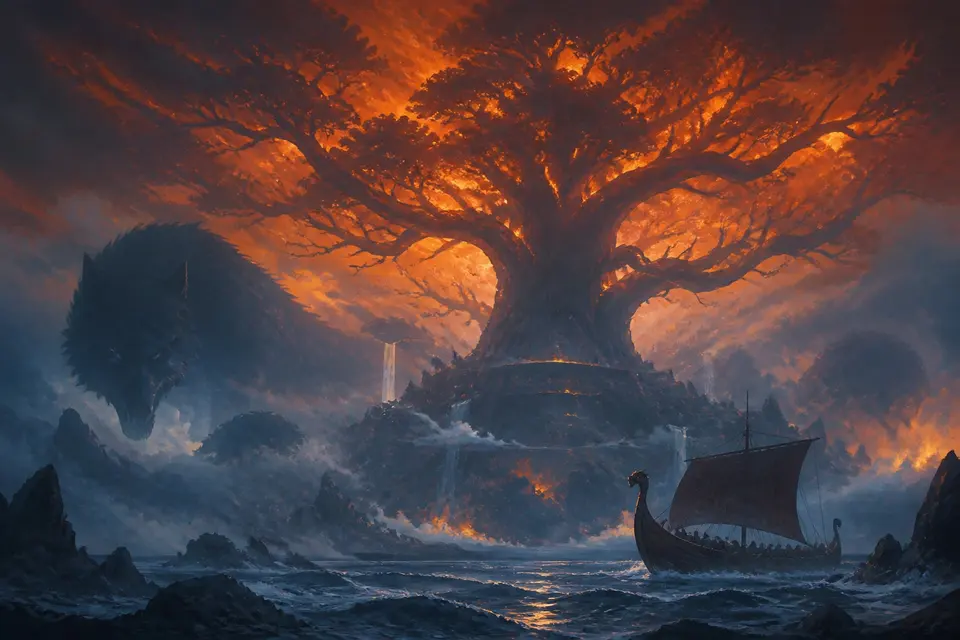
Everything hangs on Yggdrasil, a gigantic ash tree. Its name probably means “Ygg’s horse,” Ygg being one of Odin’s names, and “horse” being a poetic word for a gallows. Odin once hung himself on the tree for nine nights, pierced by a spear, to learn the runes. Its three roots reach into different places: one to the well of Urd, near the gods, where the Norns tend it; one to the well of Mímir, the source of wisdom; and one to the spring Hvergelmir in the cold realm of Niflheim, where a dragon named Níðhöggr gnaws at it. An eagle sits on top. A squirrel, Ratatoskr, runs up and down, carrying insults from the eagle to the dragon.
The realms
- Asgard is the home of the Æsir, the main family of gods, including Odin, Thor, Frigg and Baldr. It has great halls: Valhalla, where the warriors chosen by Odin feast, and Bilskirnir, Thor’s.
- Vanaheim is the home of the Vanir, a second family of gods associated with fertility, wealth and the earth. The two families fought a war and then exchanged hostages. Freyr, Freyja and their father Njörd are Vanir who live among the Æsir.
- Alfheim is the home of the light elves. Freyr was given it as a gift when he was a boy.
- Midgard means “middle enclosure.” It is the world of humans, surrounded by an ocean, with the Midgard Serpent coiled around it. The gods built a fence to protect it from the giants.
- Jotunheim is the land of the giants, the jötnar, the gods’ oldest enemies and, often, their relatives. Many gods have giant mothers or wives.
- Nidavellir (“the dark fields”) or Svartalfheim is where the dwarves live. They are the best smiths in the cosmos and made the gods’ greatest treasures.
- Niflheim is a world of cold, mist and darkness, which existed before the gods. In the creation story, it lies on one side of a great void.
- Muspelheim is the realm of fire on the other side of the void. When the warm air from Muspelheim met the ice of Niflheim, the first being, the giant Ymir, was formed. The fire giant Surtr guards its border.
- Helheim is where most of the dead go, ruled by Hel, Loki’s daughter. It is damp and gloomy, but not a place of torture. Warriors who die in battle go to Odin or Freyja instead.
How you get around
The most famous connection is Bifröst, the rainbow bridge, which links Midgard and Asgard. It is guarded by Heimdall, who needs less sleep than a bird and can hear grass grow. The bridge is made, the Prose Edda says, of fire, water and air, and it will break on the day of Ragnarök.
Why the numbers vary
Different poems seem to use different lists. The Prose Edda, for instance, mentions “home of the light elves” and “home of the dark elves” but also “home of the dwarves.” Some modern authors treat Nidavellir and Svartalfheim as the same place, others as different, which would make ten. There is also a lack of agreement about where Helheim and Niflheim begin and end. And the word heimr just means “home” or “world,” and may not mean a physical planet.
A real tree at Uppsala
There may be a historical echo of Yggdrasil in the real world. Around 1075, a German churchman named Adam of Bremen wrote a history of the archbishops of Hamburg-Bremen, in which he described the pagan temple at Uppsala, in Sweden, then still a center of the old religion. Beside the temple, he said, stood an enormous tree with spreading branches, always green in winter and summer, and nobody knew what kind it was. Near it was a spring where sacrifices were made, and a man was thrown in alive; if he did not resurface, the wish of the people would be granted. Adam also says that every nine years, nine males of every kind of creature, including men, were sacrificed and hung in the sacred grove near the temple. Adam was a Christian outsider with a taste for lurid details, so his account has to be treated with caution, but the tree, the spring and the number nine all appear to be genuine local traditions.
The realms in the movies
Many people first met the Nine Realms in Marvel’s Thor films, which use the idea freely: in Thor (2011) the Bifröst bridge connects Asgard to the other realms, in Thor: The Dark World (2013) the plot revolves around a conjunction of all nine, and the villains come from Svartalfheim. Marvel’s version puts them in the same universe as planets. The Norse sources offer something different. The realms are not distant planets. They are places connected by roots and branches, so that a god might walk from one to another on foot or on a horse.
The nice thing about the nine realms is that they function as a map of the Norse imagination. Gods, humans, giants, elves, dwarves and the dead all live in the same tree. They visit each other, steal from each other, marry, fight and get into trouble. It is a world in which no one is quite alone.