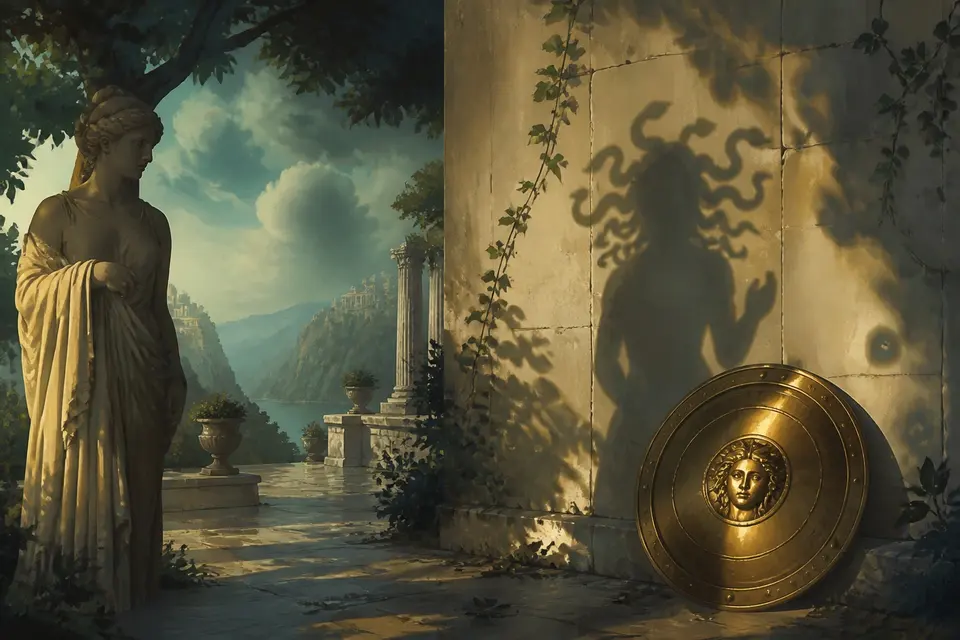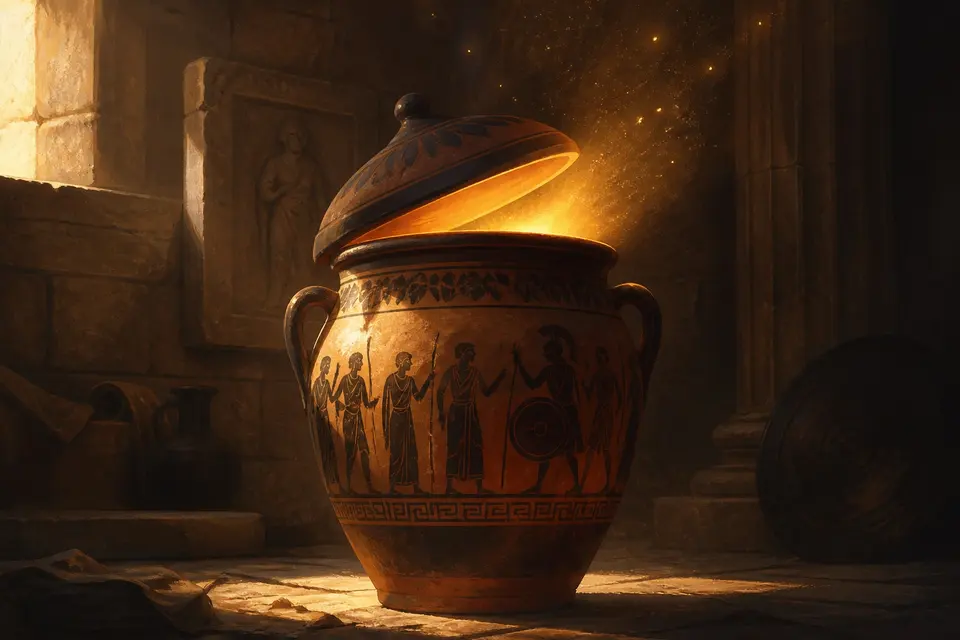
Weddings are minefields. The Greeks knew it too, and one of the most famous disasters in their mythology is a wedding where the host forgot one guest. It is hard to believe that the greatest war of the heroic age began because someone was left off a list, but that is how the story goes, at least in the tradition that came together after Homer.
The guest list
The occasion was the marriage of Peleus, a mortal king, to Thetis, a sea goddess. It was a major social event. Zeus had once wanted Thetis for himself, but a prophecy said that her son would be greater than his father, so he married her off to a human to be safe. The gods were all invited, and they came with gifts. The one deity who was not invited was Eris, the goddess of strife.
Eris is the sister of Ares, the war god, and her name simply means “discord.” Hesiod describes two kinds of Strife: a bad one that stirs up war and a good one that makes people compete and work harder. This one was the bad kind. Understandably, she took offense.
The apple
According to the story, as the guests were feasting, Eris appeared and rolled a golden apple across the floor. On it was written, in the version most often told, “To the fairest,” a word that in Greek is kallisti. Three goddesses reached for it at once: Hera, the queen of the gods, Athena, the goddess of wisdom and war, and Aphrodite, the goddess of love.
They demanded that Zeus judge between them. Wisely, he declined. A husband who rules on whether his wife is more beautiful than two of his daughters has put himself in an impossible position. Instead, he handed the job to a mortal who had no stake in the matter, a young prince named Paris, who was spending time as a shepherd on Mount Ida near Troy.
The bribes
The goddesses went to Paris, with Hermes as guide, and each tried to sway him. Hera offered power: he would rule all of Asia. Athena offered glory in war, and victory in every battle. Aphrodite offered him the most beautiful woman in the world as his wife.
Paris chose Aphrodite. Her prize was Helen, the daughter of Zeus and Leda, who was already married to Menelaus, king of Sparta. When Paris traveled to Sparta, he was treated as a guest. He left with Helen, along with a good deal of Menelaus’s treasure. In some versions Helen is carried off by force, in others she goes willingly. Greek writers argued about it for centuries.
The Greek kings had once sworn an oath to defend Helen’s marriage, so they assembled a fleet and sailed for Troy. Hera and Athena, who had lost the contest, were furious, and they sided with the Greeks. Aphrodite supported the Trojans. The war lasted ten years.
An idiom with a long life
From this story we get the phrase “apple of discord”: a small matter that provokes a great quarrel. The Judgment of Paris was one of the favorite subjects of ancient painters, and in later centuries artists like Lucas Cranach, Rubens and Renoir all painted it. In the Renaissance version, the goddesses are often shown nude, since the story called for beauty to be judged.
And a dwarf planet
The goddess of strife still has a way of starting arguments. In 2005, a team led by the astronomer Mike Brown at Caltech announced the discovery of an icy body in the outer solar system. It was soon found to be about the same size as Pluto, and it was even slightly more massive. They named it Eris, after the goddess. It was a nice fit: the discovery began an argument.
If Pluto was a planet, then so was Eris, and probably many others being found in the same region. In August 2006, the International Astronomical Union voted to create a formal definition of the word planet, and under it, both Pluto and Eris were reclassified as dwarf planets. Many people were upset, and some still are. Eris’s moon is called Dysnomia, after the daughter of Eris, a spirit of lawlessness.
The wedding that made a hero
There is a bitter irony in the setting. The wedding of Peleus and Thetis was also the occasion on which Achilles was conceived. The war that was started by an insult at the feast of his parents is the war in which their son would be killed. That sense of a circle closing is part of why the Greeks found the story so rich.
Did Helen go to Troy?
Not everyone believed that Helen had gone to Troy. The lyric poet Stesichorus, who lived in the sixth century BCE, wrote a poem attacking her as the cause of the war. According to Plato, the poet was struck blind. He then wrote a second poem, a Palinode, or “recantation,” which began: “That story is not true; you never sailed in the benched ships, you never came to the towers of Troy.” His sight returned. In Euripides’s play Helen, performed in 412 BCE, the idea is developed: Hera, still angry about the apple, substituted a phantom made of cloud for Helen, and the Greeks and Trojans spent ten years fighting over a ghost. The real Helen sat out the war in Egypt.
Who was fairest?
The Judgment of Paris was one of the favorite subjects of European painting. Rubens painted it several times; the version in the National Gallery in London, from about 1636, shows three nude women with Hermes pointing and Paris leaning forward to examine them. The Cranach version has the three goddesses and Paris dressed in armor. Painters discovered that the story gave them an excuse to paint the female figure from three angles, front, side and back. Whether Paris made the right choice is hardly the point. Everyone lost.
So the goddess who was once thrown out of a party started a war, and then, three thousand years later, got a planet demoted. She would probably be pleased.