In Florence, in a covered gallery off the Piazza della Signoria, a bronze Perseus stands on a marble base and holds up the severed head of Medusa. Benvenuto Cellini finished it in 1554 for Duke Cosimo de’ Medici, and nobody who walks past it has any doubt about who won. Now jump to 2008. An Argentine-Italian sculptor named Luciano Garbati makes a statue with the same pose and the same nudity, but he swaps the roles: Medusa stands there, a sword in one hand, and the head in the other belongs to Perseus.
Both statues are about the same story. They tell it in opposite ways, and that is exactly what Greek and Roman writers did with Medusa for about a thousand years.
The version you are not told
The oldest Medusa we have is in Hesiod’s Theogony, composed around 700 BCE. She is one of three Gorgons, the daughters of the sea deities Phorcys and Ceto, and the only one of the sisters who can die. The poem says she slept with the sea god Poseidon in a soft meadow among spring flowers, and that when Perseus later cut off her head, two children leapt out of her neck: the giant Chrysaor and the winged horse Pegasus. There is no beauty contest here, no curse, no temple. Hesiod mentions that she “suffered” and moves on.
Even in the earliest sources she is an odd monster. She is not hunted down because she did something. She is hunted because a king named Polydectes wants Perseus out of the way and tells him to bring back her head. Perseus is a young man doing an impossible chore.
How you actually kill her
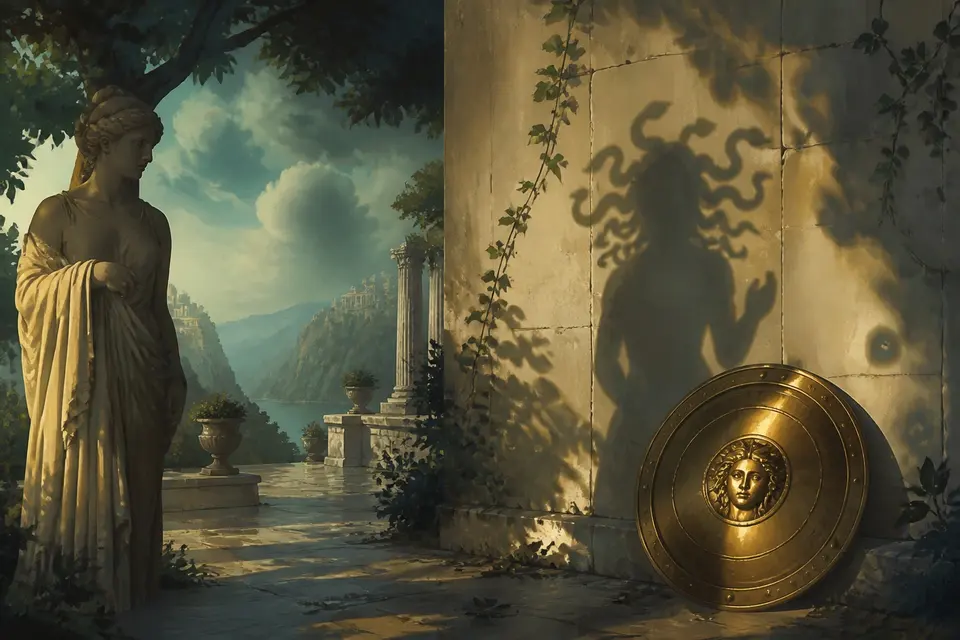
Our fullest account of the hunt comes from Apollodorus, a mythographer writing perhaps in the first or second century CE. Perseus gets help from the gods, which is typical. Hermes gives him a sickle-shaped sword. He borrows winged sandals, a magic bag to carry the head in, and a cap that makes him invisible (the cap belongs to Hades). Athena guides his hand while he looks only at Medusa’s reflection in a polished bronze shield, so her stare never reaches him.
Notice the practical genius of this. You do not defeat the thing that kills with a look by being braver. You defeat it by never meeting its eyes. Every mirror-and-monster story since owes something to this scene.
The Greek poet Pindar adds a lovely detail. In his twelfth Pythian ode, from 462 BCE, he says the goddess Athena invented flute music after hearing the Gorgon sisters wail over Medusa’s death. The aulos, the double-reeded pipe the Greeks used for everything from weddings to funerals, is supposedly Athena’s imitation of that grief. The monster’s death is mourned with a new kind of music.
Ovid changes the story
The Medusa most of us picture, the beautiful woman who was punished, is Roman. In the fourth book of his Metamorphoses, around 8 CE, Ovid has someone ask Perseus why Medusa alone among the Gorgons has snakes for hair. Perseus answers: she was once the most admired girl in her town, famous above all for her hair. Neptune (the Roman Poseidon) raped her inside Minerva’s temple. The goddess, Ovid says, turned her back and covered her eyes with her shield, and then punished the victim by changing her hair into serpents. Ovid adds, dryly, that Minerva still wears the snakes on her chest to frighten her enemies.
Readers have been angry about this passage for two thousand years, and Ovid probably intended some of that discomfort. He is a poet who likes to show gods behaving badly and lets the human pay for it. Whether you read the scene as cruelty or as a critique of cruelty, it fixed the modern image of Medusa as a woman wronged.
A face meant to protect
Before she was a victim, she was a bodyguard. The gorgoneion, the Gorgon’s face, is one of the oldest protective emblems in Greek art. It glares from the pediment of the Temple of Artemis on Corfu, built around 580 BCE, with bulging eyes, a lolling tongue and boar’s tusks. It appears on shields, on doors, on roof tiles and on the breastplate of Athena. The idea was simple: put something frightening on your property and it frightens off anything that might harm it.
Over time the face softened. A famous marble head known as the Medusa Rondanini, a Roman copy of a Greek original from the fifth century BCE and now in Munich, shows a woman with a calm, sorrowful, almost beautiful face. The tusks are gone. The tongue is gone. Artists, it seems, had started to see her differently long before Ovid wrote it down.
Medusa in the modern world
The Renaissance loved her. Caravaggio painted her head on a ceremonial shield in the 1590s, mid-scream, with blood still spurting. Cellini cast his Perseus. Centuries later the fashion designer Gianni Versace picked her as the emblem of his house in the late 1970s. He had grown up among ancient ruins in Calabria and chose her, by most accounts, because she stood for an attraction you cannot walk away from.
And then there is that other statue. Garbati made his version in 2008, long before it became famous. In October 2020 it was installed in a small park in lower Manhattan, directly across from the criminal courthouse where Harvey Weinstein had stood trial. It became a symbol of the #MeToo movement almost overnight, and the debate about it, whether it was powerful or whether it erased the original myth, was itself very Greek: a public argument about a story that refuses to hold still.
That is probably the answer to the question of which Medusa is the real one. There was a monster in Hesiod, a mourner in Pindar, a victim in Ovid, a charm on a thousand doors and a symbol in a New York park. If you want to hear them all, go back to the oldest version, look at the Rondanini head and notice that the face already looks like someone who has something to say.