Here is a trivia question with a good answer. Where does the word “psychology” come from? From the Greek psyche, which means soul, breath and, also, butterfly. And the most famous character who ever carried that name is a princess in a Roman story, written in Latin in about 170 CE by an author from what is now Algeria, in the middle of a comic novel about a man who is turned into a donkey. The story of Cupid and Psyche is the first thing most people should read from the ancient world, and it is almost never told properly.
Where it comes from
The author was Apuleius, who was born around 124 CE in Madaurus, a Roman town in North Africa, studied in Carthage and Athens and made a living as a lawyer, a lecturer and, for a while, a defendant: he was tried for using magic to win his wife. His novel, the Metamorphoses, usually called The Golden Ass, is the only Latin novel that has survived complete. Its hero, Lucius, is a curious young man who meddles with witchcraft, accidentally turns himself into a donkey and has a string of misadventures. In the middle of the book, kidnapped by robbers and held in a cave, he overhears an old woman telling a frightened girl a story to calm her down. That story is Cupid and Psyche. It takes up a few chapters, and it is by far the most famous part of the book.
Apuleius almost certainly did not invent it from scratch. Folktales of this type are found all over the world, and scholars even have a number for the family: Aarne-Thompson type 425, “the search for the lost husband.” But Apuleius is the first to write it down in this form, and he gave it a polish that has kept it alive for eighteen centuries.
The girl who was too beautiful
A king and queen have three daughters. The youngest, Psyche, is so beautiful that people stop worshiping Venus and start flocking to look at her. Temples empty. Venus, the goddess of love, is furious. She summons her son Cupid, called Amor in Latin and Eros in Greek, and orders him to make the girl fall in love with the ugliest, most miserable man in the world.
Meanwhile there is an irony. Psyche’s beauty is so intimidating that nobody asks to marry her. Her two older sisters marry kings. She sits at home, admired and alone. Her worried father consults the oracle of Apollo, and the answer is terrible: dress her for a funeral and leave her on a mountaintop, where she will be married to a monster that neither gods nor men can resist.
They do. The family weeps as if at a burial. And then the west wind, Zephyrus, gently lifts Psyche off the rock, carries her down into a valley and sets her on a bed of flowers.
The invisible husband
She wakes up in front of a palace of gold and marble. Invisible servants bathe her, feed her and sing for her. At night, in the dark, a husband comes to her bed. She never sees him. He tells her that he loves her and makes one condition: she must never try to look at him.
Of course, the husband is Cupid. He had been sent to wound her with an arrow, and had accidentally scratched himself with his own arrow while looking at her. He fell in love at once, disobeyed his mother and arranged the entire palace.
The lamp and the drop of oil
Psyche is happy but lonely. She begs her husband to let her sisters visit. He is reluctant, knowing what will happen, but he agrees. The sisters are jealous of her wealth and begin planting doubts: you have never seen him. Perhaps he is a serpent. Perhaps he plans to eat you. Take a lamp and a knife, and cut off his head while he sleeps.
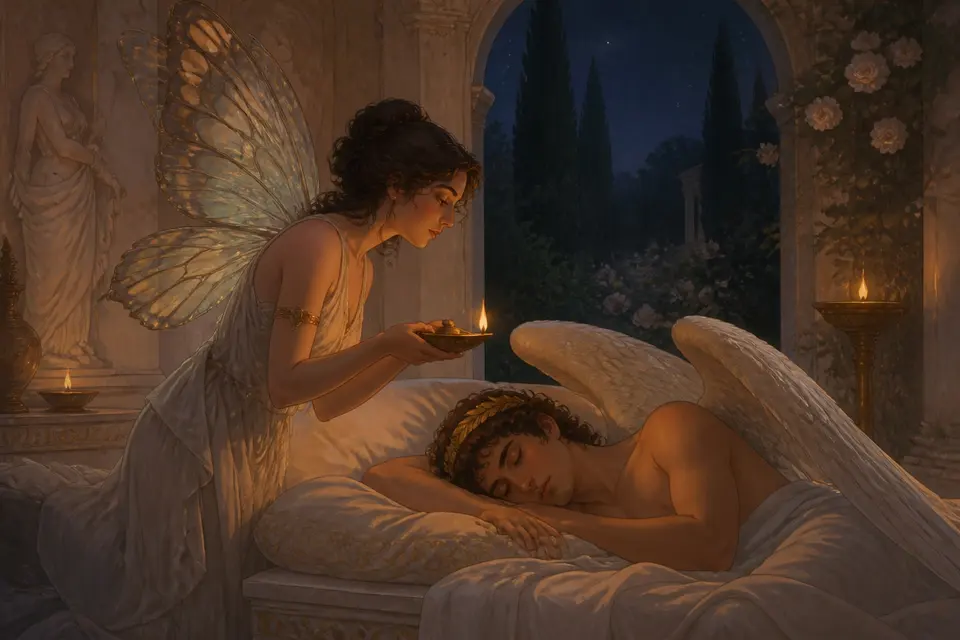
That night, Psyche takes an oil lamp and a razor. She raises the lamp. What she sees is the most beautiful god, asleep, with wings of snowy feathers. In her astonishment, she lets a drop of hot oil fall on his shoulder. He wakes, sees her with the lamp and says: love cannot live where there is no trust. And he flies away.
The four tasks
Psyche spends the rest of the story trying to win him back. She goes to Venus and begs for help. Venus, furious, sets her a series of impossible tasks.
- Sort the seeds. A huge heap of wheat, barley, poppy seeds, lentils and beans, to be sorted by nightfall. A line of ants takes pity on her and does it.
- Fetch golden wool. She must gather wool from killer sheep with golden fleece. A river reed advises her to wait until evening, when the sheep rest, and to collect the wool snagged on the bushes.
- Collect water from the Styx. The water falls from a high cliff, guarded by dragons. Jupiter’s eagle takes her flask and fills it for her.
- Go down to the Underworld. She must ask Proserpina (Persephone) for a box of beauty. A talking tower tells her how to get there and back, and gives one last warning: do not open the box.
She goes. She returns. And then she opens the box.
The box
It does not hold beauty. It holds a deathlike sleep, and she collapses. This is the moment when readers of the story usually think of Pandora, and the parallel is real: a woman, a container and a curiosity that seems unwise and also very human. But here it ends differently. Cupid, now healed, finds her, wipes the sleep from her face, puts it back in the box and asks her to take the box to Venus. Then he flies up to Jupiter and pleads their case.
Jupiter calls a meeting of the gods, proclaims the marriage valid and gives Psyche a cup of ambrosia, making her immortal. They have a daughter named Voluptas, which means “Pleasure.”
The soul and love
It is hard to read the story without thinking of its name. Psyche, the soul, has to go through trials to be united with Love. Philosophers noticed, and many have read the story as a symbol of the soul’s journey. In 1952, the psychologist Erich Neumann published Amor and Psyche, a Jungian reading of the story as a model for the development of the feminine psyche. That is one reading among many.
Others see it as one of the earliest examples of a plot that has been told over and over: Beauty and the Beast (in the version published in 1740 by Gabrielle-Suzanne de Villeneuve, and shortened in 1756 by Jeanne-Marie Leprince de Beaumont) clearly descends from it, and so does the Norwegian tale East of the Sun and West of the Moon. In all of them, a woman who breaks a promise has to find her way back, doing impossible chores, to a husband whose real face she was not supposed to see.
Afterlives
Artists loved the scene. Antonio Canova’s marble Psyche Revived by Cupid’s Kiss (1787 to 1793) is one of the most admired sculptures in the Louvre. François Gérard painted the pair in 1798. In 1819, the poet John Keats wrote “Ode to Psyche.” In 1956, C. S. Lewis, best known for the Narnia books, published Till We Have Faces, a retelling from the point of view of Psyche’s jealous older sister, which he regarded as his best book.
And space has a Psyche too. In 1852, an Italian astronomer, Annibale de Gasparis, discovered an asteroid and named it 16 Psyche. It turns out to be unusually rich in metal, possibly the exposed core of a failed planet. NASA launched a mission to it in October 2023, and the spacecraft should arrive in 2029. The princess who was too beautiful to be loved is now the name of a destination.
What to take from it
The story endures because it refuses a simple moral. Psyche’s mistake, looking, is also the thing that makes her grow. Cupid, the god of love, is as immature as any teenager. Venus is a bad mother-in-law who is also, in a way, a kind of teacher. And in the end, the human wins her place among the gods by doing something no one else had done: she went to the underworld and came back.
If you have ever tried to love someone you did not fully understand, you will probably recognize the lamp.