If you only know Hades from the 1997 animated film, you know a blue-flamed, fast-talking villain who wants to overthrow Zeus. It is a great performance and it is nearly the opposite of the character in the myths. The real Hades has no scheme. He has a job.
How the brothers divided the world
The Iliad has a beautiful summary. When the Titans fell, the three sons of Kronos drew lots. Zeus got the sky, Poseidon got the sea, and Hades got the dark misty underworld. The earth and Olympus were left shared. It is a casual, almost bureaucratic scene, and it explains Hades’s role: he did not win a kingdom, he drew the unglamorous one.
From then on, his realm was a place everyone would eventually visit, and he rarely left it. In the whole of Greek myth, there are only a few stories in which he appears on the surface of the earth. The best known is the abduction of Persephone, which happened with Zeus’s permission. In the Iliad there is a strange episode where Heracles wounds him with an arrow at Pylos and he goes up to Olympus to be healed. The god of death getting medical treatment is a rare moment of comedy.
The rich one
The Greeks were reluctant to say his name. They often called him Plouton, “the wealthy one,” because all that lay in the ground, from grain seed to silver, belonged to his realm. In Latin this became Pluto, which is why the dwarf planet has that name. They also used euphemisms like “the Host of Many” and “the Hospitable One,” because everyone ended up as his guest.
He was rarely worshipped in the way other gods were. He had few temples. The one at Elis was opened once a year and only the priest could go in. People did not pray to him for help, because there was no point. The Greeks thought of him as inflexible: he did not take bribes or let people go.
The underworld is not hell
The Greek afterlife was not a place of fire. Most people ended up in a gloomy, shadowy plain called the Asphodel Meadows, where ghosts flitted about like bats. In the Odyssey, when Odysseus visits the dead, he meets the ghost of Achilles. Odysseus says he must be happy there, being such a great hero. Achilles replies that he would rather be a hired farmhand on earth, working for a poor man, than rule over all the dead.
A lucky few went to Elysium, a place of ease at the edge of the world, and the Isles of the Blessed. And a very few offenders, like Tantalus, Sisyphus and the giant Tityos, were punished in Tartarus, a deep pit below the underworld. The judges who sorted the dead were three men who had been kings in life: Minos, Rhadamanthus and Aeacus.
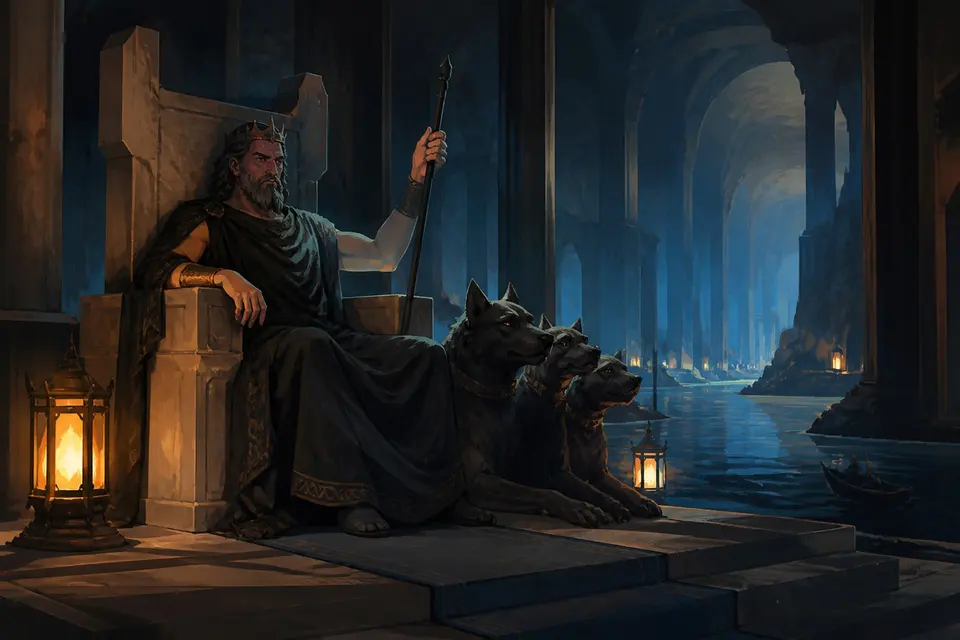
Hades did not torment souls. He simply kept them. A three-headed dog, Cerberus, guarded the door, not to keep intruders out but to make sure no one left.
How he got confused with the devil
Several things happened. The first is a matter of translation. When the Hebrew Bible was translated into Greek in the third and second centuries BCE, the translators used the word Hades for Sheol, the Hebrew term for the grave or the place of the dead. The Christian New Testament, written in Greek, uses the same word. Over time, with later ideas of hell coming in, the two got mixed up, and English translations sometimes render Hades as hell.
The second is a visual one. Medieval and Renaissance artists, who reached for the ancient world when they wanted a vocabulary of dark things, borrowed Greek underworld imagery. The three-headed dog, the fiery river and the stern judge all showed up in depictions of Christian hell. Dante’s Inferno has Charon, Minos and Cerberus in it.
What he actually is
Hades is the figure who makes the most sense of a hard fact. Everyone dies. Someone has to be in charge of what happens afterward. The Greeks pictured a king who is stern and impartial, who is not cruel, and who cannot be bargained with. That is why they feared him, and why they also, strangely, trusted him.
The nymph who became mint
Hades has one story in which he is the pursuer, but it ends in a pun. The nymph Minthe, who lived in the Underworld, caught his eye, and Hades began to court her. His wife Persephone, learning of it, was furious, and either trampled the nymph or turned her into a plant. In some versions, Hades, unable to undo the transformation, gave her a sweet scent, so that whenever she was trodden on she smelled wonderful. The plant is mint, and the Greek name for it, minthe, is the nymph’s name. In a strange way, it is a comic footnote, but it shows that the Greeks pictured their god of death as a husband with a wife who had opinions.
A real door to the underworld
There were also real places that the Greeks and Romans believed to be entrances to Hades. The geographer Strabo, writing around the start of the first century CE, describes one at Hierapolis, in what is now Pamukkale in Turkey: a cave, called the Plutonium, from which a deadly vapor rose, so poisonous that it killed any bird that flew into it. Strabo himself saw sparrows drop dead. Priests of Cybele who were immune, he says, could go in, perhaps by holding their breath. For centuries, the Plutonium was thought to be a legend. In 2013, Italian archaeologists led by Francesco D’Andria identified it, a cave with a staircase and a spring of volcanic carbon dioxide, which is heavier than air and collects near the ground. Experiments showed that birds in the cave did indeed die. The door to the Underworld turned out to be a natural gas trap.
If you have to meet someone at the end of everything, a fair judge with no favorites is not the worst option.