If you were an Athenian in the fifth century BCE and you came home to find a small statue at the front of your house, a pillar with a face, you would not have been surprised. These were called Hekataia, and they were set up at doorways and crossroads to ask a goddess to look after the place. Hecate did not have a famous myth. She had a lot of jobs.
An honored goddess
Almost nothing is known about where she came from. She was probably worshiped in Caria, in southwestern Anatolia, before the Greeks adopted her, and she does not fit comfortably into the main family tree of the Olympians. What is surprising is that Hesiod, in the Theogony, gives her a long passage of high praise, about forty lines, far more than he gives most gods. Zeus honored her above all, he says, and she kept the share of earth, sea and sky she had received from the Titans.
In Hesiod’s account, Hecate is generous. She can grant success in court, victory in war, good luck in athletic contests, a rich catch to fishermen and increase to herds. She looks after children who grow up to see the light of dawn. This is not the figure people usually associate with the name.
Torches and crossroads
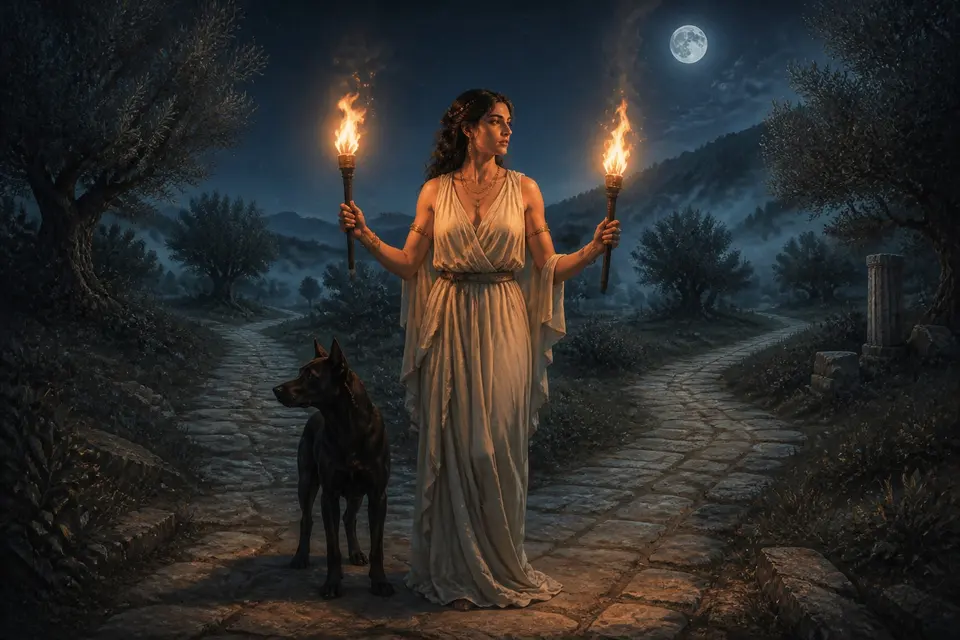
In art she holds two torches. She is accompanied by dogs, an animal sacred to her. She is often shown with three faces or three bodies, facing in three directions, which fits with her association with the three-way crossroads. One of her titles, Trioditis, means “of the three ways.”
On the last day of each month, Athenians offered what were called “Hecate’s suppers” at crossroads: food left out for the goddess and for the spirits who followed her. The meal was meant to keep the unquiet dead at bay. It was left there, and the poor were said to take it, which was considered acceptable.
The goddess who walked with the girl
Hecate has a small but important role in the story of Persephone. In the Homeric Hymn to Demeter, she is the only deity besides the sun to hear the girl’s cry as she is dragged underground. When Demeter wanders in grief, Hecate, torch in hand, meets her and offers to help find the truth. Afterward, she becomes Persephone’s attendant and companion in the Underworld. That is how she became a goddess who moves between worlds, who knows the road both ways.
She is also, in other traditions, connected with the myth of Medea, the sorceress, who is said to be her priestess. In Apollonius’s Argonautica, Medea prays to Hecate before preparing a drug for Jason.
The patron of witches
As centuries went by, Hecate’s darker side got more attention. By the Hellenistic and Roman periods, she was the patron of magic and spells, of ghosts, and of nighttime. Writers described her appearing at crossroads in the company of howling dogs. In the Greek magical papyri, a collection of spells from Roman Egypt, she is invoked again and again.
That is the Hecate Shakespeare knew. In Macbeth (around 1606), she appears as the queen of the witches, scolding the three weird sisters for acting without her. Many of the lines are probably added by another writer, but the idea took hold. She was then adopted by modern pagans and writers, who often treat her as a goddess of witchcraft, a role she acquired over the centuries.
Why a crossroads?
The reason a goddess of thresholds mattered is simple. In the ancient world, a crossroads was a place of choice and risk. You could meet strangers, robbers, bad luck. A doorway was where the safe, familiar household met the outside. Both are places where a person is in between.
Where the word “trivial” comes from
The Romans called Hecate Trivia, from tri (three) and via (road): the goddess of the place where three roads meet. A crossroads was a public place, where people met, gossiped and exchanged news, and the Latin word trivium came to mean a commonplace spot, and then, by extension, something ordinary and of little importance. That is the origin of the English “trivial,” and also of “trivia.” The idle chatter you hear in a pub quiz is named, indirectly, for a goddess of crossroads.
Her great sanctuary
Although Hecate was worshiped all over the Greek world, her greatest sanctuary was at Lagina, in Caria, in southwestern Turkey, where a grand temple was built in the Hellenistic period, and an annual festival, the Hekatesia, drew pilgrims from the surrounding region. Archaeologists have excavated the site, and its monumental gateway and the carved frieze of the temple are still visible. It is a reminder that the Hecate of the crossroads, a figure of folk belief, also had a public face, with priests and processions and a city under her protection.
A wheel and a rite
In late antiquity, Hecate became associated with a ritual instrument called the strophalos, a small golden sphere or wheel, studded with a sapphire, that was whirled on a cord during theurgic rites to call down the gods. It is described in the Chaldean Oracles, a mysterious collection of verses of the second century CE that influenced late Platonist philosophers. A stylized version of the wheel, a labyrinth-like maze in a circle, is used today as a symbol by some modern practitioners.
Hecate was the one who kept the light on in those places. When you are not sure which road to take, or when you are about to step out of your house into the dark, it makes sense to want a goddess with a torch.