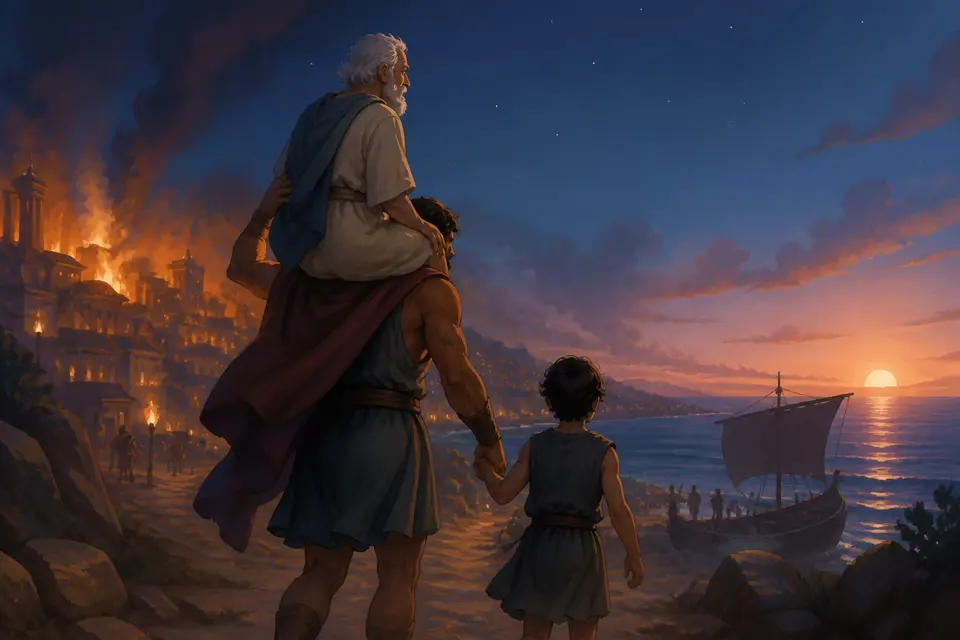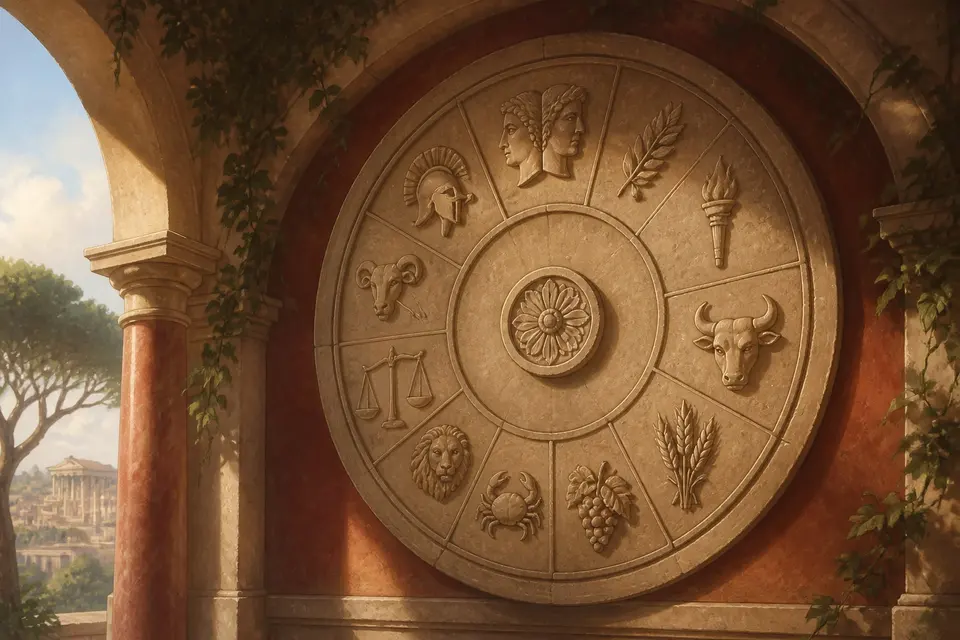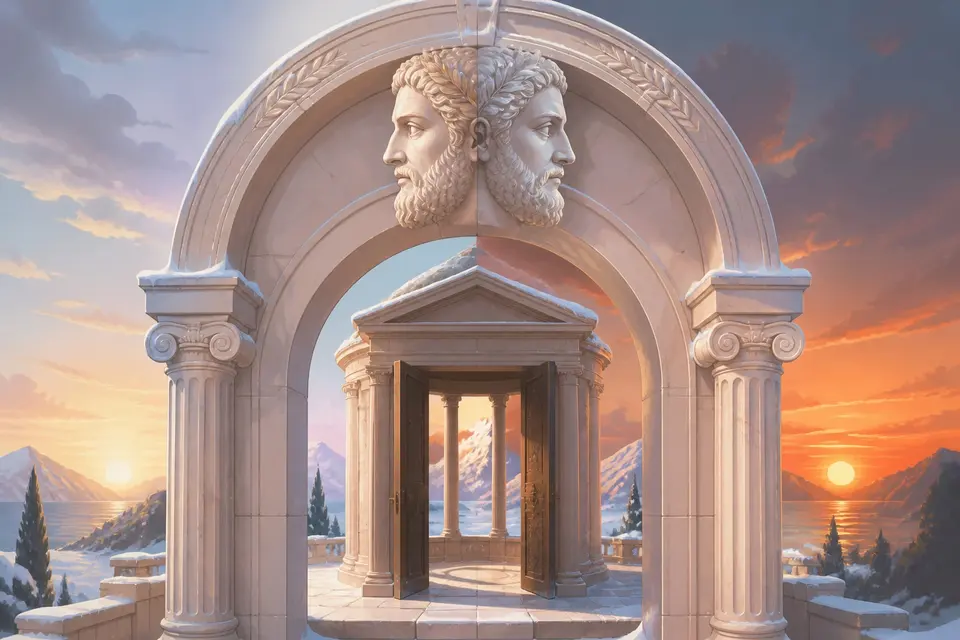
Most Roman gods were borrowed from the Greeks, with a new name. A few were not. Janus is one of them. There is no Greek Janus. The Romans themselves said so, with a bit of pride: of all the gods, he was entirely theirs. He had two faces, one looking forward and one looking back, and he governed doors, gateways, beginnings, endings and transitions. If you have ever stood on a threshold and hesitated, you have been in his territory.
The god in the doorway
The Latin word for door is ianua, and an arch or covered passage was an ianus. The god’s name is probably linked to them, and not the other way around: he is, in a sense, the divinity of the very idea of a passage. The word ianitor, a doorkeeper, gave English the word “janitor.” The month January, Ianuarius, is named for him, and so it opens the year.
In religious ritual, Janus came first. Whatever god you intended to pray to, you began by invoking Janus, because he was the one who opened the way for the prayer to reach the others. He was called Janus Pater, “Father Janus,” and, in some old hymns, “the god of gods.”
Why two faces?
The Romans had various explanations. Looking forward and back at once, he saw both the past and the future. He watched both the entrance and the exit of a house. In the myth, Janus was an early king of Latium who welcomed the god Saturn when he was driven from Olympus, and the grateful Saturn gave him the gift of seeing past and future. In Ovid’s Fasti, Janus himself describes how he came to be: he was Chaos, shapeless, before the world took form, and when it separated into the elements he took a shape with a front and a back.
A temple that said whether Rome was at war
The most unusual thing about Janus was his temple. In the Roman Forum stood a small shrine, essentially a square archway with a double door at each end, which housed a bronze statue of the god. The doors were the key: in time of war they were left open, and in time of peace they were shut.
That made the closing of the gates a rare event. According to the Romans’ own accounts, the doors were closed only a handful of times in the first seven hundred years of the city: once under King Numa, the second king, whose reign was supposedly peaceful, and again after the First Punic War, in 235 BCE. Augustus, who boasted of it in his own record of his deeds, said that the Senate ordered the gates closed three times during his reign, a sign that the long period of civil war was over. Nero closed them in 66 CE and had the event commemorated on coins.
It is an elegant bit of civic symbolism. Imagine if a country had a building whose doors you could check to see whether the nation was at war.
The first day of the year
January 1 was the day on which the Roman consuls took office, starting in 153 BCE, and it became the first day of the year in the Roman calendar. People exchanged good wishes and small gifts, sweet things such as honey and figs, to start the year well. It was considered a day of omens, and everyone tried to behave well and be cheerful, on the theory that the first day sets the tone for the year. A custom that is still with us.
Janus today
Janus keeps turning up. A person who says one thing and does another is “Janus-faced.” In technology, a few products have taken the name, and there is a moon of Saturn called Janus, discovered in 1966, which shares nearly the same orbit as another moon, Epimetheus, and swaps places with it every four years. They approach each other and exchange orbits without colliding. It is an oddly fitting use of the name.
Heads or ships
One of the best bits of Janus lore has been in your pocket. The earliest Roman bronze coin, the as, had the head of Janus on one side and the prow of a ship on the other. Roman children, according to the writer Macrobius, played a game of tossing coins and calling “heads or ships,” capita aut navia. It is the ancestor of the modern coin toss, “heads or tails.” The head on the coin, in the old days, was usually two-faced.
A hill named for him
Janus also left his name on the landscape. The Janiculum, a ridge on the western bank of the Tiber, was said to be named after him, since he was supposed to have founded a town there. Today it is a park with a view over the whole city of Rome, and every day at noon a cannon is fired from the Janiculum, a tradition that began in 1847 to help the city’s clocks stay synchronized. So even now, when Romans want to know what time it is, they listen for the god of doors.
But it is the first of January that is his real legacy. Each year, we make resolutions, look back at the past year and ahead to the next, and stand for a moment on the threshold. Janus is the god of that pause, the moment when you are neither here nor there. The Romans thought it deserved a god of its own. It is hard to say they were wrong.