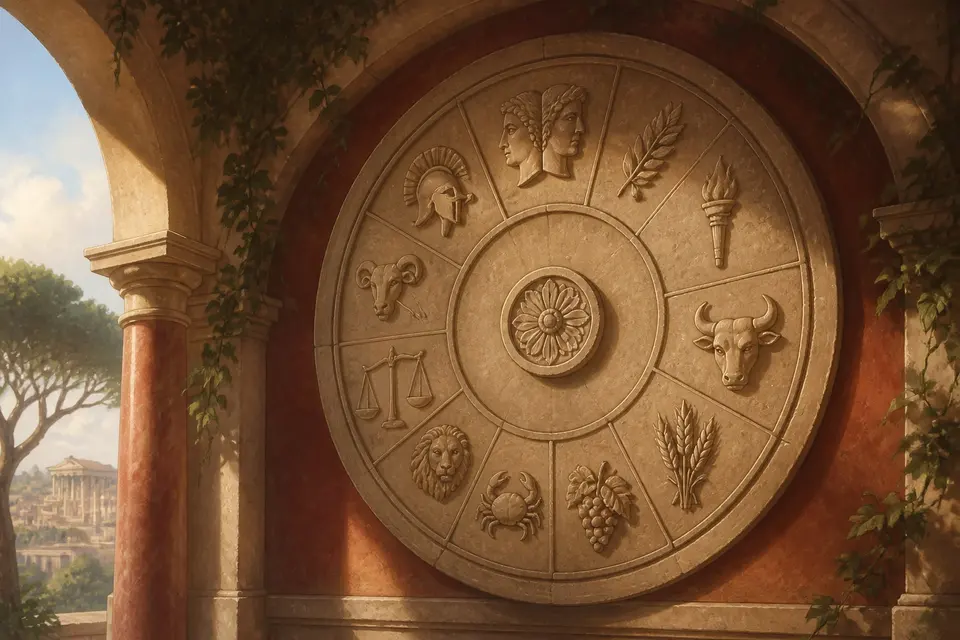
On the morning of February 15, in the year 44 BCE, the most powerful man in the world stood on a platform in the Roman Forum wearing a purple robe and sat on a golden chair. Julius Caesar had been named dictator for life. In front of him ran a young man, almost naked, covered in sweat and holding a leather strip. This was Mark Antony, and he was taking part in the Lupercalia, one of the oldest and strangest festivals in Rome. He ran up to Caesar and offered him a crown. Caesar refused it, three times, to the cheers of the crowd. A month later, he was assassinated. The Romans loved the festival. It was also, frankly, a bit scandalous.
The cave
The Lupercalia was held on February 15, and its center was a cave on the slope of the Palatine hill called the Lupercal, “the wolf’s place.” This was where, according to legend, the she-wolf nursed Romulus and Remus. A sacred fig tree grew nearby. The name of the festival is linked to lupus, wolf, and its priests, the Luperci, were organized in two guilds of young men from good families. The festival was ancient even in the Romans’ time, and the Romans themselves were not sure what exactly it was for.
What happened
We have good descriptions from Plutarch, who wrote about 150 years after Caesar. The festival began with a sacrifice of goats and a dog at the Lupercal. Two of the young men were then brought forward, and their foreheads were touched with a knife, still bloody from the sacrifice. Others wiped the blood off with wool dipped in milk, and the two young men were required to laugh. It was a ritual of purification, with a sense of humor.
After a feast, with plenty of wine, the Luperci cut strips from the skins of the sacrificed goats. Wearing little more than a goatskin loincloth, or nothing, they ran in a circuit around the base of the Palatine and through the streets of Rome. As they ran, they struck bystanders with the strips of hide. Women deliberately stood in their way, holding out their hands. According to Plutarch, it was believed that being struck brought an easy childbirth and made barren women fertile.
The strips were called februa, from the Latin word for purification, and the whole month took its name from them: Februarius, February.
Shakespeare’s version
Shakespeare knew the story from Plutarch. In Julius Caesar, the festival opens the play. Caesar says to Antony, as he is about to run: “Forget not, in your speed, Antonius, to touch Calpurnia; for our elders say, the barren, touched in this holy chase, shake off their sterile curse.” Calpurnia was his wife, and they had no children. It is a perfect little scene about power and fertility, and about what the people watching might think.
The end of the festival
The Lupercalia survived the end of the Republic and the rise of the Empire, and was still being celebrated in the fifth century CE, long after Rome had become officially Christian. It was a popular and long-lasting custom. Eventually, it was condemned by Pope Gelasius I, who ruled from 492 to 496, in a letter that has survived. He wrote a sharp reply to Roman senators who were defending it. The festival seems to have faded soon after.
And Valentine’s Day?
Here comes the popular claim: the Church replaced the pagan Lupercalia with St. Valentine’s Day on February 14, giving us a holiday of love. It is a tidy story, and you can find it in many places. But historians are skeptical.
There were indeed one or more early Christian martyrs called Valentine, associated with February 14. The feast of St. Valentine is attested from the late fifth century. Some accounts credit Pope Gelasius, the same pope who attacked the Lupercalia, with setting it. But none of the early stories about the saint have anything to do with romance. He was commemorated as a martyr. The link between Valentine and love is surprisingly late.
The first known writer to connect St. Valentine’s Day with romantic love is Geoffrey Chaucer, around 1380, in his poem The Parliament of Fowls, in which birds gather on St. Valentine’s Day to choose their mates. Chaucer might even have been inventing the association, writing for the court of King Richard II, whose marriage negotiations were then in the news. Over the next centuries, the idea took hold, with written love notes, then printed cards. In 1840s America, Esther Howland began selling lace-trimmed cards, and the Valentine’s card industry was born. Cupid, borrowed from Roman myth, was soon on every card.
What survives
There is no clear line from the Lupercalia to a heart-shaped box of chocolate. The festival of fertility and the saint’s feast share a date, and both involve a kind of mating season in February, and later writers tied them together. But the connection is a modern guess, not an established fact.
What does survive is the month. Every February, we are, without knowing it, reciting the name of a Roman festival of purification. And if you ever find yourself being whacked with a leather strip by a man in a goatskin, you are, at last, doing it right.