Most people who use the word “narcissist” have never read the story, and they usually imagine a vain young man staring at himself. The version in Ovid’s Metamorphoses is a good deal stranger, and the best part is that the mirror is not what kills him.
A prophecy about not knowing
Narcissus was born to the river god Cephissus and a nymph, Liriope. When Liriope asked the seer Tiresias whether her beautiful baby would have a long life, Tiresias gave a riddling answer: yes, if he never comes to know himself. It sounded like nonsense. Later it was exactly right.
By sixteen, Narcissus was so beautiful that both boys and girls desired him, and he rejected every one of them with a hard, proud indifference. Ovid says no one ever touched him.
Echo
Among those who loved him was the nymph Echo. She had once distracted Hera with long conversations while Zeus’s other lovers escaped, and as punishment Hera cut her voice down: Echo could no longer speak first, and could only repeat the last words of what she heard. Ovid makes the most of the comedy and pain of this. When she follows Narcissus through the forest, he calls out, “Is anyone here?” and she answers, “Here.” He calls, “Come!” and she calls back, “Come!” When he finally says, “Let us meet,” she repeats the words with joy and runs from the trees to throw her arms around him.
He pulls away. “Hands off,” he says. “I would die before I let you have me.” She answers with the only words she has: “I would let you have me.”
Ashamed, Echo hides in caves. Grief wears her body away until only her bones, turned to stone, and her voice remain.
The pool
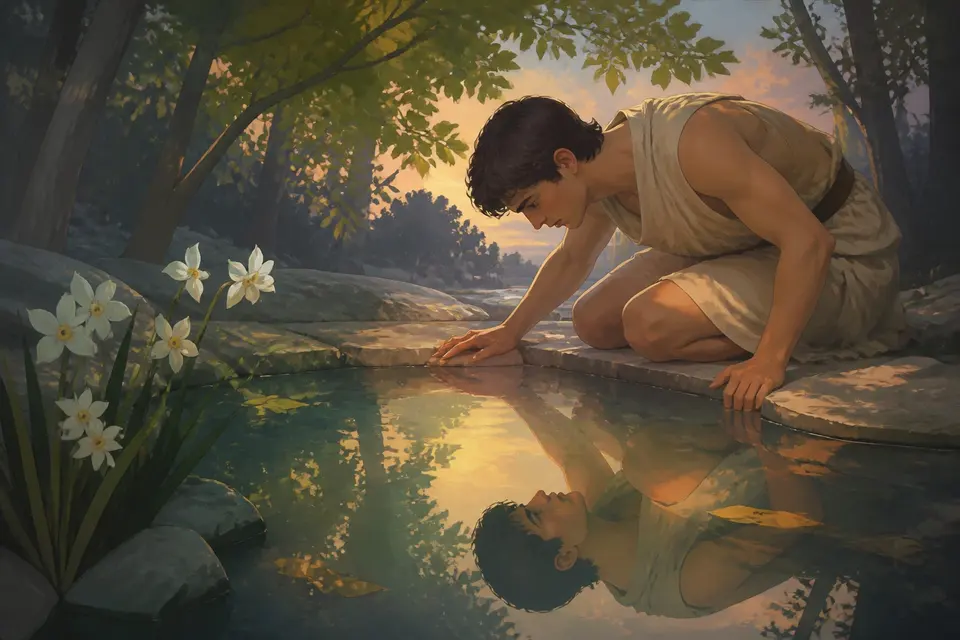
One of the people Narcissus had rejected prays that he might someday love and not get what he loves. The goddess Nemesis hears. Narcissus, tired from hunting, comes to a clear pool that no shepherd, goat or bird has ever disturbed, and bends to drink. He sees a face. He falls in love with it before he understands what it is.
Here is the part people forget. He realizes the truth. Ovid has him say, with horrible clarity, “I am he!” He understands that the beautiful boy he loves is himself. And it does not help. The one person he wants is the one he cannot reach, because lovers want to touch and a reflection can only be watched. He stays at the pool. He stops eating. He cries, and his tears ripple the reflection. He beats his chest until it turns pink. In the end he fades away.
Echo is there, in her way. When he says “Alas,” she repeats “Alas.” When he finally says “Farewell,” she answers, “Farewell.” The nymphs prepare a funeral pyre, but there is no body. In its place is a flower with a golden center and white petals around it: the narcissus.
Freud and the DSM
In 1914 Sigmund Freud published an essay called “On Narcissism: An Introduction.” He did not invent the term (a British physician, Havelock Ellis, and a German psychiatrist, Paul Näcke, had used it earlier), but Freud made it famous. He argued that everyone has a degree of self-love that develops as part of normal growth, and that excess of it could become pathology.
Today, clinicians use “narcissistic personality disorder” for a specific pattern of grandiosity, need for admiration and lack of empathy. Popular usage has stretched the word far past that. It is applied to anyone who posts a lot of selfies, which is a different thing and does not predict much.
What the myth is really about
Narcissus’s tragedy is not that he loves himself too much. It is that he cannot love anyone else. He is cut off from everyone: from Echo, from the others, from the pool. Even when he wants to connect, the only person he wants is on the other side of a surface. It is a story about isolation, and the fact that it is pretty makes it more disturbing.
Painters and a melting clock
Narcissus has been painted countless times. Caravaggio’s version, from around 1597 to 1599, shows a young man kneeling over his reflection in the dark, his arms forming a closed circle with the mirror image, so that the picture seems to be symmetrical and the figure caught in a loop. Salvador Dalí painted Metamorphosis of Narcissus in 1937, a surreal picture in which a figure crouching by a pool is echoed by a stone hand holding an egg that sprouts a flower. Dalí also wrote a poem to accompany it. He had been reading Freud.
The poison in the flower
The flower in the story is more dangerous than it looks. Narcissus bulbs contain toxic alkaloids, including lycorine, and the plant can cause vomiting, drooling and, in large quantities, more serious illness. It is not only a pretty garden flower. Ancient writers noted that the Greek word narke, which means “numbness,” is related to the name, and that the plant was said to have a stupefying scent.
Selfies and echo chambers
Two modern words are connected with the myth, whether people know it or not. In 2013, the Oxford Dictionaries chose “selfie” as its word of the year; the earliest known use was in 2002, in a post on an Australian online forum. And the idea of an “echo chamber,” a place where you hear only your own opinions repeated back, has become a standard metaphor for the way social media can narrow what we see. The legal scholar Cass Sunstein popularized the idea in the early 2000s. Both are versions of the old story: someone looking into a surface and seeing only himself, and a voice that cannot say anything new.
That is why it still resonates in an age of cameras and screens. We spend a great deal of time looking at an image of ourselves. The myth suggests that the problem with that might not be vanity. It might be loneliness.