The first great opera that is still regularly performed was not about a king or a battle. It was about a man who went down to the land of the dead to bring back his wife. When Claudio Monteverdi’s L’Orfeo premiered in 1607 at the court of Mantua, the composer chose this myth for a simple reason: if you want to show what music can do, you tell the story of the man whose music could move stones.
The best musician who ever lived
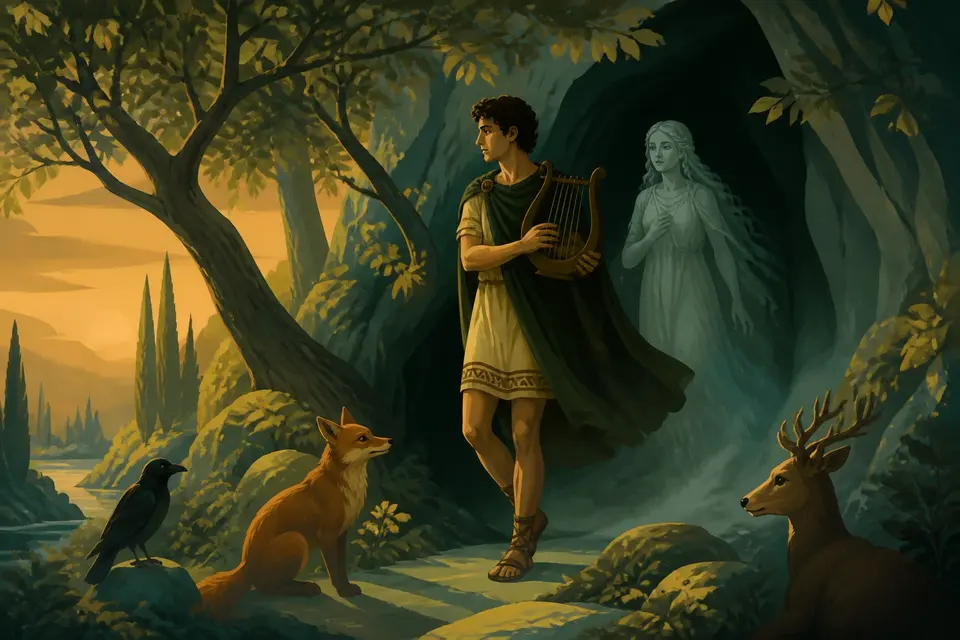
Orpheus was the son of a Muse, Calliope, and a Thracian king, or in other versions of the god Apollo himself, who gave him a lyre. He played so well that wild animals lay at his feet, trees bent toward him and rivers changed course. He sailed with Jason on the Argo, and when the ship passed the island of the Sirens, whose song lured sailors to their deaths, Orpheus took out his lyre and played more beautifully than they could sing. The crew was saved.
The wedding day
He fell in love with a nymph, Eurydice. On their wedding day, as she walked through the grass, she was pursued by a beekeeper named Aristaeus, and in fleeing she stepped on a snake, which bit her. She died. In Virgil’s version of the story, in the fourth book of the Georgics, Orpheus mourned her for days, sitting on a riverbank, singing, and then did something no living man had done: he went to the entrance of the Underworld, a cave at Taenarum, at the southern tip of the Greek mainland, and descended.
Charming the dead
He passed Charon, the ferryman of the dead. He passed Cerberus, the three-headed dog, who was tamed by the music. The Furies wept. Tantalus stopped trying to reach the water, Sisyphus sat down on his stone, the wheel of Ixion paused. Finally he stood before Hades and Persephone and sang. Ovid, in the Metamorphoses, gives part of his speech: he had not come to see the dark places, or to chain Cerberus, but for his wife, whose life was cut short too soon. Love, he said, was known up above, and he guessed it was known here.
The king and queen of the dead were moved. They called Eurydice from among the new ghosts. She came, limping from her wound. They allowed her to leave on one condition: Orpheus would walk ahead, and must not look back until they were both in the upper world.
The turn
They climbed through the dark, along a steep path, in silence. As he reached the threshold, with the light of day just in front of him, Orpheus was seized by doubt. Was she really behind him? Had he been tricked? Had she tired? He turned his head. He saw her, for an instant, and she slipped back into the dark with a single word, “farewell.” He tried to follow her but was refused. Seven days he sat at the edge of the river, without food, and then returned to the world, alone.
An uncomfortable version
There is an older, much less romantic version. In Plato’s Symposium, written in the fourth century BCE, the speaker Phaedrus says that the gods did not give Orpheus his wife at all. They showed him only a ghost, because he was a coward: he was a musician who did not have the courage to die for love, as Alcestis had, and tried to get into the Underworld alive. The punishment for that was to be killed by women. In Plato’s view, Orpheus was no hero.
The ending
After his loss, Orpheus refused the company of other women, and the Thracian maenads, the frenzied female followers of Dionysus, tore him to pieces in a rage. His head, still singing, floated down the river Hebrus into the sea and drifted to the island of Lesbos. The Muses gathered up his limbs and buried them. Zeus placed his lyre in the sky as the constellation Lyra, where it can still be seen.
A religion in his name
Orpheus was not just a character in a story. He was also, to the ancient Greeks, a religious figure. Followers of what is called Orphism believed that the soul was immortal and faced judgment after death, and that a pure life and the right rituals could lead to a better afterlife. Small gold tablets, buried with the dead, have been found in graves from Italy to Crete, inscribed with instructions for the soul in the Underworld: when you arrive, you will see a spring on the left, with a white cypress. Do not go near it. Look for the other spring, flowing from the Lake of Memory, and say to the guards, “I am a child of Earth and starry Heaven; but my race is heavenly.” Like the Egyptian Book of the Dead, they are travel instructions for the next world.
The long afterlife
The story has been retold constantly. Monteverdi’s 1607 opera is the earliest one still in the repertory. Christoph Willibald Gluck’s Orfeo ed Euridice (1762) is another landmark, and Jacques Offenbach turned the story into a comic operetta, Orpheus in the Underworld (1858), which includes the can-can. The poet Rainer Maria Rilke wrote Sonnets to Orpheus in 1922. Jean Cocteau made a film in 1950. Black Orpheus (1959), set in Rio de Janeiro during Carnival, won the Palme d’Or at Cannes. In the 2010s, the folk opera Hadestown by Anaïs Mitchell moved the myth to a vaguely New Orleans-flavored, hard-times world and won the Tony for Best Musical in 2019. And in Neil Gaiman’s comic The Sandman, Orpheus is the son of the king of dreams.
Why we still say it
“Don’t look back” is a common piece of advice. We say it about relationships, about careers, about regret. The Orpheus story is a bit more subtle. He does not look back out of malice, or foolishness. He looks back out of love, out of the need to be sure. The tragedy is that the very doubt that makes him human also makes him lose her.
It may be why the myth hurts so much: the thing you most want is within reach, and the only condition is that you trust, in the dark, without proof.