If you only know the Odyssey from summaries, Penelope is the wife who waits. She sits at home for twenty years while her husband sails around the Mediterranean having adventures, and when he comes back, she is faithful. It is an unfair reading. Read the poem and she is one of the sharpest characters in it: a woman who defends her home, her son and herself against over a hundred armed men, using only her intelligence. Homer describes her with the same word he uses for Odysseus: periphron, “very thoughtful.”
The situation
Odysseus has been gone for twenty years: ten at Troy and ten trying to get home. Everyone assumes he is dead. In his palace on the island of Ithaca, more than a hundred young nobles, the suitors, have moved in. They demand that Penelope choose one of them to marry and become king. Meanwhile, they eat the household’s food, drink its wine, slaughter its cattle and behave outrageously. Homer says there are 108 of them. Penelope’s son Telemachus is too young to throw them out. If she refuses, they will simply take what they want.
She cannot say no outright. So she plays for time.
The shroud
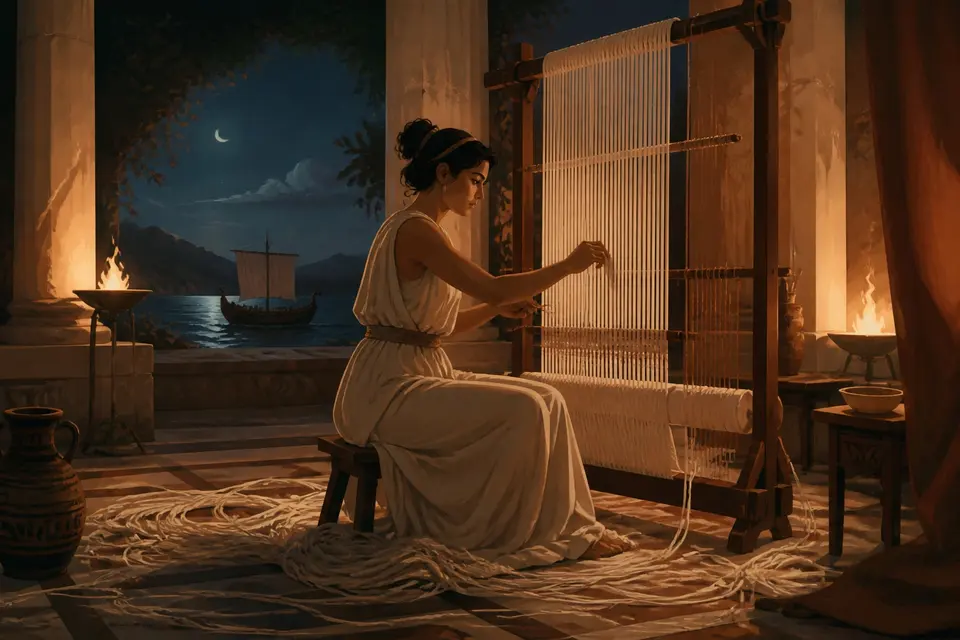
Penelope tells the suitors that she will choose one as soon as she finishes weaving a burial shroud for Laertes, Odysseus’s old father. It is a respectable excuse, because failing to provide a shroud for a relative would have been a disgrace. All day she weaves at her loom. At night, by torchlight, she unpicks what she has done. For three years, the work never advances.
The trick fails only when one of her maids betrays her, and the suitors catch her in the act. By then, she has gained enough time for something else to happen: her son has grown, and her husband is on his way.
Testing the stranger
When Odysseus finally reaches Ithaca, he arrives disguised as an old beggar. Penelope, in a long scene, talks to him without knowing who he is. He tells her a made-up story, and she weeps. He assures her that he has heard that her husband is near, and she does not believe him. Many husbands before him had come with stories, she says.
She also announces a contest: she will marry whoever can string Odysseus’s great bow and shoot an arrow through twelve axe heads in a row. It is a test no one but Odysseus could pass. Whether she knew who he was at that moment is one of the most argued questions in Homer.
The bed
After Odysseus has killed the suitors, Penelope still does not rush to him. Her old nurse tells her that the beggar is her husband. Penelope is cautious: it might be a god in disguise. She tests him. She tells her maid to move their bed out of the bedroom. Odysseus explodes: the bed could not be moved, he says, because he built it himself, around the trunk of a living olive tree that still stands in the room. The tree is one of the bedposts. Only he, and Penelope, and one servant could know it.
It is the moment she has been waiting for, a secret that only her husband could possess, and she bursts into tears and embraces him. Critics have praised the scene for two thousand years. It is a recognition of something that has no relation to appearance or heroics: a shared secret, a bed rooted in the earth.
Faithful, or not?
Not all ancient authors treated her so kindly. Some later traditions say that Penelope was unfaithful, and that the god Pan was the child of her union with Hermes, or with all the suitors. Others say Odysseus sent her back to her father. These versions are mostly from later and less admired sources, but they show that Penelope was a figure about whom people kept arguing.
Penelope’s revenge
In recent years, Penelope has been reclaimed by novelists. Margaret Atwood’s The Penelopiad (2005) retells the story from Penelope’s own voice, from the afterlife, with the twelve maids that Odysseus had hanged as a Greek chorus. In 2017, Emily Wilson published the first translation of the Odyssey into English by a woman, and her version brings out how much of Penelope’s intelligence is in Homer’s own words. Both have made readers look again at the figure of the waiting wife.
Unraveling at night
We still say “Penelope’s web” for work that is never finished. A modern writer may find it a good image for any strategy of delay, for the way someone with no power uses the tools she has. There is also something modern in the idea of a person who spends the day looking as if she were working, and uses the night to protect her real aim.
Maybe it is time to stop thinking of Penelope as the patient one. She is the strategist. And the olive tree is still standing.