In 1818, a twenty-year-old Englishwoman named Mary Shelley published a novel about a scientist who built a living creature from dead tissue and then abandoned it. She gave it a subtitle: Frankenstein; or, The Modern Prometheus. Most people forget the subtitle. But it is the key to the book, because it tells us that the author thought of her hero as a new version of a very old Greek figure, one who defied the gods to give humans a tool that could elevate them or destroy them.
Forethought
The name Prometheus means “forethought.” He was a Titan, one of the older generation of gods who were overthrown by Zeus, but he had sided with Zeus in the war, and was therefore allowed to remain free. His brother, Epimetheus, whose name means “afterthought,” was famous for acting first and thinking later.
In some versions of the myth, Prometheus was also the creator of humankind, who molded people out of clay. In all versions, he was their champion.
The trick at Mecone
The conflict began at a meeting between gods and mortals at a place called Mecone, to decide how sacrificial animals would be divided. Prometheus slaughtered an ox and split it into two portions. In one he hid the edible meat and the entrails, inside the stomach, which looked unappetizing. In the other he wrapped the bones in glistening fat. He asked Zeus to choose. Zeus took the fat and found only bones. Hesiod says that the king of the gods saw through the trick and chose it anyway, so that he would have a reason to punish humanity. That is why, ever since, the Greeks burned the bones and fat for the gods and ate the meat themselves.
The fire
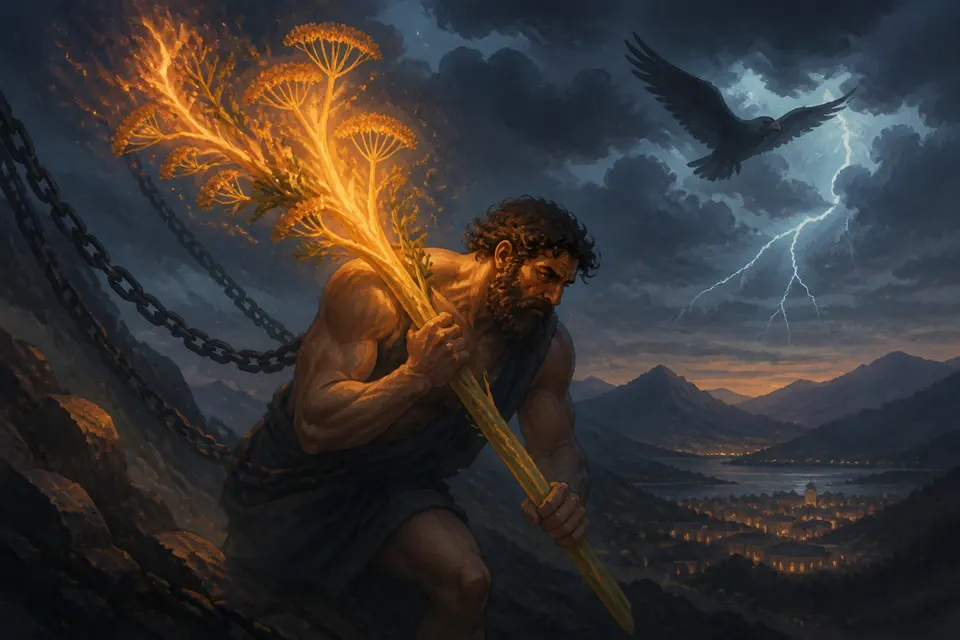
In revenge, Zeus took fire away from humans. Without it they could not cook, make tools or stay warm. Prometheus went to the forge of Hephaestus, or to the sun’s chariot, depending on the version, and took a spark in a hollow stalk of fennel. He carried it back and gave it to people. It was a transgression and a gift. Fire made everything else possible: metalwork, ceramics, bread.
The punishment
Zeus had Prometheus chained to a rock in the Caucasus mountains. Every day an eagle came and ate his liver, and every night it grew back, so that the torture was endless. It went on for ages, until Heracles shot the eagle and, with Zeus’s consent, freed him.
The detail about the liver is a bit of folk insight that happens to be true: the liver is the only major human organ that can regenerate. Whether or not the Greeks knew that, they chose an organ that grows back. They also considered the liver the seat of emotions, so that the punishment was intended to feed on his pride.
A very different Prometheus
The most famous ancient treatment is the tragedy Prometheus Bound, attributed to Aeschylus in the fifth century BCE. In it, Prometheus is a rebel and a martyr, chained to the rock, defying Zeus. He gives a long speech listing everything he taught humans: numbers, letters, how to build houses and ships, how to read the stars, medicine, how to read the future from omens, how to mine metals. When humans were living like ants in sunless caves, he says, he gave them the arts that made them civilized. It is a heroic, almost political portrait, and generations of readers have taken him as a symbol of resistance to tyranny.
The Romantics
The Romantic poets adored him. Mary Shelley’s husband, Percy Bysshe Shelley, wrote Prometheus Unbound in 1820, a verse drama in which the Titan is freed and the world is transformed. Lord Byron wrote a poem. Beethoven composed a ballet, The Creatures of Prometheus (1801), and used its theme again in his Eroica symphony. For them Prometheus was the unbowed human spirit.
Mary Shelley’s version was more ambiguous. Victor Frankenstein is a modern Prometheus who steals the secret of life, but the novel asks what responsibility the creator has for what he makes. He runs away, and everything goes wrong.
The Promethean moment
That question has never gone away. In 2005, the biographers Kai Bird and Martin Sherwin published American Prometheus, a life of the physicist J. Robert Oppenheimer, who led the Manhattan Project. It was the basis of Christopher Nolan’s 2023 film Oppenheimer. Writers about artificial intelligence, genetic engineering and climate technology routinely invoke Prometheus, sometimes as a warning and sometimes as an encouragement. Ridley Scott’s film Prometheus (2012) used the idea in a science fiction setting.
In New York, at Rockefeller Center, a gilded bronze statue of Prometheus by the sculptor Paul Manship, installed in 1934, hangs over the ice rink. He carries fire, with a fan of rays behind him. Millions of people skate under him each winter.
What the myth asks
Is Prometheus a hero or a thief? The Greeks themselves were divided. Hesiod treats him as a trickster whose gift came with a price: Zeus’s revenge was the creation of Pandora. Aeschylus sees him as a benefactor. The question is hardly an academic one. Every major technology, from fire to the printing press to the internet, has brought both gains and costs.
What the story gives us is a way of seeing that tension. The same spark that cooked a meal could burn down a city. The gift is real, and so is the price, and the one who steals fire is rarely the one who decides what to do with it.