There is a pretty good chance that, at some point this week, you described a task as “Sisyphean.” You were probably talking about email. The word is so common that we have forgotten what Sisyphus actually did. He was not a hard worker unlucky enough to be punished for diligence. He was a trickster, and he cheated death twice.
The clever king
Sisyphus was the legendary founder and king of Corinth, a city on a narrow strip of land between two seas. The Greeks described him as the cleverest and most greedy of men. He was a figure who always had a scheme, and several stories show him outsmarting the gods themselves.
In one of them, Zeus had carried off the nymph Aegina, and her father was frantic. Sisyphus, who had seen where Zeus took her, offered to tell him in exchange for a spring of fresh water for Corinth. The father agreed. The spring still flows on the hill above Corinth, the Peirene fountain. Zeus did not forgive the betrayal, and he sent Thanatos, Death, to fetch Sisyphus.
Chaining death
Sisyphus put on a show of being cooperative, asked Thanatos to demonstrate how the chains worked, and trapped him. With Death locked up in a closet, nothing on earth could die. Chaos followed. People who were badly wounded could not pass away. Ares, the war god, was furious because battles had lost all point. Eventually Ares freed Thanatos and handed Sisyphus over.
Even then, Sisyphus had a backup plan. Before he went down he told his wife not to bury him or give him the proper offerings. When he arrived in the underworld, he complained to Persephone that his wife had disrespected him, and asked to go back to earth for three days to straighten things out. Persephone let him. Naturally, he never came back.
The boulder
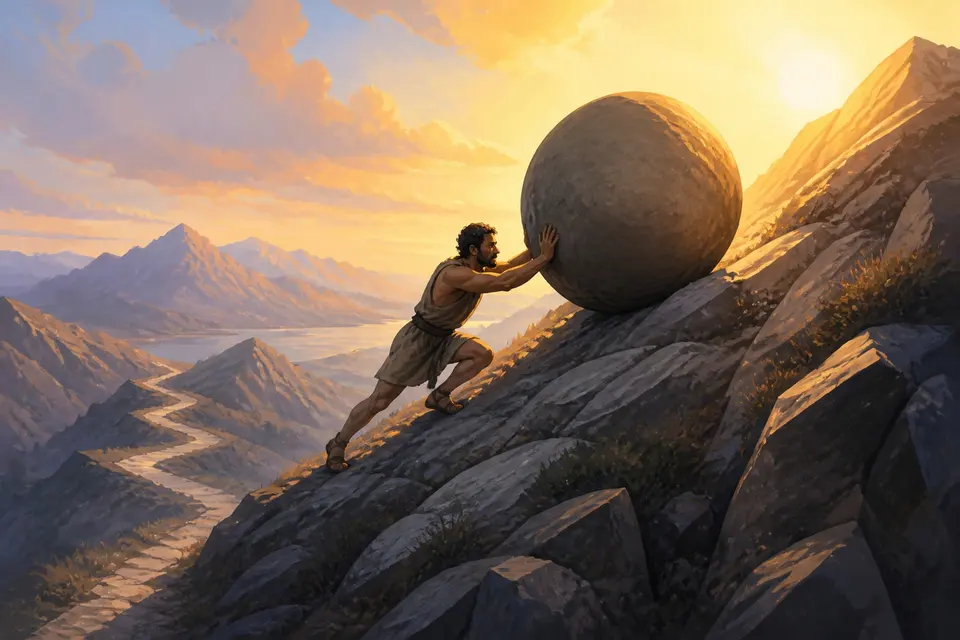
Eventually he was caught again, and this time the gods devised something fitting. In the eleventh book of the Odyssey, Odysseus, visiting the underworld, sees him. “With both his hands he was pushing a huge stone,” he says, “straining with hands and feet to shove it uphill. But just as it was about to crest the top, its weight turned it back, and the cruel stone rolled down again to the plain.” Then Sisyphus begins again, with sweat pouring from his limbs and dust rising from his head.
It is a precise punishment. The man who cheated death by cleverness is forced into endless physical labor with no result. The gods choose the thing that is the opposite of a trick: the thing that cannot be gotten around.
Camus and the happy man
In 1942, in occupied France, the writer Albert Camus published a long essay called The Myth of Sisyphus. It opens with a famous sentence: there is only one truly serious philosophical problem, and that is suicide. Judging whether life is or is not worth living, he says, is answering the fundamental question of philosophy.
Camus argued that human beings want meaning and the universe does not provide it, and that this clash is “the absurd.” You can respond to it with despair, or by jumping into belief in something beyond reason, or by accepting it and living in full awareness. Sisyphus, he says, is the absurd hero. The moment that fascinates Camus is when the boulder rolls down and Sisyphus walks back to get it. In that pause, he is conscious. He knows the whole structure of his fate. And that is a kind of victory, because a fate that is lucid cannot be scorned.
Camus ends with his most quoted line: “One must imagine Sisyphus happy.” He means that the struggle toward the height is enough to fill a man’s heart.
Why we say it about work
The word has taken on a life of its own. We use it for the dishes, the inbox, the backlog, the laundry. In the last decade, writers on burnout have used it for jobs in which effort resets every day. It is not an accident that the image survives in an age when so much of our work is not a finished object but an ongoing process.
The founder of a festival
Sisyphus left a real mark on Corinth. According to tradition, when the body of a drowned boy, Melikertes, washed up on the shore, Sisyphus instituted funeral games in his honor. They became the Isthmian Games, one of the four great Panhellenic festivals, held every two years near Corinth, along with the Olympic, Pythian and Nemean Games. So the man famous for being punished with hard labor was also the founder of a sports festival.
In paint and in pixels
The painter Titian made Sisyphus in 1548 and 1549 as part of a series on the damned for Mary of Hungary, the regent of the Netherlands. It shows a muscular, bent figure straining with the boulder on his back, on a steep black slope. In the video game Hades (2020), Sisyphus is a character in the Underworld who is cheerful about his task, in a nod to Camus’s ending, and gives the player advice. Whoever wrote it clearly believed that he was happy.
It is also a gentler myth than it first seems. The ancient version is a punishment. Camus’s version asks whether, if the hill cannot be escaped, there is anything to find on the walk down. Different people answer that differently. That, probably, is why it keeps being told.