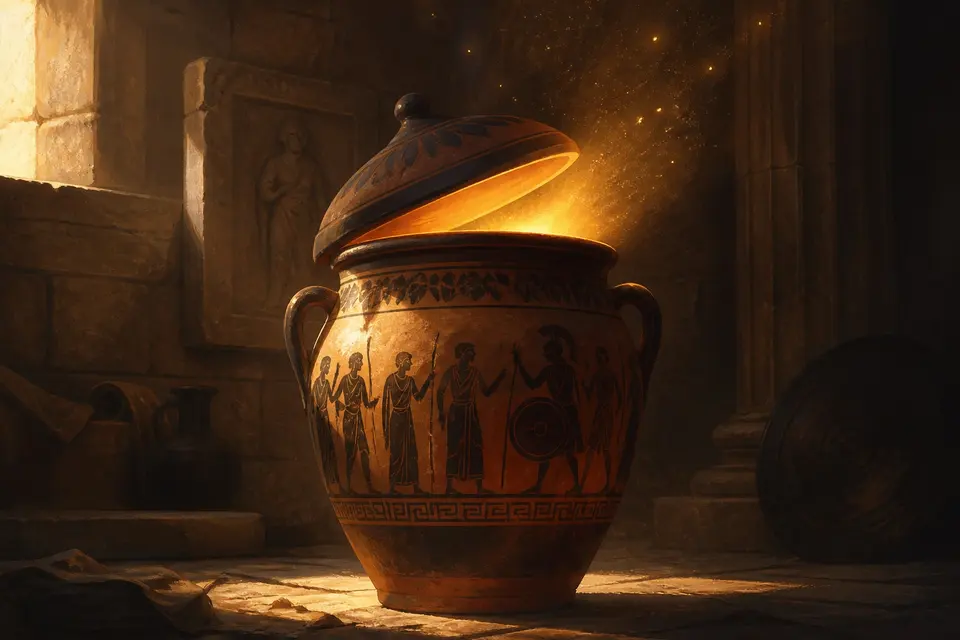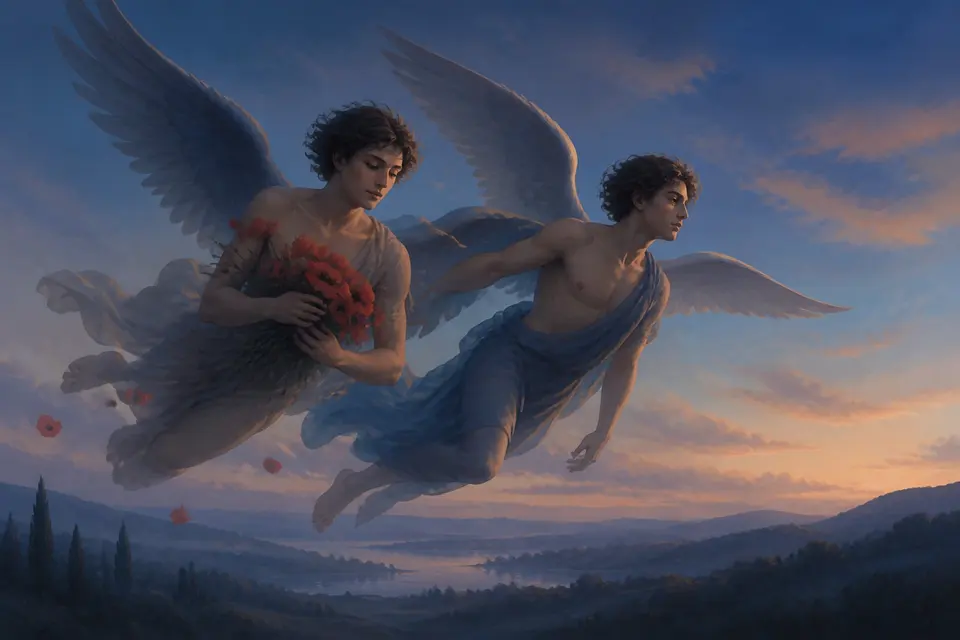
On a Greek vase painted around 515 BCE, a dead warrior is being lifted out of battle. He is naked, bleeding from the chest, and he is carried by two winged figures in armor who look almost identical. The painter, Euphronios, has labeled them in Greek: Hypnos, Sleep, and Thanatos, Death. They are brothers, and they are doing a gentle job. The vase is called the Euphronios krater, and its story outside the picture is nearly as dramatic. The Metropolitan Museum of Art in New York bought it in 1972 for a record price, and in 2008, after Italian prosecutors showed it had been looted from an Etruscan tomb, the museum sent it home to Italy. It now sits in a museum near Rome.
The scene it shows is from the Iliad, and it is a good place to start with a pair of gods who barely get any stories of their own.
The children of Night
Hesiod’s Theogony places them very early. Nyx, Night, gave birth by herself to a long list of things that people tend to fear: Doom, Death, Sleep, the tribe of Dreams, Blame, Distress, the Fates, Retribution, Deceit, Old Age and Strife. In that crowded family, Hypnos and Thanatos are twins, and Hesiod describes them in a few lines that have been quoted ever since.
They live in the dark region of Tartarus, where Night’s house stands. They never see the sun. Each day, the poet says, one goes out while the other comes in, and they greet one another as they cross the threshold. Sleep is quiet and gentle to humankind, and moves over the earth and the sea’s wide back. Death, by contrast, has a heart of iron and a pitiless spirit of bronze in his breast, and any man he seizes, he holds.
It is one of the most economical portraits in Greek literature: two brothers on opposite shifts, one kind and one not, passing each other in the doorway.
Carrying Sarpedon
In the sixteenth book of the Iliad, a hero called Sarpedon, a son of Zeus who fights on the Trojan side, is killed by Patroclus. Zeus, watching from above, wants to save him and is told by Hera that this would break the rules. He settles for honoring him instead: he sends a rain of blood on the battlefield, and he tells Apollo to clean the body and give it to Sleep and Death, “the twin brothers,” to carry back to Lycia, his homeland, for burial by his family. That is the scene the painter Euphronios chose.
The fact that two such frightening figures are given such a tender task says something about how the Greeks saw death. A good death, for a hero, was a kind of homecoming.
Tricking Zeus
Hypnos also appears in a comic episode in book fourteen of the Iliad. Hera wants to distract Zeus from the battle at Troy so that Poseidon can help the Greeks. She borrows Aphrodite’s magic charm and then finds Hypnos on the island of Lemnos and asks him to put Zeus to sleep. He is terrified. He has done it before, he says, and Zeus nearly threw him out of the sky. Only Night, his mother, saved him by hiding him.
Hera bribes him with the offer of one of the younger Graces as a wife. He agrees on the condition that she swears an oath by the river Styx. He then climbs into a pine tree, disguised as a bird, and waits. After Zeus and Hera spend a loving afternoon on a mountain, Zeus falls into a sweet slumber, and the Greeks get their breathing room.
The family of dreams
Hypnos has a few children of his own. The best known is Morpheus, who is the god who takes human form in dreams, according to Ovid, and whose name gives us morphine. His brothers Phobetor and Phantasos appear in dreams as animals and as inanimate things. They live in a cave, in Ovid’s description, where the sun never reaches, and where the god lies on a soft couch surrounded by poppies. The picture of sleep in a dark, cool cave, with the sound of a river over pebbles, is one of the most comfortable in Latin poetry.
What the twins show
It is tempting to say that the Greeks saw sleep as a little death. They did, but the myth goes further. Hypnos and Thanatos are siblings. The difference is not one of kind but of degree and of how gentle the hand is.
That is why artists have come back to the pair for twenty-five hundred years. In an age when we like to think of death as an enemy, the Greek image of two brothers who share a house and a mother, and pass each other on the threshold every day, is more soothing than it sounds.