In 1542, the Spanish explorer Francisco de Orellana became the first European to travel the whole length of the largest river on Earth. His men said that, along the way, they were attacked by tall, light-skinned women who fought alongside the local men. Orellana named the river after the warriors of Greek myth: the Amazon. Whatever the explorers saw, the name stuck, and more than four hundred years later, a company founded by a man named Jeff Bezos named itself after the river, which is why one of the world’s biggest companies is, at second hand, named after a nation of mythical women.
The Amazons of the Greeks
The Greeks were fascinated by the Amazons. They were a nation of women who lived at the edge of the known world, usually in the area of the Black Sea, who fought on horseback with bows, spears and a crescent-shaped shield, and whose society did not depend on men. The Iliad calls them antianeirai, “equal to men,” or perhaps “a match for men.” Several of the great heroes were said to have fought them.
- Heracles, as his ninth labor, had to bring back the belt of the Amazon queen Hippolyta.
- Theseus carried off Antiope, an Amazon, and the Amazons invaded Athens in retaliation. The battle was one of the most popular subjects in Greek art, appearing on the Parthenon, the temple of Apollo at Bassae and the Mausoleum of Halicarnassus.
- During the Trojan War, the Amazon queen Penthesilea came to Troy’s defense and was killed by Achilles, who, according to later poets, fell in love with her as she died.
A false etymology
A famous bit of Greek folk wisdom held that the name Amazon meant “without a breast,” from a- (without) and mazos (breast), and that the women cut off their right breast to draw a bow more easily. It is a vivid image and almost certainly wrong. It appears in no Greek art: Amazons in vase paintings have both breasts, sometimes one exposed. Modern linguists suspect the name comes from an Iranian word meaning “warriors.” The story probably arose as an attempt to explain an unfamiliar word.
Herodotus and the Scythians
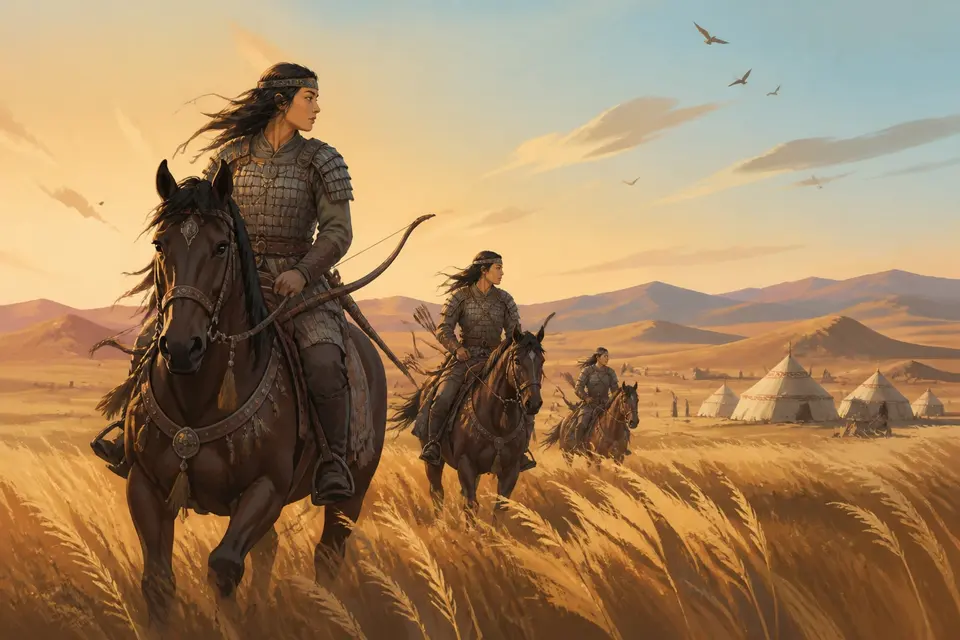
The historian Herodotus, writing in the fifth century BCE, tells a more down-to-earth story. After a battle with the Greeks, some Amazons were captured and put on ships, but they overpowered the crew and ended up on the northern shore of the Black Sea, where they met the Scythians, a nomadic people. The young Scythian men and the Amazons got to know each other. They married, but the women refused to move to the men’s towns, so the couples moved off together and founded a new tribe, the Sauromatae. Herodotus reports that the women of this tribe continued to ride, hunt and fight alongside men, and that a girl could not marry until she had killed an enemy.
What archaeology found
For a long time, this was assumed to be pure fantasy. Then archaeologists began to excavate the burial mounds, or kurgans, of the Eurasian steppe, from southern Russia to Kazakhstan, where Scythian and related peoples buried their dead in the first millennium BCE. In a number of graves, the skeletons of women were found with bows, arrowheads, daggers, spears and sometimes horse gear. Some had injuries consistent with combat. Several of these women show healed or fatal wounds from weapons, the kind of injuries you would expect in someone who really did fight.
The scholar Adrienne Mayor, in her 2014 book The Amazons: Lives and Legends of Warrior Women across the Ancient World, argues that these graves are evidence that the myth was based on real women. Many archaeologists are cautious, noting that weapons in a grave do not prove that a person fought, and that no single grave is the Amazons. But it is now widely accepted that women on the steppe, in nomadic societies where everyone rode and hunted, took part in warfare more than the Greeks themselves did.
The Greek view
To the Greeks, the Amazons were fascinating because they were the opposite of everything a Greek city expected of women, who were meant to stay at home. Greek art and literature often portray them as a threat that had to be defeated by a hero. At the same time, many artists painted them with undeniable admiration. A famous story says that Penthesilea’s beauty was only visible to Achilles once he had killed her.
Wonder Woman
The Amazons had an enormous afterlife in modern popular culture. In 1941, the psychologist and writer William Moulton Marston created Wonder Woman for DC Comics, giving her the identity of Diana, princess of the Amazons of Themyscira, an island of immortal warrior women. Marston, who had been involved in developing an early lie detector, wanted a heroine who would show that women could be strong. She has been a pop-culture symbol ever since, from the 1970s TV series to the 2017 film starring Gal Gadot.
Not only Greek
There is another surprising link. In the West African kingdom of Dahomey, in what is now Benin, a regiment of women soldiers served in the royal army until the late nineteenth century. European observers called them “Amazons,” and the name stuck. They were real, organized and feared. They were the subject of the 2022 film The Woman King.
The real point
The Amazons teach us that a myth can hold a kernel of truth. The Greeks told a story about a world turned upside down. Archaeologists have found that, in a place the Greeks barely knew, it sometimes was.