On the island of Crete, a few kilometers from the modern city of Heraklion, there is a hill with the ruins of a palace. It has more than a thousand rooms, according to some estimates, along twisting corridors, around courtyards, with storage jars as tall as a man. It was built about 3,700 years ago, by a civilization that we call the Minoans, after a legendary king named Minos. When the archaeologist Arthur Evans dug it up in 1900, he was convinced he had found the building that had inspired the myth of the Labyrinth. He might even have been right.
The story
King Minos of Crete prayed to Poseidon for a sign that he was the rightful ruler, and the god sent a magnificent white bull from the sea. Minos was meant to sacrifice it, but he liked it too much and kept it. As a punishment, Poseidon made Minos’s wife, Pasiphaë, fall in love with the bull. She asked the inventor Daedalus for help, and he built a hollow wooden cow for her to hide in. The result was the Minotaur, a creature with a man’s body and a bull’s head, named Asterion, “the starry one.”
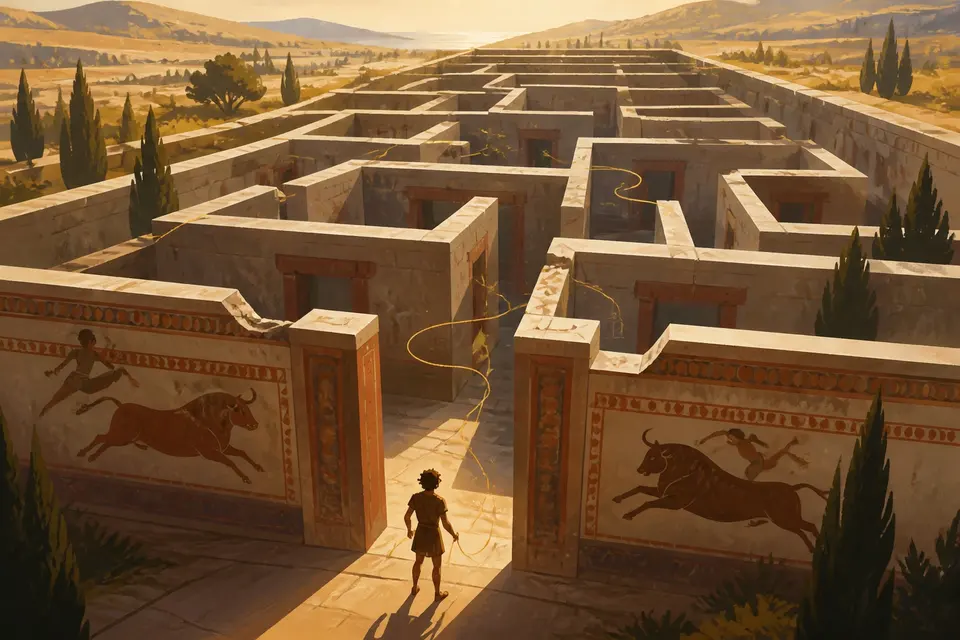
Minos did not kill it. Instead, he had Daedalus build a structure from which the Minotaur could never escape: the Labyrinth. It was a maze so complex that even its builder could hardly find his way out.
The tribute
Minos’s son Androgeos had been killed in Athens, and Minos, who ruled the sea, demanded a tribute: every nine years, or in some versions every year, Athens had to send seven young men and seven young women to Crete. They were put into the Labyrinth to be eaten by the Minotaur.
Theseus, the son of the king of Athens, volunteered to join the third group, intending to kill the monster. On Crete, Minos’s daughter Ariadne saw him and fell in love. She knew the maze was a trap, so she gave him a ball of thread, which he tied to the entrance and unwound as he went deeper. He found the Minotaur at the center, killed it with his bare hands or a sword, and followed the thread back out.
What happened to Ariadne
Theseus sailed away with Ariadne but abandoned her on the island of Naxos, where she woke up alone. In the best-known version, the god Dionysus found her there and married her. Meanwhile, Theseus forgot to change the black sails of his ship to white, as he had promised his father if he survived. His father, seeing black sails, threw himself into the sea, which is why it is called the Aegean.
Evans and the palace
In the early twentieth century, Sir Arthur Evans, a wealthy English archaeologist, bought the hill at Knossos and began to dig. He found a vast palace, with frescoes of dolphins, young people leaping over bulls, and a symbol that appeared everywhere: the double axe, which the ancient Cretans called labrys. Evans suggested that the word “labyrinth” derived from it, so that it meant “house of the double axe.” It is plausible, though not certain.
Evans spent decades at the site and, in the process, had large parts of the ruins rebuilt in reinforced concrete, painted in bright colors, to show how the palace might have looked. The result is controversial. Some critics say he imagined too much, and the Knossos you see today owes as much to Evans as to the Minoans. Others say it gives visitors a better sense of what it was like.
The bull
The bull was certainly important to the Minoans. The most famous fresco, the so-called Bull-Leaping Fresco, shows a figure in mid-somersault over the back of a charging bull while two others stand by. We do not know if the sport was real. Some scholars think it was a ritual, others a symbolic scene. It is not hard to see how a story about a monster, a bull and young people thrown into a palace could have grown from memories like these.
Another possible inspiration is geological. Around 1600 BCE, the volcanic island of Thera, now Santorini, about 110 kilometers north of Crete, erupted in one of the largest eruptions in human history. Some researchers have linked it to the decline of Minoan power, though the timing and effects are debated. Perhaps the memory of a lost sea power fed the legend of a tribute-demanding king.
A maze, or a labyrinth?
Modern puzzle-makers make a distinction. A maze, in the strict sense, has choices and dead ends, and the goal is to find the way. A labyrinth, in the older sense, has a single path that winds to the center and back, with no choices. Ancient images of the Labyrinth, on Cretan coins and Roman mosaics, show the second kind. There is only one path to follow. The Minotaur’s Labyrinth may have been a place not where you are lost, but where you cannot escape.
Which raises the question of the thread. If there is only one path, you do not need it. Perhaps Ariadne’s thread is a later addition, from the days when the Labyrinth became a maze. In any case, “Ariadne’s thread” has become a standard phrase for a method of solving a complex problem step by step, and it is used in logic, mathematics, computer science and detective work.
The ship of Theseus
Plutarch adds a lovely detail. The Athenians, he says, preserved the ship in which Theseus had sailed to Crete, and kept it for centuries, replacing planks as they decayed, so that eventually every part had been replaced. Philosophers argued about whether it was still the same ship. That is the origin of the “Ship of Theseus” paradox, a favorite thought experiment about identity.
The Minotaur today
The Minotaur has fascinated artists. Picasso, who loved bullfighting, drew and etched the creature dozens of times in the 1930s, in works such as Minotauromachy (1935), and sometimes used it as a kind of self-portrait. Jorge Luis Borges wrote a short story, “The House of Asterion” (1947), told from the Minotaur’s point of view: a lonely creature, waiting for a redeemer. It is one of the most sympathetic monsters in literature.
Perhaps that is the final surprise of the myth. We think we know the story as a tale of a hero killing a monster. But the oldest labyrinth is not really about the hero. It is about the thing in the center, kept in a maze, so that no one has to look at it.