The popular version of the Icarus story is one sentence long: a boy flew too close to the sun, and his wings melted. If you have heard any moral from it, it is probably “don’t be so ambitious.” But the story as the Romans told it is about something stranger, and its most famous retelling is about someone who isn’t even in the picture.
Why they were flying at all
Daedalus was an Athenian inventor, the best craftsman in the Greek world, and he had a talent for getting into trouble. He killed a nephew who threatened to outdo him, fled Athens and ended up at the court of King Minos on Crete, where he built the Labyrinth to hold the Minotaur. Then he helped Minos’s daughter Ariadne give Theseus the thread that let him escape the maze, and Minos locked Daedalus and his son Icarus in a tower.
The sea was patrolled by Minos’s ships. The land was guarded. The Roman poet Ovid, writing around 8 CE in the eighth book of the Metamorphoses, gives Daedalus a line that sums up the problem: Minos might block the land and sea, but the sky is open. So the inventor sat down to study birds.
Feathers and wax
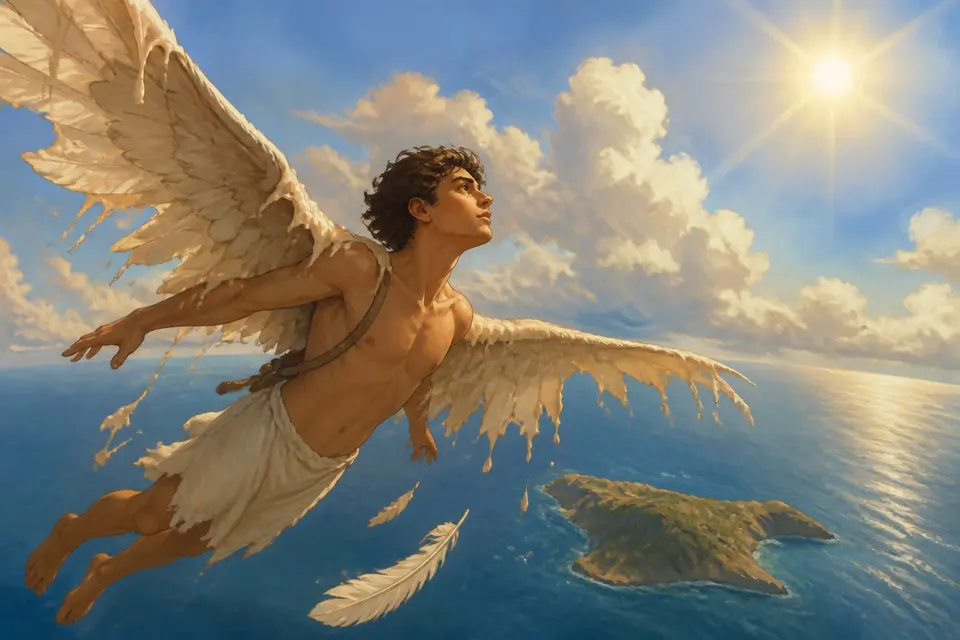
He laid out feathers from short to long, like the pipes of a flute, tied the middle with thread, fixed the base with wax and bent each row into a gentle curve. Ovid describes the boy playing nearby, chasing a feather that blew away and squeezing the wax between his fingers, delighted by the mess. It is a small, touching detail: the father working hard at the thing that might save them, the son treating it as a toy.
Before they took off Daedalus gave his instructions. The key line is easy to miss: he told Icarus to fly the middle path. Not too low, because the sea would wet the feathers and weigh them down. Not too high, because the sun would melt the wax. Only the middle would do.
Everyone remembers the second half. Almost nobody remembers that the first half is also a way to fall.
The fall
They flew. Fishermen, shepherds and farmers looked up and thought they were seeing gods. Icarus, delighted, began to climb. The wax softened and the feathers spread out of their frame. Ovid’s phrase for what came next is perfect: he flapped bare arms that no longer held the air. His father looked back and saw nothing but feathers on the water. The sea where Icarus fell was named the Icarian Sea, and an island nearby, Ikaria, still carries his name.
The painting where nobody notices
The most famous image of the story is a sixteenth-century painting, Landscape with the Fall of Icarus, long attributed to the Flemish artist Pieter Bruegel the Elder. A ploughman works a field in the foreground. A shepherd looks at the sky. A ship sails by. In the lower right corner, a pair of legs is disappearing into the sea. Almost nobody in the painting seems to notice.
In 1938 the poet W. H. Auden saw it in a Brussels museum and wrote “Musée des Beaux Arts,” which begins with the observation that the Old Masters were never wrong about suffering: it happens while someone else is eating or opening a window or walking dully along. Icarus’s fall is “not an important failure” to the people around him. The ship “had somewhere to get to and sailed calmly on.”
Scholars now question whether Bruegel himself painted the Brussels picture, and what it actually meant to its first viewers. Some think it was a comment on a proverb about the plough that does not stop for a dying man. Whatever the original intention, the picture has become the way we feel about the story: the fall is private and the world is indifferent.
The warning we forgot
We usually use Icarus as a warning against ambition, but Ovid’s Daedalus is not saying “don’t aim high.” He is saying “don’t forget the limits of what you have built.” Wings made of wax have a design range. Fly outside it in either direction and they fail.
That is a more modern idea than it sounds. It is the gap between a bold plan and a boring engineering fact. The boy forgot that the thing keeping him in the air had a tolerance. His father had not.
It may also be why the second half of the story, the grieving father who names a land after his son and hangs up his own wings in a temple, has always felt more powerful than the flight itself. The tragedy is not that someone reached too high. It is that someone loved their own freedom more than they remembered the advice of the person who made it possible.