On a clear night in midsummer, look up and find the brightest star in the constellation Lyra, a blue-white point high overhead. That is Vega. Now look across the broad, hazy stripe of the Milky Way, and you will see another bright star, Altair, in the constellation Aquila. In Chinese tradition these stars are two people: Vega is Zhinü, the Weaver Girl, and Altair is Niulang, the Cowherd. They are a couple who are separated by the river of stars, and who are allowed to meet only once a year.
The story
The most common version goes like this. Zhinü was a goddess, or a heavenly maiden, who wove the clouds and the colored sunsets for the heavenly court. She was tired of her work, and one day she slipped down to earth to bathe in a lake. A poor cowherd named Niulang, who lived with his old ox, was told by the ox, which was actually a banished star, to take one of the women’s robes. Zhinü, finding her clothes gone, could not go back, and she stayed with him. They fell in love, married and had two children, a boy and a girl. For several years they lived happily, he farming and she weaving.
The river
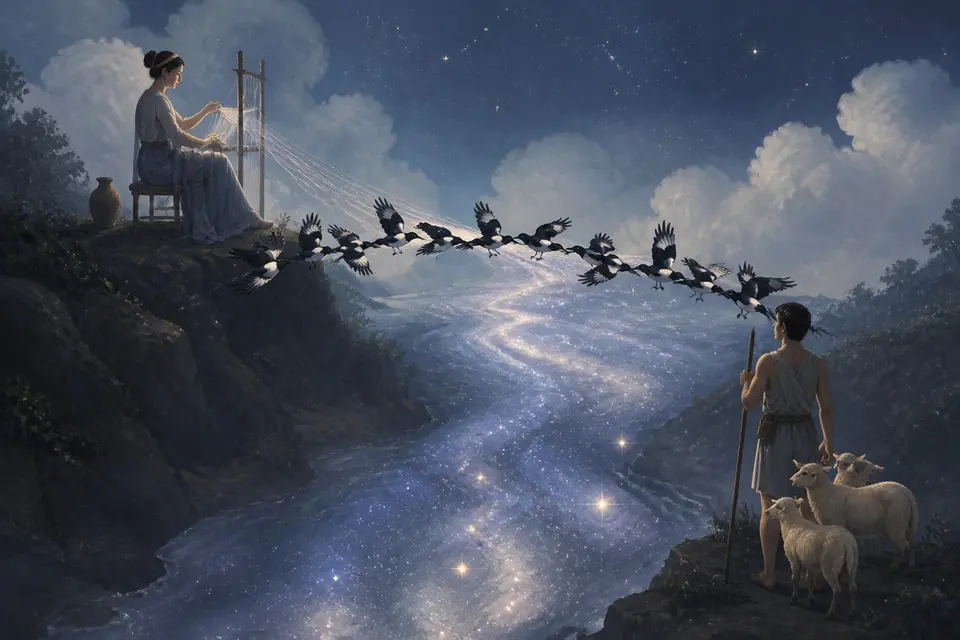
But the heavenly court found out. Zhinü’s grandmother, the stern queen of heaven, was furious that a goddess had married a mortal, and took her back. Niulang, clutching his children in two baskets slung from a pole, tried to follow, with the help of the ox’s hide, which let him fly. Just as he was about to reach her, the queen took a hairpin from her hair and drew a line across the sky. It became the Milky Way, a wide, turbulent river that separated the couple forever.
The magpies
The couple’s grief was so great that, moved to pity, the magpies of the earth took flight. On the seventh day of the seventh month of the lunar calendar, they fly up in their thousands and form a bridge across the river with their wings, so that the lovers can meet for one night. If it rains on that day, it is said to be the tears of the lovers. The magpies are said to lose the feathers on top of their heads from being walked on by Zhinü.
An old story
It is one of the oldest love stories in China. The two stars are mentioned in the Book of Songs, the earliest anthology of Chinese poetry, compiled around 600 BCE, though only as stars, without a story. By the Han dynasty, around the second century CE, a famous poem in a collection called the Nineteen Old Poems gave the story its emotional key: “Far, far away is the Cowherd star, bright, bright is the Weaver Girl. Slender, slender, she lifts her pale hand, clack, clack, she plies her loom. All day long she does not finish a pattern; her tears fall like rain. The Milky Way is clear and shallow, how far apart are they? Only a river’s width, gazing at each other without speaking.”
Qixi
The seventh day of the seventh lunar month, usually in August, is called Qixi, “the Evening of Sevens.” It is sometimes known as the Chinese Valentine’s Day. In the past, it was a festival for girls. Women displayed their needlework, prayed to the Weaver Girl for skill and wisdom, and tested their dexterity with a game: they would try to thread a needle by moonlight, or float a needle on water and read the shadow it cast. This was called qiqiao, “begging for skill.”
In modern times, it has been revived as a festival for couples, with flowers and gifts, and it is a major day for weddings and marriage registrations in China. Some people point out that it is a love story about a family separated by authority, which is not an obvious model for romance.
The same story across Asia
The Weaver Girl and the Cowherd appear throughout East Asia. In Japan, the festival is called Tanabata and is held on July 7 (or in August in some regions). People write wishes on strips of colored paper and hang them on bamboo branches. The Japanese names are Orihime and Hikoboshi. In Korea, the festival is Chilseok, and the characters are Jingnyeo and Gyeonu. The story traveled with Chinese culture and took root locally, and each country put its own customs into it.
Stars and satellites
The magpie bridge, Que Qiao, has found a new role in a rather different setting. In 2018, China launched a communications relay satellite to a point beyond the Moon so that a lander could talk to Earth from the far side. It was named Queqiao, “Magpie Bridge.” The mission was Chang’e 4, which landed in January 2019. The ancient bridge of birds that connects lovers across an impassable gap has become a bridge of radio waves across the Moon.
A story about a gap
It is easy to focus on the romance, but the story also says something about distance and time. The lovers are not apart because they stopped loving each other. They are apart because the universe is organized in such a way that they cannot be together, except once a year. Many people who have lived apart from a loved one, because of work, war or migration, have found something familiar in the picture of two bright stars gazing at each other across a river.
On a clear night in August, you can go outside and look. They are still there.