In December 1790, workers repairing the main square of Mexico City, the Zócalo, dug up a stone disk about three and a half meters across and weighing roughly twenty-four tons. It had been buried since the Spanish conquest. At its center was a face with a protruding tongue, surrounded by symbols, and around that was a ring of day-signs and two great serpents wrapping the edge. Scholars gave it the name “the Aztec calendar” and it has been on every Mexican tourist poster since. It is not exactly a calendar. It is a diagram of how the world works, and it begins with the idea that the world has already ended four times.
What the Mexica believed
The people we call the Aztecs called themselves the Mexica. Their capital, Tenochtitlan, was built on an island in a lake in the early fourteenth century, and by 1500 it was one of the largest cities in the world. They told a story of the cosmos in which time was divided into ages, each presided over by a sun. Each age had ended in a catastrophe.
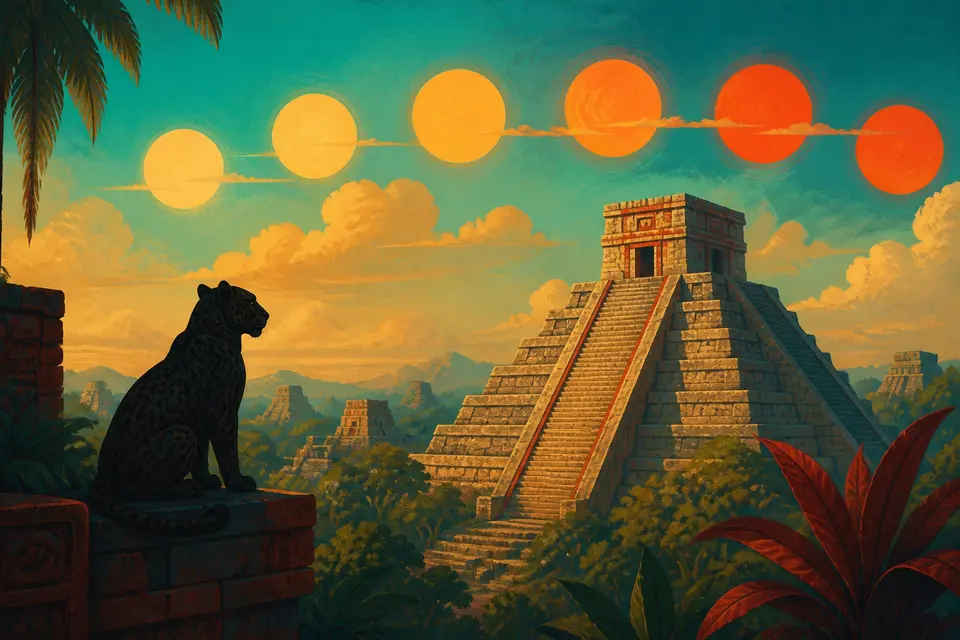
A text from 1558 called the Legend of the Suns gives the order. The first sun, Four Jaguar, ended when jaguars devoured the people. The second, Four Wind, ended in hurricanes, and the survivors were turned into monkeys. The third, Four Rain, ended when fire fell from the sky. The fourth, Four Water, ended in a flood, and the people were turned into fish. Other sources give a different order, and not everyone agrees on what each age was made of.
The current age, the fifth, is called Four Movement, Nahui Ollin. Its name comes from the day on which it began, and the word ollin means movement, as in an earthquake. The Mexica believed that this sun, too, would end, and that it would end by earthquakes.
How a sun gets started
The best-known creation story is set at Teotihuacan, the ruined city that was already ancient by the time the Mexica arrived. In the story, the gods gathered in the darkness and asked who would become the sun. A rich and proud god, Tecuciztecatl, volunteered. Another god, small and covered in sores, named Nanahuatzin, was asked to join him.
The two prepared for four days. Tecuciztecatl brought gold, feathers and precious jade. Nanahuatzin brought reeds tied together and thorns from the agave, stained with his own blood. A great fire was built, and the two gods were called to jump in. Tecuciztecatl approached four times and each time turned back, afraid of the heat. Nanahuatzin shut his eyes and jumped.
Shamed, Tecuciztecatl followed. Nanahuatzin rose in the east as the sun, Tecuciztecatl as a second sun. The other gods, annoyed that two suns were too bright, threw a rabbit in the face of the second, which dimmed him. That is why the moon is less bright than the sun and why, the story says, you can see a rabbit on it.
The sun that would not move
There was one more problem. The sun hung in the sky and would not move. The gods realized it needed something: they would have to give themselves in sacrifice. One of them, the wind god Ehecatl, killed them all, and only then did the sun start its journey across the sky.
The story helps explain one of the most disturbing parts of Mexica religion. If the gods had given their own blood to set the universe in motion, then people owed the gods the same. The Mexica called this nextlahualiztli, “debt-payment.” War captives and others were sacrificed in rituals, especially at the great temple in Tenochtitlan. Historians debate the scale. Spanish accounts give enormous figures, and many scholars consider them exaggerated. But the practice was real, and it was woven into how the Mexica understood the cosmos.
Fifty-two years
The belief in a fragile cosmos shaped ordinary life. The Mexica used two calendars: a 260-day ritual calendar and a 365-day solar calendar. Every 52 years, the two lined up again, and that was a dangerous moment. On the last night, people put out all their fires, broke their household pots and waited on rooftops. Priests climbed a hill near Tenochtitlan and watched for the movement of the Pleiades across the sky. When the stars passed the point they expected, a priest kindled a new fire on the chest of a sacrificial victim, and runners took the flame to every temple and home. The sun, once again, had been given another 52 years.
What the Sun Stone shows
The carving in the center of the Sun Stone is usually described as the sun god, Tonatiuh, but some scholars argue that it is the earth monster, Tlaltecuhtli, and the debate is not settled. What is clearer is that four squares around the central face carry the signs of the four previous suns, and the central figure is the fifth. It is a picture of the whole cosmos, in time.
A beautifully anxious idea
Most creation myths tell you how the world began. The Mexica story is about how it continues. The world is not guaranteed. It is a precarious, repeated achievement, and everyone has a part in keeping it going.
A great deal of what we know about these beliefs was written down after the Spanish conquest, often by Spanish friars or Indigenous scribes working under Spanish supervision, so the picture is never entirely clean. But the idea of the world as a thing that is made and unmade, and the sun as something that has to be won each time, is one of the most memorable images in the mythology of the Americas.