In the main hall of the General Post Office in Dublin, the building from which the leaders of the 1916 Easter Rising proclaimed an Irish republic, stands a bronze statue. It shows a young, naked man slumped against a pillar, head bowed, with a raven perched on his shoulder. It was unveiled in 1935 as a memorial to the rebels, and the figure it uses is not a politician or a soldier. It is a mythical hero from the Iron Age: Cú Chulainn.
A boy named Sétanta
Cú Chulainn is the central figure of the Ulster Cycle, a group of Irish tales set in the first century CE and written down in the early Middle Ages. His real name was Sétanta. He was the son of the god Lugh and a mortal woman, and as a boy of about seven, he left home for the court of his uncle, King Conchobar of Ulster. He arrived at the Red Branch fort playing hurling, a stick-and-ball game, against a hundred and fifty boys at once. And he beat them all.
The hound of Culann
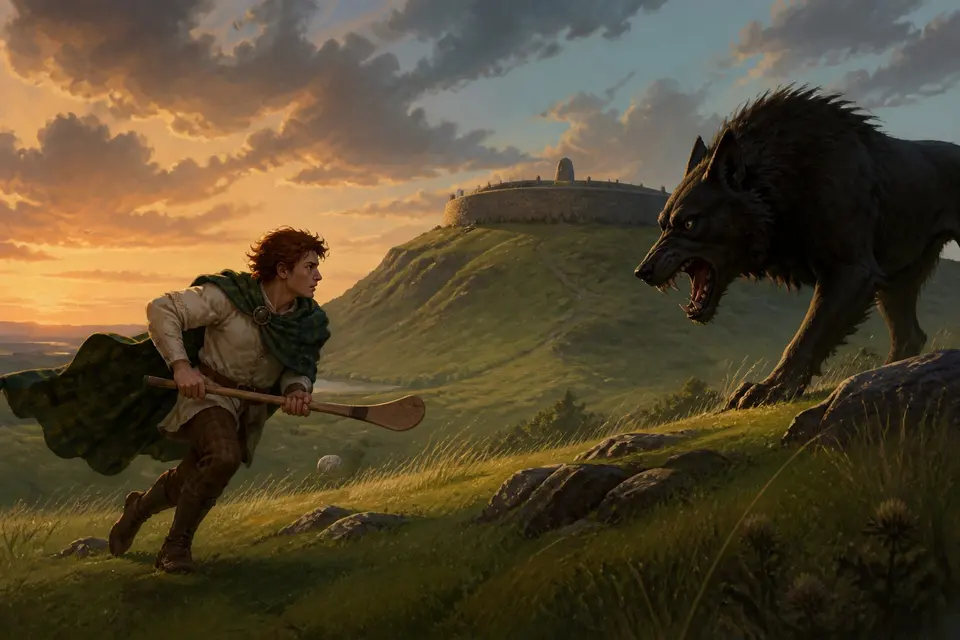
One evening, Conchobar was invited to a feast at the house of the smith Culann, and Sétanta was going to follow. Culann unleashed his huge guard hound at nightfall, forgetting that the boy was coming. The hound attacked. Sétanta, who was only a child, drove his hurling ball down the animal’s throat and killed it with his bare hands.
Culann was distraught: his guard dog was dead. The boy offered to take its place, to guard the smith’s property until a new hound could be raised. From then on, he was called Cú Chulainn, “the Hound of Culann.”
The choice
As a teenager, Cú Chulainn overheard the druid Cathbad say that whoever took up arms on that day would be famous forever, but would have a short life. He went straight to Conchobar and asked for weapons. When the druid protested, Cú Chulainn said that he did not care: one day, one night of glory was enough. It is the same choice that Achilles makes in the Iliad, and scholars have long noticed the parallel, and also the difference: Achilles hesitates, and Cú Chulainn does not.
The warp-spasm
In battle, Cú Chulainn went through a terrifying transformation called the ríastrad, usually translated “warp-spasm.” In the text, his body twists inside his skin, his feet and knees turn to the back, one eye becomes so deep it can barely be seen, and the other bulges out to the size of a cauldron. A fierce light rises from his head. He becomes so frightening that the enemy flees. In some accounts, after a fight, he cannot be calmed down until three vats of cold water are poured over him, or the women of Emain Macha go out naked to meet him, shocking him into shame.
The Cattle Raid of Cooley
The most famous Irish epic, the Táin Bó Cúailnge, “the Cattle Raid of Cooley,” is built around him. Queen Medb of Connacht, jealous that her husband owns a great bull and she does not, decides to steal the best bull in Ireland from Ulster. She gathers a huge army and invades. But the men of Ulster are under a curse: the goddess Macha, forced to race while pregnant, laid a curse on them that, in times of crisis, they would suffer the pains of childbirth for five days and four nights. They are incapacitated.
Only Cú Chulainn, who is too young to be affected, is left to defend the province. He holds off an entire army by himself, fighting single combats at fords, one champion a day. The most heartbreaking of these is against Ferdiad, his best friend, who has been tricked by Medb into fighting him. They fight for three days, and each night they exchange food and medicine. On the fourth day, Cú Chulainn kills his friend with the barbed spear, the gáe bolga, and grieves over the body.
The death
His end comes through treachery and magic. His enemies, led by Medb’s allies, trick him into breaking taboos, or geasa: he is forbidden to eat the flesh of a dog, and yet when an old woman offers him some, to refuse would be another taboo. He is lured into a final battle and mortally wounded by a spear. Knowing that he is dying, he does not lie down. He walks to a standing stone, ties himself to it with his own belt, so that he can die on his feet, facing his enemies. They hesitate to approach him. Only when a raven lands on his shoulder do they know he is dead.
Sculpture and symbol
That is the image captured in the Dublin statue, by the sculptor Oliver Sheppard, made originally in 1911 and moved to the GPO in 1935, where it commemorates those who died in the Easter Rising. In the early twentieth century, during the Irish cultural revival, he became a national symbol of courage and sacrifice. The poet W. B. Yeats wrote several plays about him.
A hero for the present
Cú Chulainn lives on in surprising places. Hurling, the ancient Irish sport, is still played, and he is its mythic patron. In the popular Japanese video game series Fate, he appears as one of the most popular characters, a spear-wielding hero with a cursed fate.
He is a complicated hero: a child who kills, a lover who is unfaithful, a warrior who fights alone, a man who knows what the price is and pays it. The Irish tradition honors him not for being a perfect hero, but because he is willing to stand, even when he is dying.