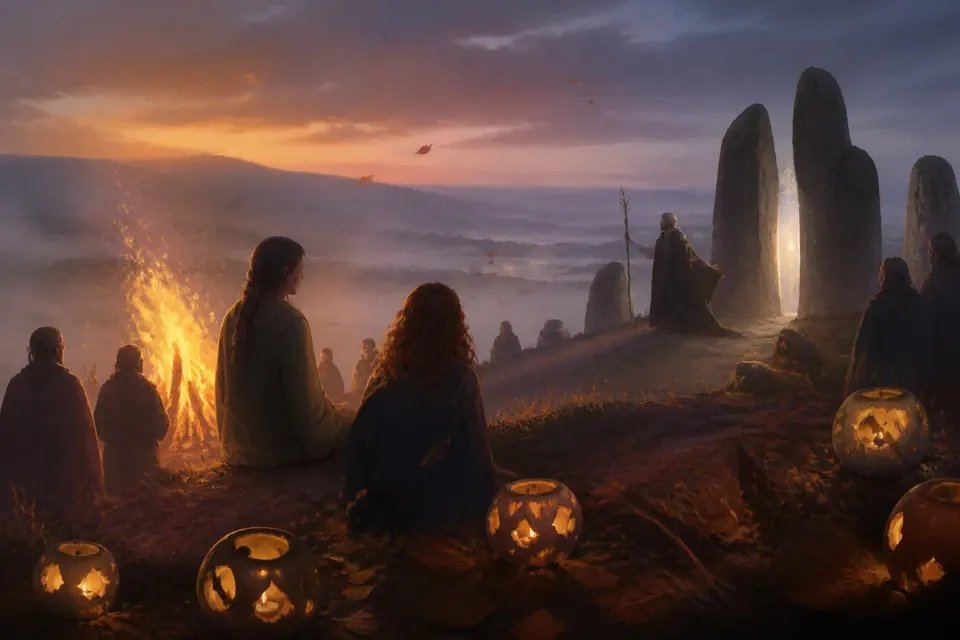
Walk through the Irish countryside and you may see a small, circular mound or a ring of earth in the middle of a field, with a hawthorn tree on top, that the farmer has plowed around for generations. Ask him why and he may shrug and say, “That’s a fairy fort.” The belief is still strong enough that, in recent decades, road projects in Ireland have been rerouted around lone hawthorn trees. In Irish tradition, the fairies are not tiny winged creatures. They are the old gods, the Tuatha Dé Danann, and they live under the hills because they lost a war.
The book of invasions
The story is told in the Lebor Gabála Érenn, “The Book of the Taking of Ireland,” an eleventh-century compilation that tells the mythical history of the island as a series of invasions. Each wave of people arrives, conquers or settles, and then gives way to the next. Christian scribes put the work together, and they tried to fit it into the framework of the Bible, tracing the invaders back to Noah. The result is a strange mixture of scripture, history and myth.
The Tuatha Dé Danann, “the peoples of the goddess Danu,” are the fourth or fifth to arrive, depending on the version. The text says they came in dark clouds to the mountains of Connacht, and the sun was hidden for three days. They had learned magic in four northern cities, and each city gave them a treasure: a stone, a spear, a sword and a cauldron.
The treasures
The Four Treasures of the Tuatha are among the best-known objects in Celtic myth. The Stone of Fál, which cried out under the rightful king. The spear of Lugh, which never missed and always returned to the hand. The sword of Nuada, from which no one could escape. And the cauldron of the Dagda, from which no company ever went away hungry. Some modern writers see in them a source for the Holy Grail and Excalibur, though scholars are cautious about that.
The great battles
On arrival, the Tuatha fought the Fir Bolg, the previous inhabitants, at the first Battle of Mag Tuired. They won, but their king, Nuada, lost an arm. Since a king had to be physically perfect, he had to step down. A smith made him a silver arm, and he later returned to the throne.
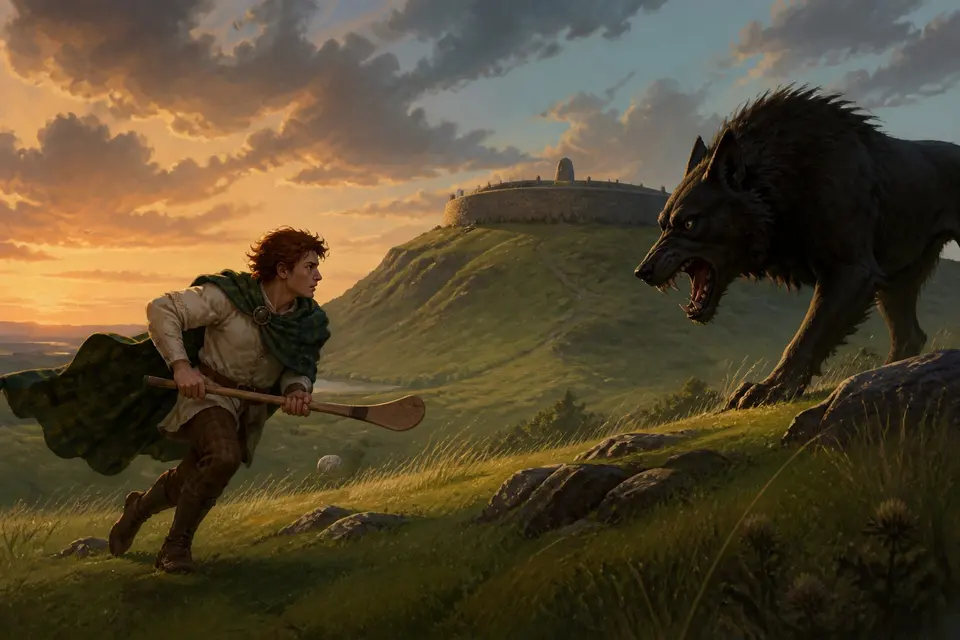
Then came the Fomorians, a monstrous race that ruled from the sea. In the second Battle of Mag Tuired, the Tuatha, under the young, many-skilled hero Lugh, defeated them. Lugh killed the Fomorian king, Balor of the Evil Eye, whose gaze was lethal, with a sling stone that drove his eye out the back of his head. The Morrígan, the goddess of war and fate, proclaimed the victory.
The Milesians arrive
The next invaders were the Milesians, the ancestors of the Gaels, who came by sea from Spain. They were led by the poet-warrior Amergin. As he stepped onto the shore, he is said to have spoken a poem, one of the oldest in Irish: “I am the wind on the sea, I am the wave of the ocean, I am the bull of seven battles...” It is a declaration of belonging.
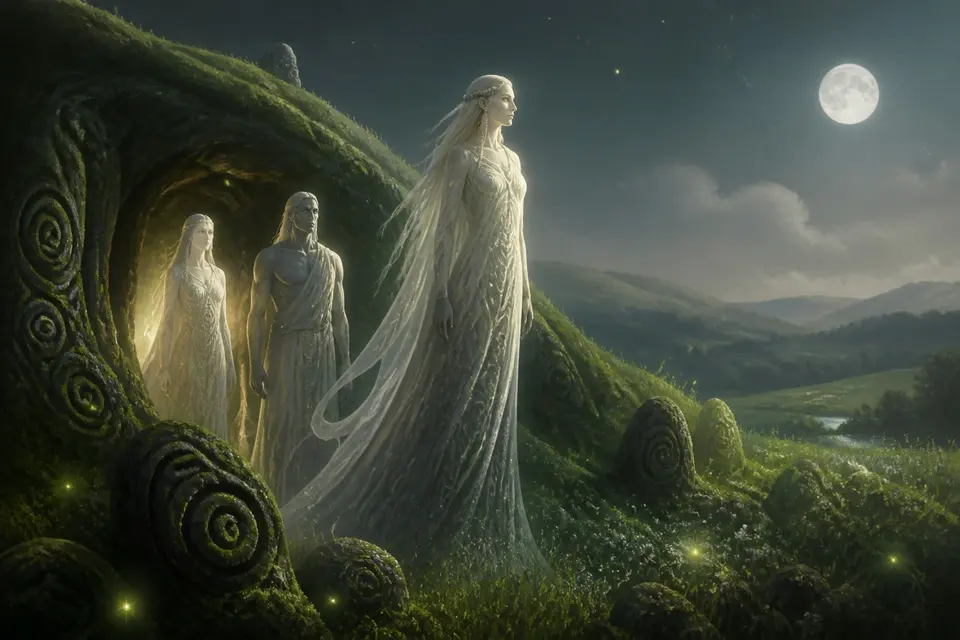
The Tuatha, after some negotiation, agreed to give up the surface of the land. The Milesians would hold it above the ground, and the Tuatha would take what lay beneath. They retreated into the sídhe, the mounds and hills of Ireland. The Dagda, the “good god,” divided the mounds among the lords. From then on, the people of the mounds, the aos sí, lived underground, invisible but close.
From gods to fairies
As Christianity took hold, the old gods did not vanish. They lost their place as objects of worship and gradually turned into something smaller and less formal. Medieval Irish writers kept their stories alive, but often as an account of ancient heroes and kings. Over time, ordinary people began to talk of the daoine sídhe, the “people of the mounds,” and to treat them with respect, even fear: beautiful, powerful and dangerous. They stole children, led travelers astray and punished insults. Nobody was foolish enough to call them “fairies” to their faces. They were the Good People, the Gentry, the Fair Folk.
The real mounds
Some of the sites that the stories name are real. The best known is Newgrange, in the Boyne Valley in County Meath, a huge passage tomb with a white quartz facade, built around 3200 BCE. That makes it older than Stonehenge and the Great Pyramid of Giza. At dawn on the winter solstice, a beam of sunlight enters through a narrow opening above the door and travels along the passage to light the chamber at the heart of the mound. It is an astonishing piece of engineering.
The Irish stories give Newgrange to the god Aengus, a son of the Dagda, who tricked his father into giving it to him. A site that was already ancient when the first stories were told had to be explained, and the people who saw it explained it as the house of the gods.
Why it feels right
It is hard to find a gentler idea in mythology. The old gods, defeated, did not die. They went home. They live just below the surface, under the hill at the end of the field, still powerful, still watching. If you pass the hawthorn, you might want to be polite.