On the night before the Battle of Clontarf, in 1014, so the old chronicle says, a woman appeared to Murchad, the son of the High King Brian Boru. Her name was Aoibheall, and she was a woman of the fairy hill of Craig Liath. She told him that he would die in the battle the next day. He did. It is one of the oldest appearances of a bean sí in Irish writing, and she is already doing what she does best: telling someone, kindly and without any power to change it, that their time is near.
Where the name comes from
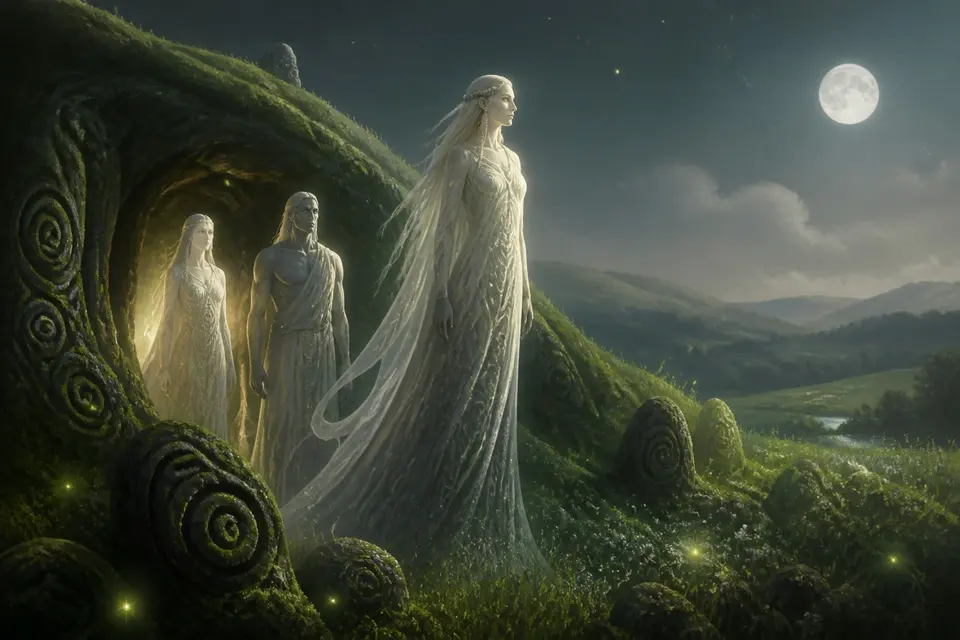
Banshee is a spelling of the Irish bean sí, which means “woman of the sí,” or “woman of the fairy mound.” The sí are the hills and ancient burial mounds in which, according to tradition, the aos sí, the people of the Otherworld, live. In Scotland, the equivalent is bean-shìth. The Clontarf story comes from a twelfth-century account, Cogadh Gaedhel re Gallaibh, and the idea of a female spirit who foretells a death is probably much older.
The family’s spirit
Traditionally, the banshee is attached to specific families. The most frequently named are those whose names begin with O’ or Mac, the old Gaelic families: the O’Neills, O’Briens, O’Connors, O’Gradys and Kavanaghs. She follows a family through generations and cries when one of them is about to die, especially if the death is at some distance. She does not cause the death. She announces it, and in some tellings, it is an honor.
What she looks like
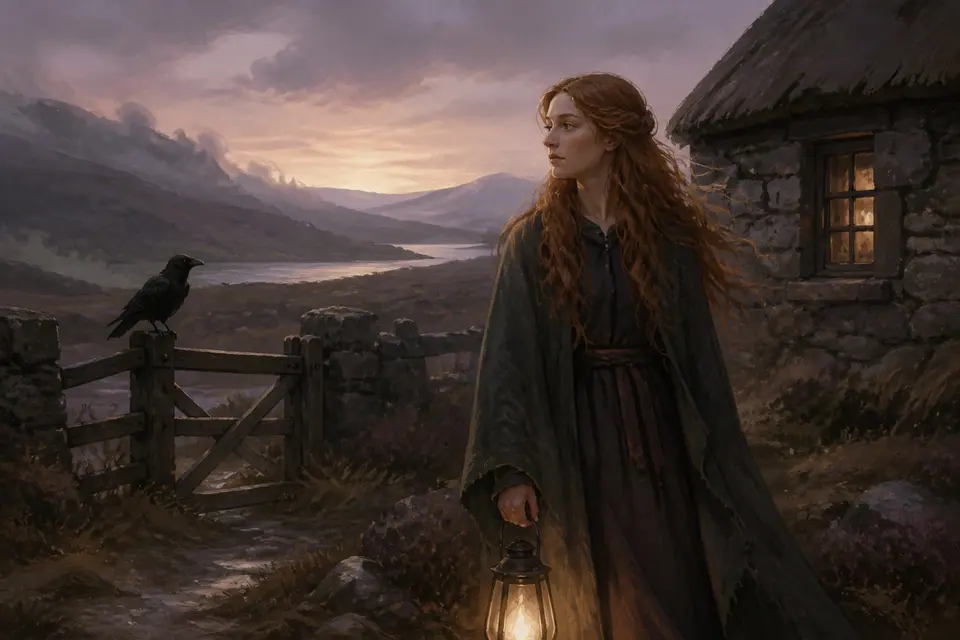
Accounts vary. She is sometimes a young woman, beautiful and pale, with long red or silver hair. She is sometimes an old woman, thin and ragged, in a gray cloak. She may be a washerwoman at a stream, scrubbing the bloodstained clothes of the person about to die. Her eyes are often red from crying. Her hair is long and she often combs it, which is why folklore warns that if you find a comb on the ground, you should not pick it up. It may belong to the banshee, and she can take offense.
Her cry is sometimes described as a wail, sometimes as a keening song, sometimes as something between a scream and a lament. People who have heard it say that you do not forget it.
Keening
The banshee draws on a real tradition. In traditional Ireland, a funeral included keening, caoineadh, a ritual lament sung by women. Sometimes the keener was a relative. Sometimes she was a professional, a bean chaointe, hired to lead the lament. The keening was a performance of grief, with a fixed vocabulary of praise and sorrow. It was often improvised, and a good keener was admired. The Church, which found it too pagan and too noisy, tried to ban it for centuries. It faded in the nineteenth century.
In that light, the banshee looks like a supernatural keener: a mourner who comes before the family does. She is the voice of the tradition itself, going on after the people who practiced it had stopped.
A cousin in Scotland
Scotland has a related figure, the bean nighe, “the washer woman.” She is a small woman at the ford of a stream, washing the shrouds or clothes of people who will soon die. If you can sneak up on her and ask her questions, she must answer. If she sees you first, you may be in danger. Other lands have similar spirits: the Welsh cyhyraeth, a moan heard before a death, or the Gwrach y Rhibyn, “hag of the mist.”
The tender part
The banshee is frightening, but she is not a villain. She is not a ghost who wants revenge. She grieves, she is faithful and she does not abandon her family. Many of the stories describe her as a kind of friend. A man hears the cry and knows that he should put his affairs in order. He gets time to say goodbye.
A poem that is a banshee
One of the great poems in the Irish language is, in a sense, a human banshee. In 1773, a young Irish woman, Eibhlín Dubh Ní Chonaill, found her husband, Art Ó Laoghaire, dead on the road near Macroom, County Cork, shot by a British officer after a dispute over a horse. She is said to have drunk his blood from his body as she knelt over him, and then to have composed, at the wake, a long keening poem, Caoineadh Airt Uí Laoghaire, “The Lament for Art O’Leary.” It is a raw, passionate piece of grief, moving from tenderness to rage and back, and it is considered one of the finest works of Irish literature. It was kept alive for decades in oral tradition, and was written down only later.
The poem shows what keening was at its best: not a formula but a living art in which a woman, in the presence of the dead, gave her feelings the shape of poetry. When people said a banshee was crying, that is the tradition they had in mind.
The banshee in modern culture
The banshee has also had a busy life in popular culture. In Marvel comics, a mutant named Sean Cassidy, an Irish Interpol agent with a sonic scream, took the name in 1967. A television series, Banshee, borrowed the title in 2013 for a crime story set in Pennsylvania. And in Martin McDonagh’s 2022 film The Banshees of Inisherin, set on an imaginary Irish island during the civil war of 1923, an old woman named Mrs. McCormick, dressed in black, stands on the edge of the action and predicts deaths, just as a banshee would. The film’s title leaves open whether she is the only banshee, or whether everyone else on the island is one.
That may be why the legend lasts. It turns a moment of dread into a gesture of care: someone, from beyond the hill, is crying for you.