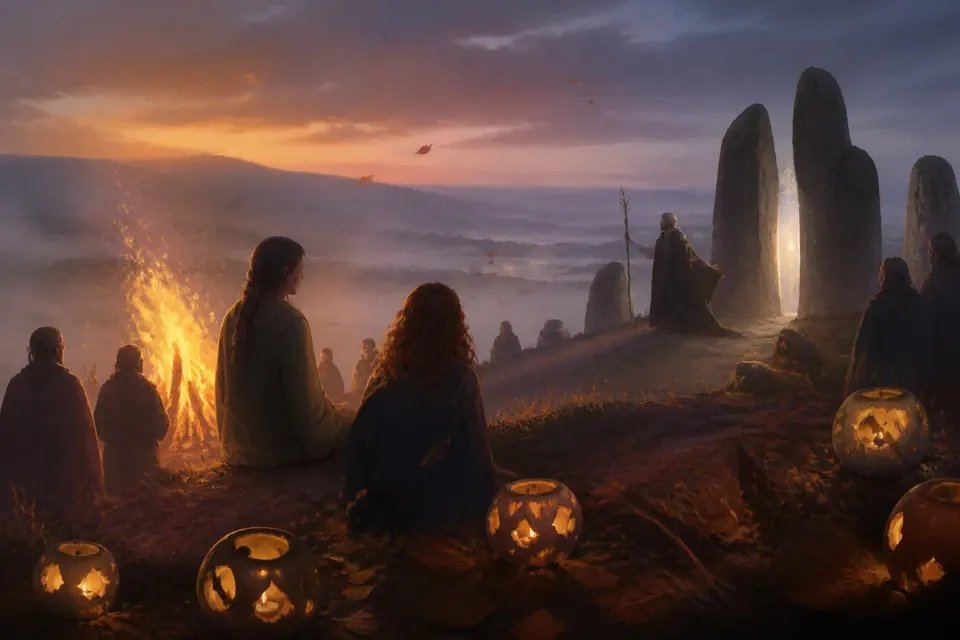
Each year at the summer solstice, thousands of people gather at Stonehenge to watch the sun rise over the stones. Among them, a small number wear long white robes and call themselves druids. They are sincere, and they are part of a tradition that goes back more than 200 years. But the connection between the druids of the Iron Age and the stones of Stonehenge does not exist. Stonehenge was completed around 1500 BCE, at least a thousand years before the first mention of druids in any written source.
Who were the druids?
We know about the druids almost entirely from outsiders. They were the priestly class of the Celtic peoples of Gaul, Britain and Ireland, and they left no writings of their own, since they apparently disapproved of putting sacred knowledge in writing. What we have comes from Greek and Roman authors, and some of it is clearly hostile propaganda.
The most detailed account is from Julius Caesar, who spent eight years conquering Gaul in the 50s BCE. In his Gallic War, he says that the druids are the religious leaders of the Gauls. They oversee sacrifices, public and private, and settle disputes. They are exempt from military service and taxes, which is why many young men want to join them. Training can last twenty years, and the pupils learn a huge number of verses by heart, not writing them down. Druids believe, Caesar says, that the soul does not die but passes from one body to another after death, and this makes them unafraid of dying. He also claims that they sometimes burn people alive in huge wicker figures, a detail that has captured the imagination ever since, though most historians doubt that it was a regular practice and suspect exaggeration.
The mistletoe
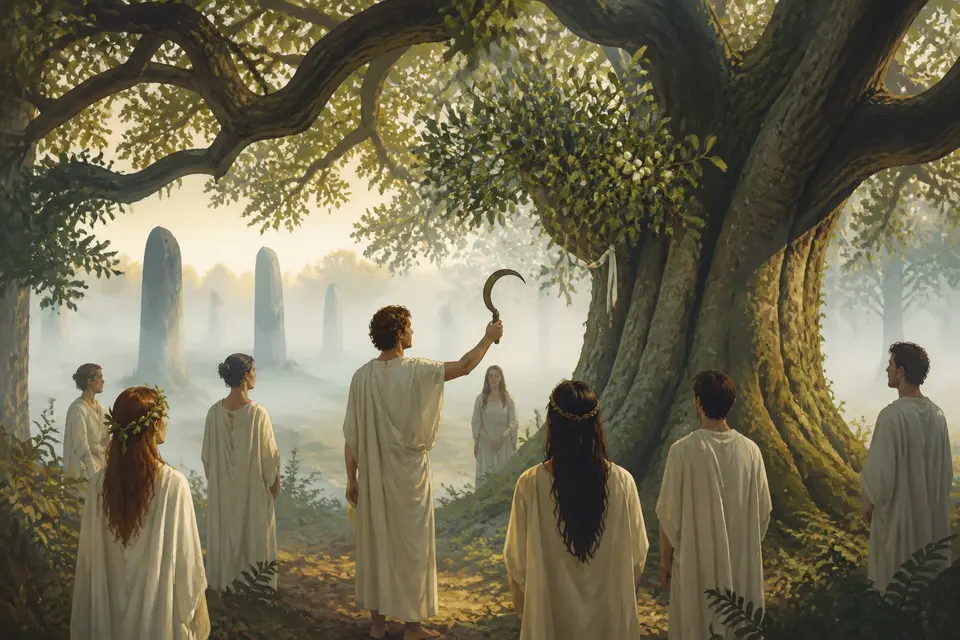
The writer who gave us the golden sickle was Pliny the Elder, who wrote in the first century CE. In his Natural History, he describes a ritual in Gaul: druids hold the mistletoe, a plant that grows on oak trees, to be sacred, and the oak itself is sacred as well. When mistletoe is found on an oak, they hold a ceremony. A white-robed priest climbs the tree and cuts the mistletoe with a golden sickle, and it is caught in a white cloak. Two white bulls are sacrificed. The mistletoe is believed to cure illness and to be an antidote to poison. That is the origin of the picture of the white-robed druid with a golden sickle.
It is worth noticing that Pliny was not an eyewitness and seems to have been working from earlier accounts, and that there is no archaeological evidence for any such ceremony.
Anglesey
The best-attested event in druid history is a battle. In 60 or 61 CE, the Roman governor of Britain, Suetonius Paulinus, led an army to attack the island of Mona, now Anglesey, off the northwest coast of Wales, which was a stronghold of resistance and, according to Tacitus, of the druids. In his Annals, Tacitus describes the scene: on the shore stood a dense line of armed men, and among them black-robed women with disheveled hair and torches, like Furies. Around them stood druids, raising their hands to the sky and shouting curses. The Roman soldiers were momentarily frozen with fear, but their commander urged them on, and they crossed, cut down the defenders and burned the sacred groves.
It was an act of religious and political suppression. While Paulinus was at Anglesey, the British queen Boudica launched her great rebellion in the east, and he had to rush back.
Not the builders of Stonehenge
The notion that druids built Stonehenge came from antiquarians of the seventeenth and eighteenth centuries, especially John Aubrey, who suggested it in the 1660s, and William Stukeley, who in the 1740s enthusiastically promoted the idea that the monument was a druid temple. Neither had any way of dating it. Today, radiocarbon dating shows that the first stage of Stonehenge dates to about 3000 BCE, and the large sarsen stones were put up about 2500 BCE. The druids, as attested by Roman writers, belong to the last few centuries BCE and the first century CE. The monument was already ancient when they appeared.
An invented tradition
The modern druid movement has its own origins. In 1792, a Welsh stonemason and poet named Edward Williams, who called himself Iolo Morganwg, held a ceremony on Primrose Hill in London, which he called the first Gorsedd of the Bards of the Island of Britain. He claimed that it was based on ancient druidic customs passed down in Wales, and he forged a number of documents to support it. The ceremony was incorporated into the Welsh Eisteddfod, the national festival of poetry and music, where bards in white, blue and green robes still take part in ceremonies. It is a traditional ceremony, but an invented one.
A glimpse in a bog
There is one tantalizing find. In 1984, peat cutters in Lindow Moss in Cheshire, England, found a preserved body, now known as Lindow Man, who was killed around the first century CE. He had been struck on the head, garroted and had his throat cut. His last meal included a small piece of burnt bread, and traces of mistletoe pollen. Some scholars have suggested that he was a ritual victim, and that the mistletoe was part of the rite. Others are skeptical. The case is tantalizing, but it proves nothing.
What we can say
The honest answer is that we know very little about the druids. They existed. They were respected. They were religious specialists, legal authorities and teachers. They were targeted by the Romans. And almost everything else is speculation. They have been a blank screen for projection, in Victorian Britain, in modern fantasy and in comic books. In the Asterix series, the druid Getafix brews a magic potion. It is as good a portrait as any: a wise, kindly, comical old man who knows things and is not telling.