In the early 1700s, a Spanish Dominican friar named Francisco Ximénez, who was serving as a parish priest in the highlands of Guatemala, was shown a manuscript. It was in K’iche’, the language of his parishioners, written in the Latin alphabet. He copied it and added a Spanish translation. His copy is the only one that survives, and it is now in a library in Chicago. The book is the Popol Vuh, “the book of the community,” and it contains one of the most inventive stories in the literature of the Americas.
Three attempts at making people
The book begins before the world exists. There is only the sky and the sea, and the gods in the water. They decide to make a world, and to make beings who can speak and praise them. They try three times.
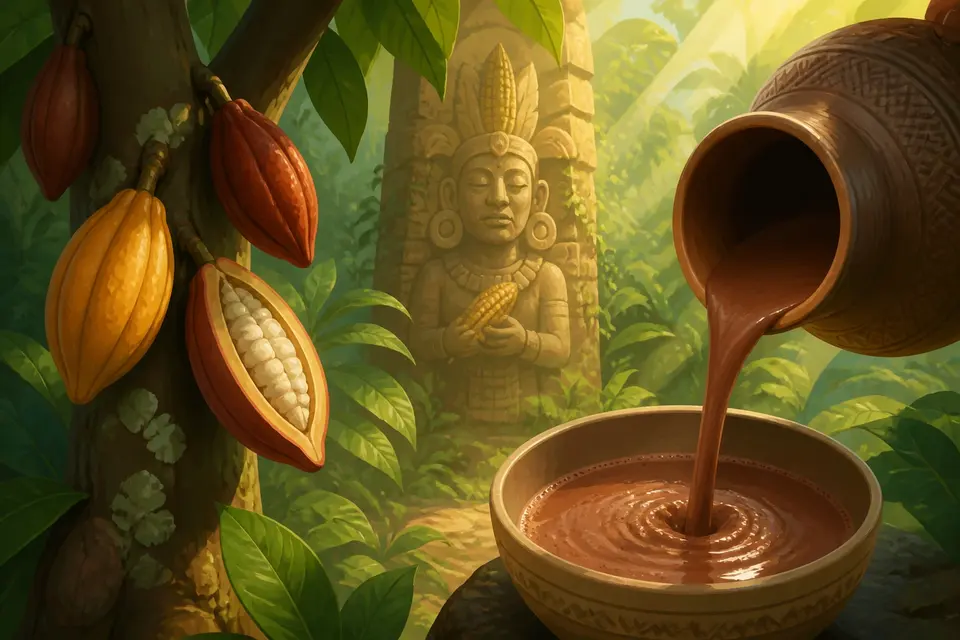
The first creatures are animals, who cannot speak the gods’ names. They are told that they will be eaten. The second attempt is humans made of mud, who are soft and fall apart. The third are made of wood, and they look like people, but they have no hearts or minds, and the gods destroy them in a flood. Their descendants, the book says, are monkeys. At last the gods make humans from maize, ground and mixed with water, and these are the first people who are able to think and give thanks.
The ball game
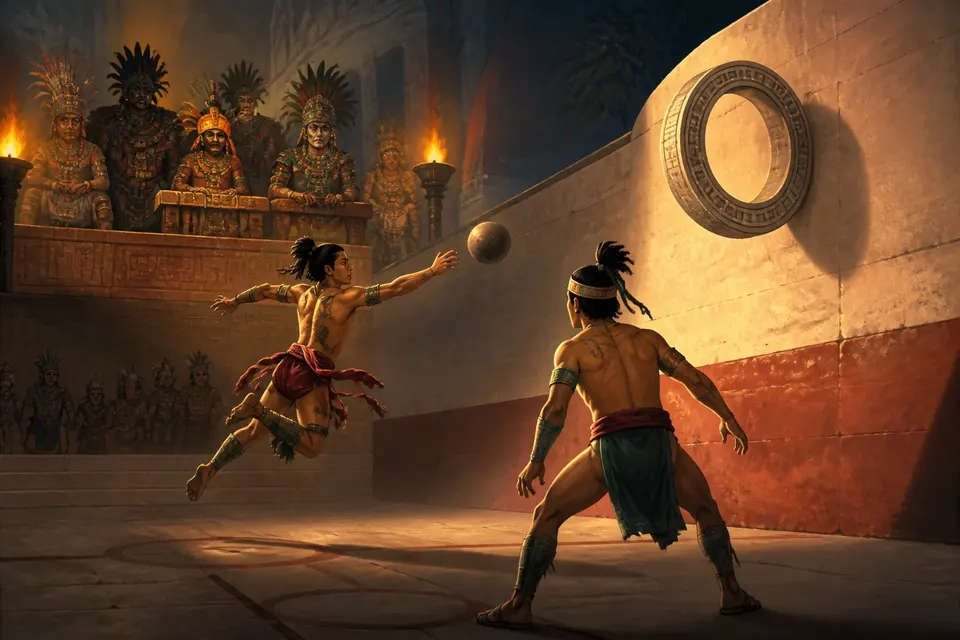
Before the final creation, the Popol Vuh tells another story. Two brothers, Hun Hunahpu and Vucub Hunahpu, love to play the ball game, a sport played in a stone court with a heavy rubber ball that players bounce off their hips. It was played all across Mesoamerica. Some of the courts are still standing, including a huge one at Chichén Itzá. They play so noisily that the lords of the underworld, Xibalba, hear them and get irritated. One of the lords is called One Death and another Seven Death.
The lords of Xibalba invite the brothers down for a game. They put them through a series of tricks. The brothers fail, and are killed. Hun Hunahpu’s head is hung in a calabash tree. When a daughter of one of the lords passes by, the head spits in her hand, and she becomes pregnant. Her father tries to kill her, but she escapes to the surface, where she gives birth to twin boys, Hunahpu and Xbalanque.
The twins go down
The twins grow up as hunters and, like their father, are fond of the ball game. They also play loudly. The lords of Xibalba summon them. The twins go, and are put through a series of trials in houses: the Dark House, the Rattling House (a cold place full of hail), the Jaguar House, the Fire House and the Bat House, where a monstrous bat called Camazotz cuts off Hunahpu’s head.
They survive with a combination of cunning and luck. In the Dark House they keep a cigar and a firefly alight, and trick the lords by pretending the cigar has burned out. When Hunahpu loses his head, his brother replaces it with a squash, and then carefully puts the real head back. They dupe the lords at the ball game itself and defeat them.
The performance
The twins’ final trick is a brilliant piece of theater. They disguise themselves as wandering performers and put on a show for the lords. They burn a house, and then bring it back unharmed. They sacrifice a dog, and bring it back to life. They sacrifice each other, and revive each other. The lords of Xibalba are delighted, and ask the twins to do the same to them. The twins sacrifice the two chief lords, and do not bring them back.
The remaining lords of the underworld give up and beg for mercy. The twins agree to spare them but strip them of power: they will no longer receive the offerings of noble people, only those of the poor and the sinful.
Sun and moon
In the end, the twins rise into the sky. In the usual reading, one becomes the sun and the other the moon, or the sun and Venus. They also restore their father, in a sense, to the world of the living. His head becomes the maize god, who is born again each year from the earth.
A bridge between worlds
The ball game in the story is not just a sport. In Maya thought, the court was a portal between the world of the living and the underworld, and the game was a re-enactment of the struggle between life and death, light and darkness. The rubber ball, bouncing between the two sides, stood for the sun going down and coming up again.
It also has an element that readers still enjoy: the heroes win by being clever. They are not the strongest, but they are the best at playing tricks. In that way the Popol Vuh belongs to a very old tradition of storytelling, in which the weak defeat the powerful with a good joke and a good plan.