If you were online in 2012, you remember it. There were countdown clocks, disaster films, survival kits, and a rumor that a planet called Nibiru was about to collide with Earth. On December 21, the date on which the Maya calendar was supposedly going to run out, a few people gathered in the hills of France around a mountain they were told would be a safe haven. Nothing happened, and the next day it was just December 22. How did a calendar become a doomsday?
How the Maya counted
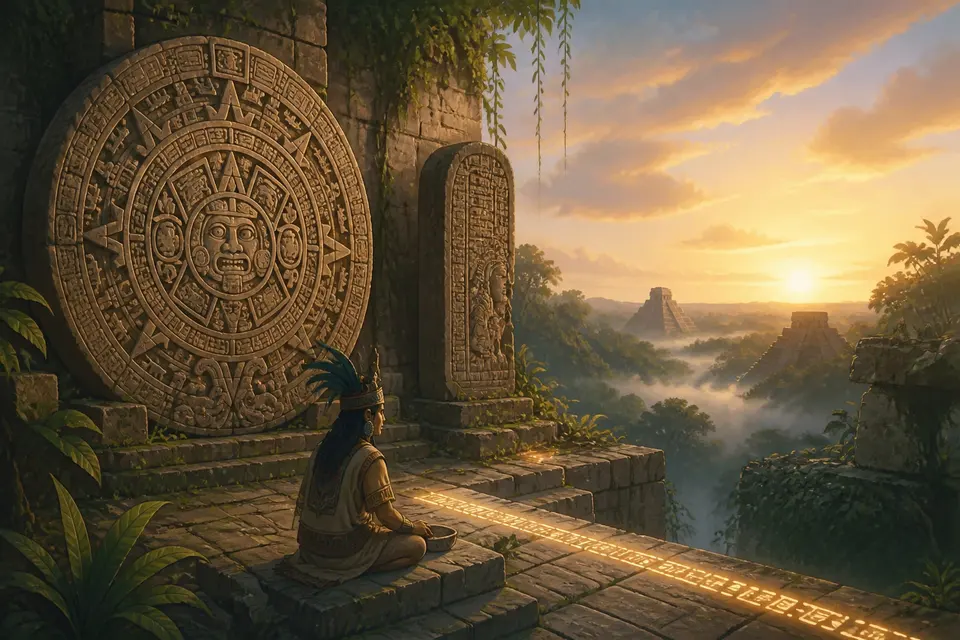
The Maya used several calendars at once. A ritual calendar of 260 days, and a solar year of 365 days, meshed like gears and repeated every 52 years, in what is called the Calendar Round. But a Calendar Round is too short to date events over many centuries, so they also used a system called the Long Count, which gives every day a unique address.
The Long Count works like an odometer. A day is a k’in. Twenty days make a winal. Eighteen winals, or 360 days, make a tun. Twenty tuns, about 19.7 years, make a k’atun. And twenty k’atuns, about 394 years, make a b’ak’tun. A date is written as five numbers, for instance 9.12.11.5.18. It counts days from a starting point, which, according to the most widely used correlation with our calendar, was August 11, 3114 BCE.
On December 21, 2012, the count reached 13.0.0.0.0. That is the end of the thirteenth b’ak’tun. The odometer rolled over to the next level.
What the Maya actually wrote
Very few Maya inscriptions mention the date. The best known is Monument 6 from Tortuguero, in the Mexican state of Tabasco, carved in the seventh century CE. It is badly damaged. A line toward the end seems to say that on the completion of the thirteenth b’ak’tun, something will “descend,” and it names a god, Bolon Yokte’ K’uh. The text breaks off and nobody knows what comes next. It is not a prediction of destruction. More likely it is describing a ritual or a return of a deity at the end of a cycle, a good reason for a celebration.
In fact, the Maya had a habit of looking far into the future. Stelae at Cobá, in the Yucatán, record Long Count numbers so vast that they dwarf the age of the universe. An inscription at Palenque, in the temple over the tomb of the ruler K’inich Janaab’ Pakal, calculates an anniversary of his accession that falls in the year 4772 CE. The idea that the Maya thought 2012 would be the end is absurd.
How the myth began
The 2012 idea came not from the Maya but from Western writers. In 1966, in a book called The Maya, the archaeologist Michael Coe suggested that, according to the Maya, the world would end on that date. In the 1980s, the American writer José Argüelles, who was a New Age figure and an organizer of the 1987 “Harmonic Convergence,” spread the idea that the date would be a time of spiritual transformation. From there it merged with the lore about alignments and rogue planets. A 2009 disaster film by Roland Emmerich, 2012, gave it a final push. Reports said that the film’s website made people so anxious that NASA scientists published an explainer, “Beyond 2012: Why the World Won’t End.”
The Maya are still here
There is a sad irony in the story. Many of the people who worried about the Maya apocalypse seemed to assume that the Maya had disappeared. They have not. More than six million people in Guatemala, Mexico, Belize and Honduras identify as Maya today, and about thirty Mayan languages are spoken. In 2012 many communities held ceremonies to mark the beginning of a new b’ak’tun. In Guatemala and southern Mexico, there were festivals with music and dance and a sense of renewal.
Many Maya people were irritated by the doomsday fuss. For them the new cycle was a time for reflection and hope, not catastrophe.
What the calendar tells us
The Maya calendar is a remarkable achievement. Its authors tracked the sun, the moon and Venus with astonishing accuracy, and they built a system for naming days that could be extended without limit. It was not a countdown. It was a way of saying that time keeps going.
The 2012 episode is a good example of how a culture’s ideas can be misread when they are taken out of context. If you want to hear what the Maya actually said about the end of the world, you may have to wait: they did not say it would end in 2012. They said that it would, at some point, begin again.