Egyptian myths are often fragmentary. Spells, hymns and bits of stories turn up in tombs, but the Egyptians rarely wrote out a story from beginning to end. The one exception, the story of Isis and Osiris, comes from a Greek writer, Plutarch, who wrote it down around the year 100 CE in an essay called On Isis and Osiris. Plutarch was a priest at Delphi, a philosopher and an enthusiast, and he put the pieces together from what he had learned. It is the most complete version we have, and it reads like a murder mystery.
A king and a jealous brother
Osiris was king of Egypt, and he was a good one. He taught his people how to farm, made laws and put an end to cannibalism, according to Plutarch. When he traveled abroad to spread civilization, his wife Isis ruled in his place and ruled well. His brother Set, the god of storms, deserts and disorder, was resentful.
On Osiris’s return, Set planned a banquet with seventy-two conspirators. At the party he showed off a beautiful chest, made exactly to Osiris’s measurements, and promised it to anyone who fit it. One by one the guests lay down. When Osiris climbed in, Set and his friends slammed the lid, nailed it shut and sealed it with molten lead. They threw the chest into the Nile.
The search
Isis cut her hair, put on mourning clothes and searched for the chest. It had floated down the river and out to sea, until it washed up on the coast of Byblos, a city in what is now Lebanon, where a tamarisk tree grew around it. The king of Byblos was so impressed by the huge tree that he cut it down and made it a pillar of his palace. Isis, disguising herself as a servant, got herself hired as a nurse for the king’s baby, and in the end she revealed who she was and asked for the pillar. She took the chest home.
Unfortunately, Set found it. While out hunting by moonlight, he recognized the chest, opened it and cut Osiris into fourteen pieces, which he scattered across Egypt.
The reassembly
Isis started again. With her sister Nephthys, she traveled along the Nile and collected the pieces. Where she found one, a shrine was later built. Only the phallus was missing; a fish had eaten it. Isis made a replacement of gold, or in some versions of clay. Anubis, the jackal god, bound the body in linen. This, the Egyptians said, was the first mummy.
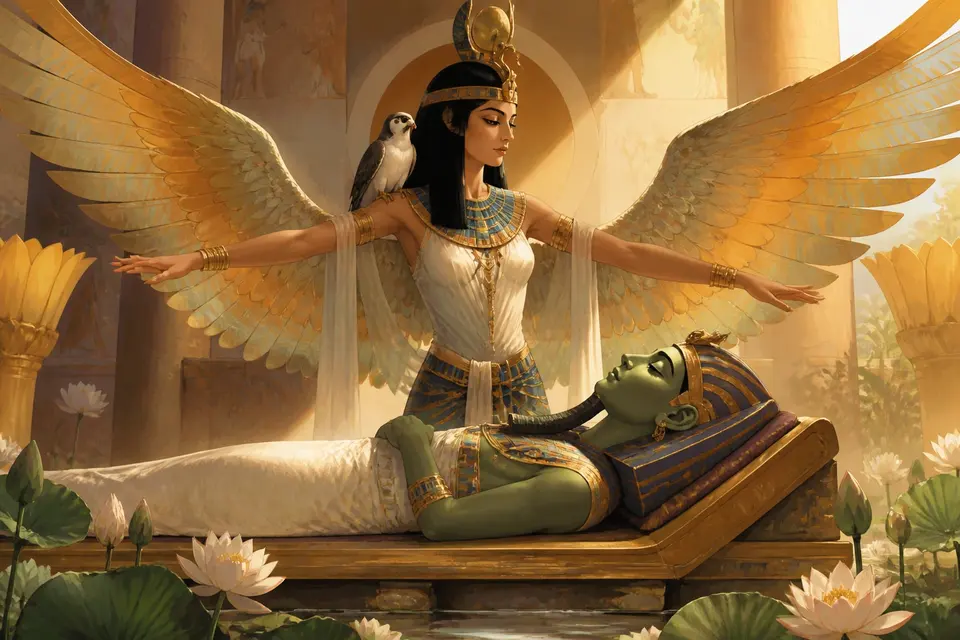
Then Isis, in the form of a kite, a bird of prey, fanned breath into the body with her wings and conceived a son, Horus. In some tellings she did this just before the body went cold, in others by magic.
The avenger
Horus grew up in hiding in the marshes of the Nile Delta. When he was old enough, he challenged Set for the throne. The conflict was long, with contests, lawsuits before the gods and some very odd moments. In one episode Horus lost an eye, which was later restored by Thoth. That eye, the Eye of Horus, became one of the most popular protective amulets in Egypt. In another, the gods held a trial and, after many years, decided in Horus’s favor.
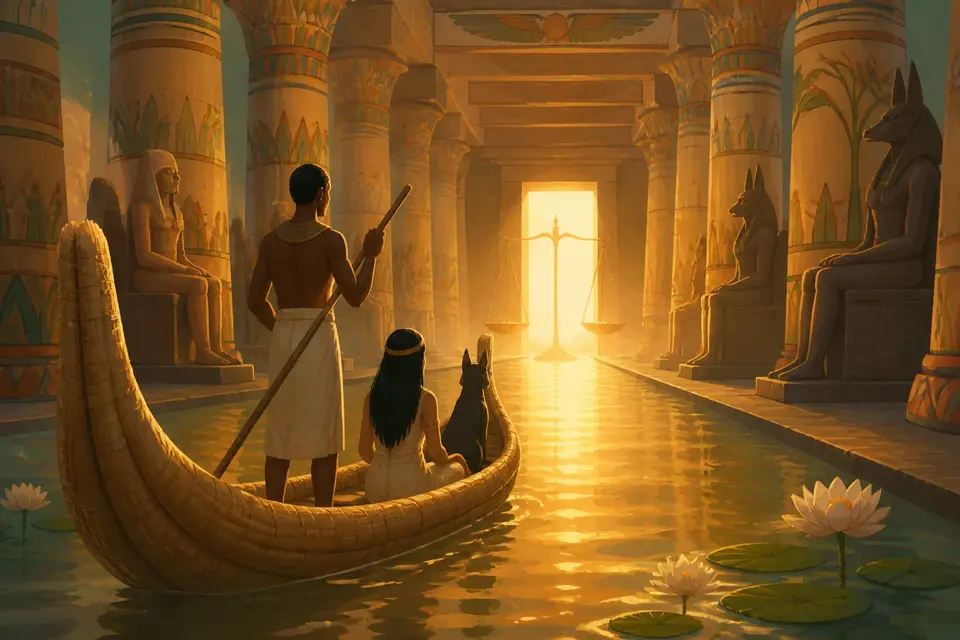
Osiris, restored but unable to live among the living, became the king of the dead and judge in the underworld. Horus became the king of Egypt. Every pharaoh was seen as Horus in life, and, when he died, as Osiris.
The Nile connection
The story fits the rhythm of the river. Egypt’s fortune depended on the annual flood. The land was dry for months, and then the water came, bringing new silt and a new crop. Osiris was associated with the grain that dies and returns, and with the flood. He is often painted with green or black skin, the colors of vegetation and fertile soil. A well-known ritual involved making a figure of Osiris out of earth, planting it with barley and watching it sprout.
A goddess who traveled
Isis was the heart of the story, and her appeal outgrew Egypt. In the Hellenistic period, her worship spread across the Mediterranean. By the first century CE there were temples to her in Rome, Pompeii and as far away as Britain and the Rhine. She was a goddess of magic, motherhood and protection. She was called “the one of ten thousand names.”
Many scholars think that Christian images of the Madonna and child owe something to pictures of Isis nursing Horus. The idea is debated, but a story that began in the Nile Valley and was still being told two thousand years later in a Greek philosopher’s essay is certainly one with staying power.