Imagine you live in a world where nothing guarantees that the sun will rise tomorrow. That is not how we think about the dawn, but it was how Egyptians thought of it, or at least how the royal tombs describe it. In their imagination, the sun’s daily appearance was a victory, won each night against a monster.
The sun’s two boats
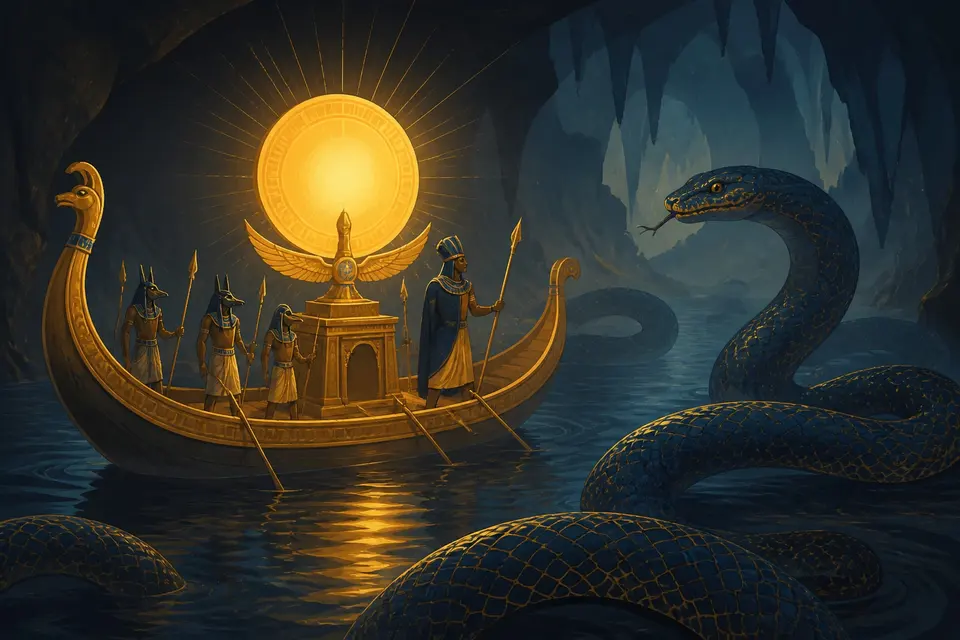
The sun god was Ra, sometimes combined with other gods in forms like Amun-Ra and Ra-Horakhty. During the day, he sailed across the sky in a vessel called the Mandjet, the “Boat of Millions of Years,” a journey that lasted twelve hours. At sunset, he left the sky and entered the underworld, the Duat, to travel in a second boat, the Mesektet, through twelve more hours of darkness.
This voyage is described in a series of funerary books painted on the walls of royal tombs in the New Kingdom, beginning around 1500 BCE. The best known is the Amduat, “That Which Is in the Underworld.” It divides the night into twelve hours, each with its own gate, its own landscape and its own inhabitants. In some hours, the dead cheer as the light passes and are briefly warmed. In others, the boat has to pass through terrifying places, guarded by serpents with fire in their mouths.
The enemy
The greatest danger of the voyage was Apep, whom the Greeks called Apophis, an enormous serpent that lived in the primeval waters. He was not an ordinary monster. He was the embodiment of chaos, the force that opposed maat, the principle of order. Texts describe him as “the evil lizard,” “the enemy,” “the one whom Ra hates.” Sometimes he is said to be so long that no one could see the end of him.
Apep’s weapon was a hypnotic stare and a roar. In some versions, he tried to drink the water of the underworld river so that the boat would be stranded on a sandbank. In others, he simply tried to swallow the boat. Gods on board fought him. The goddess Mehen coiled around the boat’s cabin to protect the sun god. And, in one of the most notable features of the story, the god Set, often shown as the villain of the Osiris story, stood in the prow with a spear. Set, the god of storms and disorder, was the one strong enough to hold the serpent back.
Helping from below
The Egyptians did not leave the fight to the gods alone. Priests of the temple of Amun at Karnak recited a ritual called the “Book of Overthrowing Apep.” The text instructed them to make a wax figure of the serpent, write its name on papyrus, spit on it, trample it with the left foot, stab it with a flint knife and burn it in a fire. They did this at various times of day, especially at dawn and at midnight. A storm or a solar eclipse might be seen as an attack by Apep.
Midnight and rebirth
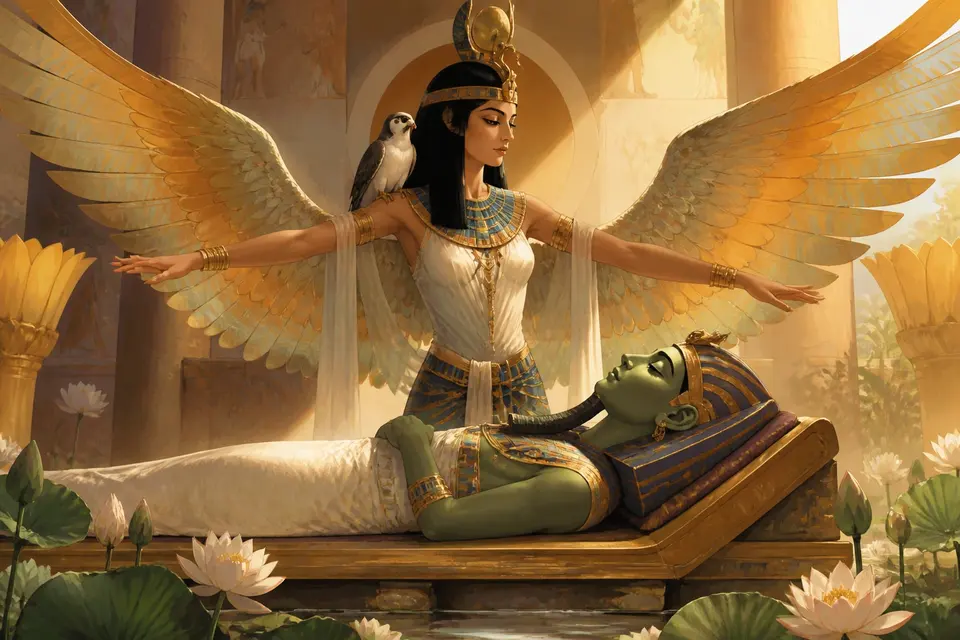
At the deepest hour of the night, according to the books, Ra met Osiris, the god of the dead. In an image from the tomb of Nefertari, the sun god appears with a ram’s head, joined to the mummified body of Osiris, with the inscription “Ra rests in Osiris, Osiris rests in Ra.” The two gods were united, and the dead in the underworld got to see the sun god’s light.
At the twelfth hour, the boat reached the horizon. Ra, now in the form of the scarab beetle Khepri, was pushed into the sky by a giant dung beetle. The Egyptians observed that dung beetles roll balls of dung across the ground, and out of the ball emerge new beetles, so they treated the beetle as a symbol of rebirth. The sun came up again. The monster had lost for another day.
A fear of forgetting
It is easy for us to treat this as a poetic way of describing day and night. The Egyptians took it more literally. The idea of maat was central to their religion and their government. Chaos was always present, just beyond the edge of order. The king’s duty, and the priests’ daily rituals, were to keep the world running.
That is one reason why this story is so affecting. It says that the sunrise is not a given. It is a daily act of defense, performed by gods, priests and, in a sense, everyone. Every dawn is an anniversary of a battle.