One of the most quoted passages about the dangers of technology was written about 2,400 years ago, and it begins with an Egyptian god. In Plato’s dialogue Phaedrus, Socrates, strolling outside Athens with a friend, says that he has heard an old story from Egypt. In the city of Naucratis there lived an ancient god named Theuth, the Greek form of Thoth, who invented numbers, calculation, geometry, astronomy, the games of draughts and dice, and, most important of all, letters. He went to the king of Egypt, Thamus, who ruled in Thebes, and proposed that the new arts be given to all the Egyptians.
The king’s reply
Thamus asked what each art was good for. When Theuth came to letters, he said: “This discipline, my king, will make the Egyptians wiser and improve their memories. I have found a remedy for both memory and wisdom.” The king was not impressed. “Most ingenious Theuth,” he said, “the person who can create an art is not always the best judge of its usefulness to those who use it. You, the father of letters, have said the opposite of what they can do. This discovery will produce forgetfulness in the souls of those who learn it, because they will not practice their memory. They will trust in writing, which is external and depends on marks that belong to others, and not remember from within themselves.”
Writing, the king continued, was not a cure for memory but a reminder. Students would acquire the appearance of wisdom, not the reality. They would hear many things without being taught, and would seem to know a great deal while generally knowing nothing, and would be difficult to get along with, having the show of wisdom without its substance.
The irony
There is a deep irony in the story. Plato wrote it down. We know Socrates’s view because his student wrote it in a book. And Plato’s dialogues, which are among the most influential texts in Western philosophy, are themselves a product of the technology that Thamus warned against.
Who was Thoth?
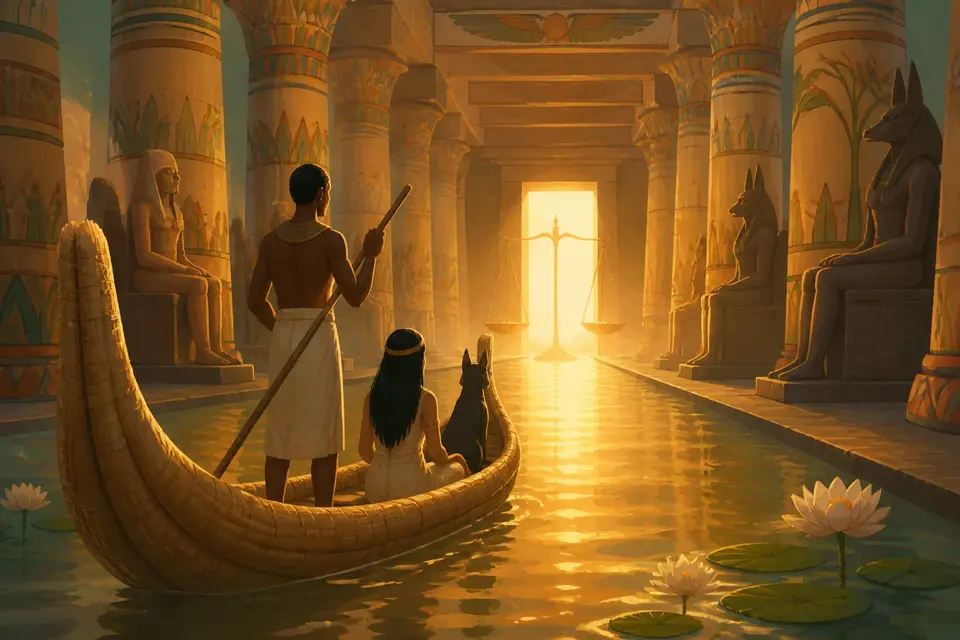
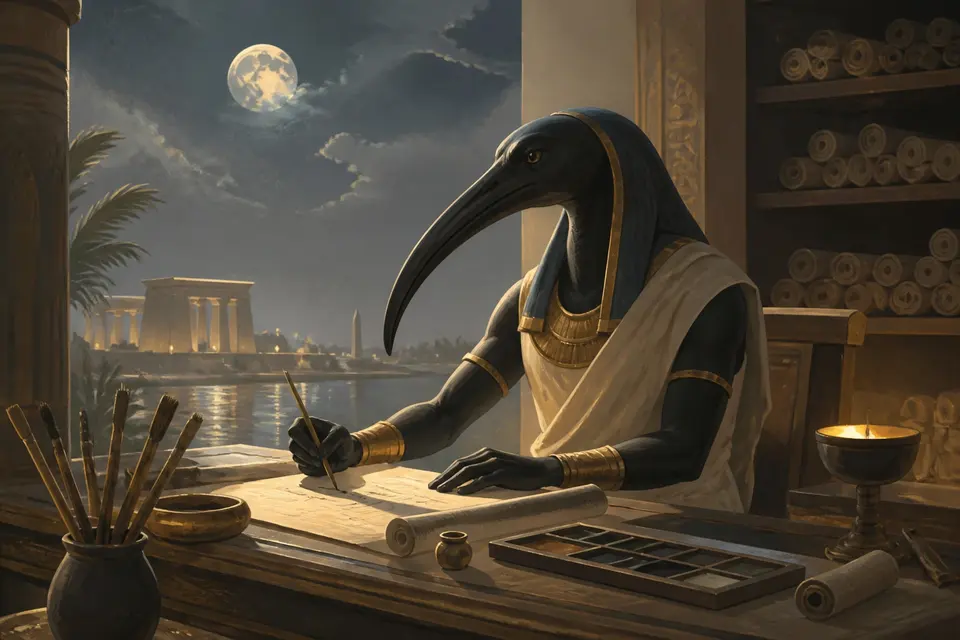
Thoth, in Egyptian Djehuty, was one of the major gods of ancient Egypt. He was shown as an ibis, or as a man with the head of an ibis, or sometimes as a baboon. He was the god of writing, wisdom, the moon, measurement and magic. His main cult center was Hermopolis, in Middle Egypt. He was also the scribe of the gods, who recorded the result when the hearts of the dead were weighed in the Hall of Judgment.
He was said to have invented the hieroglyphs, which the Egyptians called medu netjer, “the words of the god.” He was connected to the calendar and to mathematics. Egyptian scribes, who had a vital role in the administration, prayed to him before writing, and, according to some accounts, poured out a bit of the first water from the ink bowl in his honor.
The scribe’s world
Scribes were the educated elite of ancient Egypt, and they were proud of it. A Middle Kingdom text, The Satire of the Trades, composed around 2000 BCE, describes the miseries of every other profession: the potter stained with clay, the washerman beaten, the farmer who is taxed, the soldier who is marched into danger. Only the scribe, it says, has an easy life, because he does not have to do manual work. The text advises a young man to love books more than his mother. It is the earliest version of a pep talk for a student, and also one of the first complaints about white-collar snobbery.
The god of two worlds
The Greeks identified Thoth with their own god Hermes, who was also a messenger and a god of travelers, and the two merged in the figure of Hermes Trismegistus, “Thrice-Great Hermes.” A collection of mystical and philosophical writings of the first few centuries CE, the Hermetica, was attributed to him, and an influential text known as the Emerald Tablet was ascribed to him. The Hermetic tradition influenced medieval and Renaissance alchemy and astrology, and traces of it are still found in the language of magic and esoteric thought: “hermetically sealed” comes from the name.
Why the argument is alive
Thamus’s complaint is still being made in new forms. When printing was invented in the fifteenth century, some scholars warned that it would make people lazy and crowd the world with bad books. When calculators were introduced into schools, they were accused of ruining arithmetic. In recent years, researchers have studied what is sometimes called the “Google effect”: people tend to remember where to find information rather than the information itself. And, with the rise of artificial intelligence writing tools, the debate has returned once more. If a machine can write for us, what will happen to our own ability?
The balanced view
It is easy to see Thamus as a Luddite, and to make fun of the idea that writing damaged memory. Obviously, writing was a gain. It allowed knowledge to accumulate, communicate across time and allow the existence of law, science, literature and everything we call civilization. But the king may have been right about one thing: every tool that extends the mind also changes it. We do not memorize epic poems the way people did before writing. We have outsourced some skills and may well have lost something.
The point of the story is not to choose between Thoth and Thamus. It is to remember that both were right. The god gave us a gift, and the king warned us what it would cost. We are still working out the price.