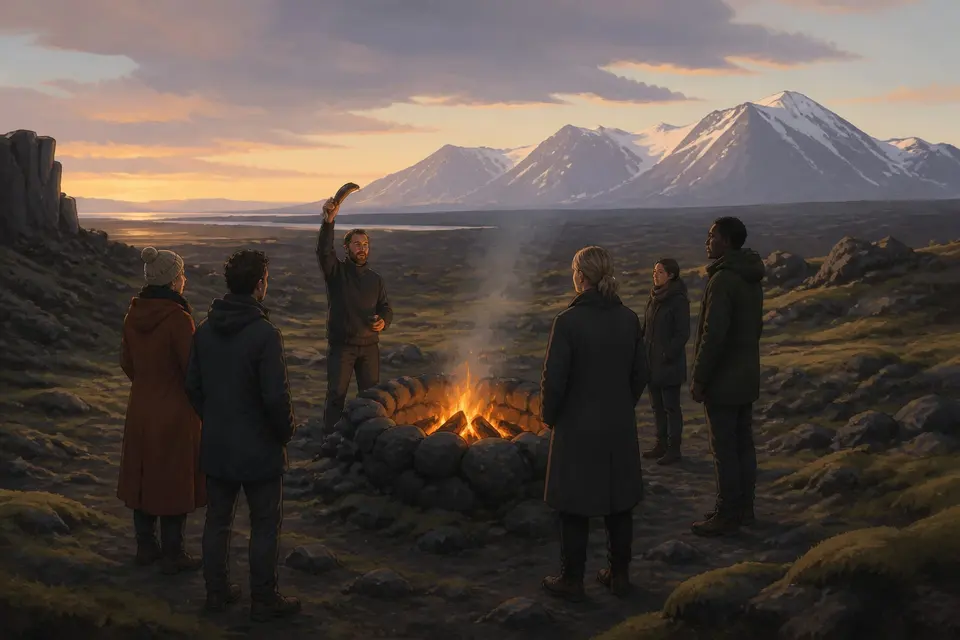
Yes, the Norse gods are still worshipped today, but by a small number of people. Modern Heathenry, also called Ásatrú, is a revival rebuilt from medieval texts, not an unbroken survival of Viking Age worship.
Ásatrú means "faith in the Æsir." In Iceland, the best-known group, Ásatrúarfélagið, honours gods such as Odin, Thor, Freyr and Freyja. For who these gods are in the sources, see The Norse Gods: Who Is Who in Asgard and Beyond.
Is this an unbroken tradition?
No. Scholars classify Heathenry as a new religious movement, and more precisely as a reconstructionist form of modern Paganism. It was put together from what survived.
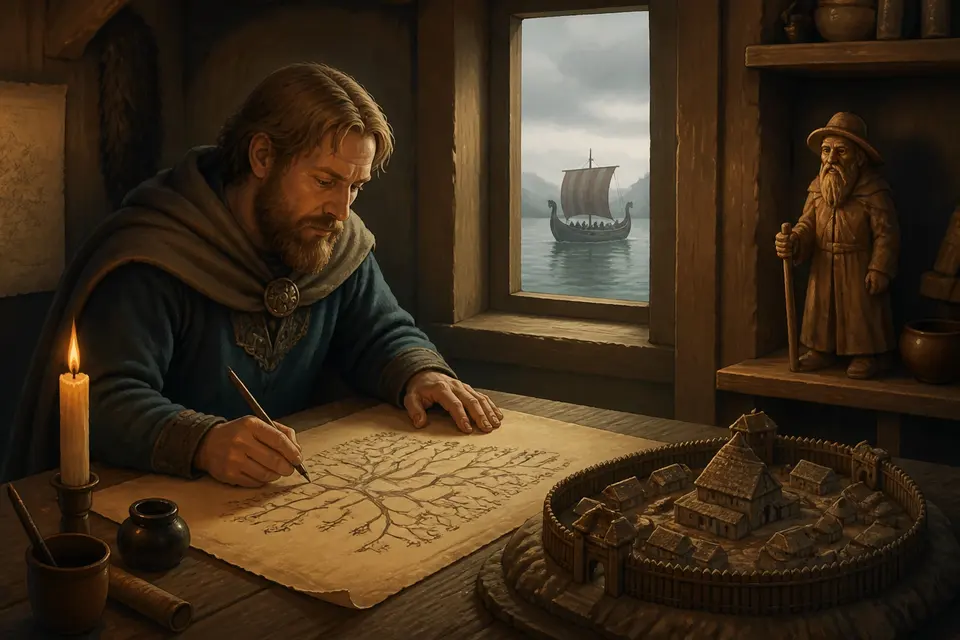
What survived is late. Most of what we know about Norse pagan belief comes from sources written down after the conversion, above all the Prose Edda and the Poetic Edda, whose surviving manuscripts date from the 13th century. Practitioners also draw on Beowulf and the Nibelungenlied. The Odin of those books, who gives an eye for wisdom, is described in Odin Gave an Eye for Wisdom.
Scholars differ on when the modern movement began. Organised forms emerged in the 1970s, with earlier Romantic and völkisch precursors, and one strand runs through writers such as Guido von List and his "Wotanism."
How did Iceland's Ásatrú group begin?
Ásatrúarfélagið was founded on the first day of summer in 1972. In 1973, after lengthy negotiations and over the objections of the Evangelical Lutheran Church of Iceland, the Ministry of Religious Affairs recognised it. Recognition let it conduct legally binding ceremonies and receive a share of the church tax. Sources give different dates in May 1973.
Sveinbjörn Beinteinsson, a farmer and poet, was a co-founder and the first allsherjargoði (chief priest). He led the group until his death in 1993. For most of that time it had no more than 100 members.
How many people follow the old gods?
Nobody knows exactly. Iceland has the clearest numbers, because members register. Statistics Iceland counted 3,583 members, a 244% rise since 2007. By 2018 the figure was 4,349, or 1.2% of the population. It is Iceland's largest non-Christian faith. But registered membership is not the same as belief.
Worldwide, counts are rough. The scholar Graham Harvey said in 2007 that an exact count is impossible. A self-selected census in 2013 found 16,700 Heathens in 98 countries, mostly in the United States. Stefanie von Schnurbein (2016) judged that there were probably no more than 20,000. These figures come from different methods and cannot simply be added to Iceland's registry. In the 2011 census of England and Wales, 1,958 people described themselves as Heathen.
Is there one organisation?
No. "Forn Sed" ("old custom") is not one body. Some Scandinavian writers use it as another name for Ásatrú or for Heathenry in general, while others use it for a distinct, more traditionalist stream. In Scandinavia the groups are separate:
Sweden's Samfundet Forn Sed Sverige, which began in 1994 as Sveriges Asatrosamfund and was registered in 2007, had 650 members in 2023. Norway's Forn Sed Norge was recognised as a religious body in 1999 and had 137 registered members in 2022. Denmark's Forn Siðr was established in 1997 and officially recognised in 2003, though one source gives 1999 for its formation.
The word "folkist" also means something different in Scandinavia from "folkish" in the American movement. Summaries of the research say the Forn Sed / Nordisk Sed stream in Scandinavia stresses living local tradition. They name Forn Sed Norge and the Swedish Samfälligheten för Nordisk Sed as proponents, and say both reject American Asatru.
Do they believe the myths literally?
Mostly not. Icelandic belief is varied. Some followers regard the gods as real beings, others value them mainly as culture, and others see them as symbols of natural and psychic forces. The group's high priest has said it does not read the medieval texts literally.
That also means the modern gods are not the screen versions. The hammer-swinging figure of the films differs from the one in the sources, as Thor in Myth vs. Thor in the Movies shows. The horned helmets of the popular image are another invention, covered in Vikings Never Wore Horned Helmets.
What about far-right groups?
Far-right use of Norse imagery is real, but it is not the movement as a whole. In the United States, the Asatru Folk Assembly, founded by Stephen McNallen, belongs to the "folkish" wing. Critics, including the Southern Poverty Law Center, the Anti-Defamation League and Heathen groups such as The Troth, argue that it is a hate group. American organisations as a whole span the political and spiritual spectrum. Heathens who hold folkish and far-right views tend to prefer the terms Odinism, Wotanism or Wodenism.
Michael Strmiska names staying welcoming to diversity as a key challenge for the Icelandic group, in opposition to the white-supremacist forms of Norse Paganism that developed in other countries.
The gods also live on in ordinary language, as Four Days of Your Week Are Named After Norse Gods explains. That is memory, not worship.
What we rely on
Ancient sources
- The Prose Edda (13th century), trans. Jesse L. Byock (2005).
- The Poetic Edda (13th century), trans. Carolyne Larrington (1996).
Modern scholarship
- Michael F. Strmiska, "Ásatrú in Iceland: The Rebirth of Nordic Paganism?", Nova Religio 4(1), 2000, pp. 106-132.
- Michael F. Strmiska and Baldr A. Sigurvinsson, "Asatru: Nordic Paganism in Iceland and America," in Modern Paganism in World Cultures, ed. Michael F. Strmiska (2005), pp. 127-180.
- Stefanie von Schnurbein, Norse Revival: Transformations of Germanic Neopaganism (Brill, 2016).
- Matthias Gardell, Gods of the Blood: The Pagan Revival and White Separatist Terrorism (Duke University Press, 2003).