The Norse gods are two families: the Æsir, led by Odin and including Thor, Frigg, Baldr, Týr and Heimdall, and the Vanir, whose best-known members are Njörðr, Freyr and Freyja, who fought a war against the Æsir and then made peace. Almost everything we know about them was written down in Iceland, about two centuries after Iceland became Christian.
In the 1070s, a German churchman named Adam of Bremen wrote a history of his archbishopric and, to explain what remained of paganism in the north, described a famous temple at Uppsala in Sweden. It was, he says, covered in gold, and inside it stood statues of three gods. Thor, the strongest, sat on a throne in the middle. Wodan, whom Adam translates as “fury” and who “carries on war,” stood on one side, and Fricco, who gives peace and pleasure to mortals, on the other. Adam was not there himself; he was told about it. But the picture is useful as a warning. If you only read the Icelandic books, Odin is the king of the gods. If we trust the report Adam was given of Uppsala, the god in the central seat was Thor.
So there is no single “Norse religion.” The gods below are the ones that show up in the surviving sources, and this guide will say which source each one comes from.
Two families, one war
The poem Völuspá, “the seeress’s prophecy,” remembers the first war in the world. A woman named Gullveig, often linked with the Vanir, is speared and burned three times in the hall of Odin. The Æsir gather on their thrones to ask whether they should pay tribute to the Vanir or share all the offerings. Odin hurls a spear into the host, the wall of the Æsir’s stronghold is broken, and the Vanir, with their magic, trample the field.
How the war ended is told by Snorri Sturluson in the Ynglinga saga. The two sides made peace and exchanged hostages. The Vanir sent Njörðr and his son Freyr. The Æsir sent Hœnir, a handsome god who could not make a decision without help, and with him Mímir, the wisest of them. When the Vanir noticed that Hœnir never gave an answer unless Mímir was beside him, they felt cheated, cut off Mímir’s head and sent it back. Odin kept the head, preserved it with herbs, and consulted it for hidden knowledge. In another telling, in Snorri’s Prose Edda, the two sides sealed the truce by spitting into a vat, and from the spittle the gods made a man named Kvasir, the wisest of all.
After that, Njörðr, Freyr and Freyja live among the Æsir and are counted as gods in the same company. For the homes of the two families, see The Nine Realms of Norse Mythology, Explained.
The Æsir
| God | Known for | Where to read more |
|---|---|---|
| Odin (Óðinn) | Wisdom, poetry, runes, war and the dead; the chief of the gods in the Icelandic sources | Odin Gave an Eye for Wisdom |
| Thor (Þórr) | Thunder; the strongest of gods and men, and the defender against the giants; his hammer is Mjölnir | Thor in Myth vs. Thor in the Movies |
| Frigg | Odin’s wife; she knows the fates of all, though in one poem we are told she does not speak of them | Four Days of Your Week Are Named After Norse Gods |
| Baldr | The best-loved of the gods; his death is a turning point on the road to Ragnarök | What Is Ragnarök? |
| Týr | A god of war and, in the view of many scholars, of law and oaths; he lost his hand to the wolf Fenrir | Fenrir and the Ribbon Made of Things That Do Not Exist |
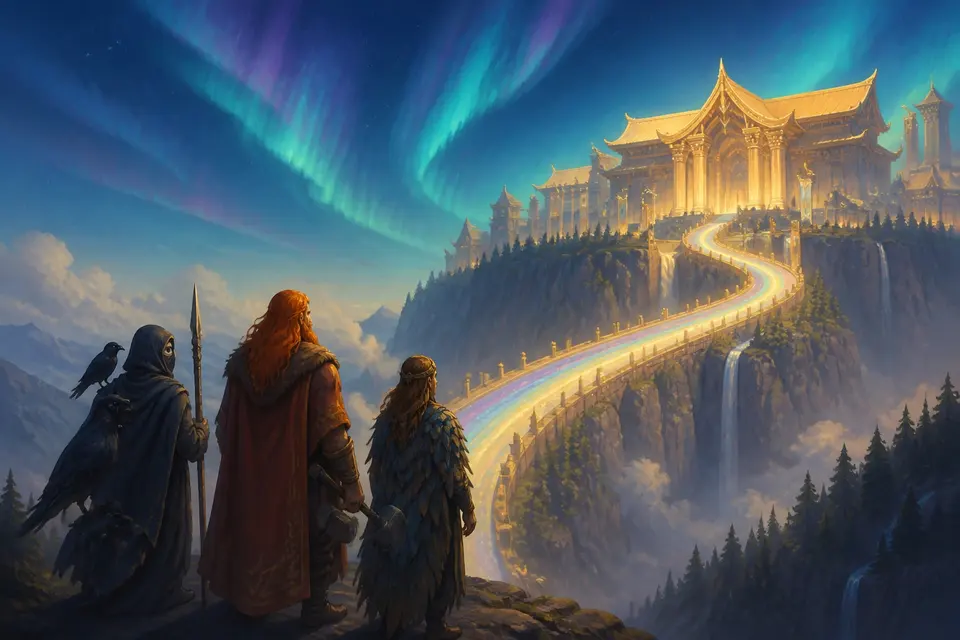
| Heimdall | The watchman of the gods, who guards the rainbow bridge and will sound his horn at Ragnarök | What Is Ragnarök? |
| Loki | A trickster of giant birth whom Snorri counts among the Æsir; Odin’s blood brother, and the cause of Baldr’s death | Loki: The Trickster Who Changes Shape and Is Friday the 13th Really Loki’s Fault? |
| Bragi | The god of poetry; his wife is Iðunn, keeper of the apples that keep the gods young | |
| Víðarr | “The silent god,” a son of Odin who avenges his father at Ragnarök and survives it | What Is Ragnarök? |
| Ullr | A god linked in Snorri with archery and skiing, whose name appears in oaths |
Thor is the one with the most to show for him outside the books. Hundreds of small hammer pendants, worn by Viking Age people, survive in graves and hoards, and a small bronze figure found in Iceland, usually identified as Thor, sits gripping a hammer-shaped object.
The Vanir
The Vanir are, in the sources, a family of gods of wealth, fertility and the sea.
- Njörðr is the god of the sea, the winds and wealth. Snorri tells that he was raised among the Vanir, came to the Æsir as a hostage, and married a giantess named Skadi, who wanted a home in the mountains while he wanted the shore. They could not agree where to live.
- Freyr gives rain, sunshine and the harvest, and is a god of peace and plenty. In the poem Skírnismál, he falls in love with a giantess, Gerðr, and gives away his sword to win her. The sword is missing at Ragnarök.
- Freyja is the goddess of love and desire, owner of a famous necklace, and the one who taught the other gods the magic of the Vanir, seiðr. The poem Grímnismál adds a surprise: when warriors die in battle, Freyja chooses half of them for her hall, and Odin gets the other half.
Giants, and gods who are half giants
The gods are not a separate species from their enemies. Skadi and Gerðr are giantesses who marry gods. Loki’s father is a giant, and Loki’s children, the wolf Fenrir, the world serpent Jörmungandr and Hel, ruler of the dead, are the monsters the gods fear most. Hel is not simply the Christian hell: she is a goddess who keeps the dead who did not die in battle, in the realm named after her. For the beginning of this story, see A Cow, a Giant and a Skull Sky: How the Norse World Began.
Frigg or Freyja?
They are often mixed up, and not only by modern readers. They are two figures in the sources: Frigg is Odin’s wife and Baldr’s mother, and Freyja is the Vanir goddess of love and magic. Friday is named for one of them, and it is debated which. That puzzle belongs to the story of the days of the week, and we tell it there.
Where the stories come from
Almost nothing about the Norse gods was written down by the people who worshipped them. Iceland became Christian around the year 1000, and the main books were written afterward.
- The Poetic Edda is a collection of anonymous poems, preserved mainly in a manuscript from about 1270. Some poems are thought to be much older than the manuscript, but dating them is debated.
- The Prose Edda was written around 1220 by Snorri Sturluson, an Icelandic chieftain and poet, as a handbook for poets who needed to understand old verse. It is also a source for the poems, and he organized his material in a way that can look more tidy than the original.
- Poems by court poets, the skalds, are older still in parts, and give some of the names and the myths in compressed form.
- Outside Scandinavia, the main sources are brief: Adam of Bremen on Uppsala, and the Roman writer Tacitus, who in the first century CE reported that the Germanic peoples worshipped gods he compared with Mercury, Hercules and Mars.
The gods belong to many peoples over a long time. The Viking Age alone lasted about three centuries, and people in Norway, Iceland, Sweden and Denmark did not worship the same gods in the same way.
Quick answers
- Who is the strongest Norse god? According to Snorri, Thor is the strongest of all gods and men. Odin is the wisest and the highest in rank, but not the strongest.
- Is Odin really the king of the gods? In the Icelandic poems, yes: he is the “All-Father.” In the other evidence, such as the temple at Uppsala and the many personal names built on Thor’s name, Thor seems at least as important to ordinary people.
- Is Loki a god? It depends who is telling the story. By birth he is a giant, the son of Fárbauti and Laufey. Snorri counts him among the Æsir, and in the poem Lokasenna he is a guest at the gods’ feast, where he insults most of them.
- Is Hel the Norse hell? Not quite. Hel is both a person, Loki’s daughter, and a place, the realm of those who die of illness or old age. In most sources it is gloomy rather than a place of torment, though Snorri, who was a Christian, also describes a place where the wicked suffer, so the picture is mixed.
What we rely on
Primary sources
- The Poetic Edda (Codex Regius, about 1270): Völuspá 21-24 (the first war), Grímnismál 14 (Freyja’s share of the slain), Skírnismál, Lokasenna 29 (Frigg’s knowledge of fate). Translation: Carolyne Larrington, The Poetic Edda (Oxford World’s Classics, 1996; rev. 2014).
- Snorri Sturluson, Edda (about 1220), especially Gylfaginning (chapters on Njörðr, Freyr, Freyja and the other gods) and Skáldskaparmál (the origin of Kvasir). Translation: Anthony Faulkes, Edda (Everyman, 1987), or Jesse Byock, The Prose Edda (Penguin, 2005).
- Snorri Sturluson, Heimskringla, Ynglinga saga chapter 4 (the war and the hostages). Translation: Alison Finlay and Anthony Faulkes, Heimskringla, vol. 1 (Viking Society for Northern Research, 2011).
- Adam of Bremen, History of the Archbishops of Hamburg-Bremen 4.26-27 (the temple at Uppsala). Translation: Francis J. Tschan (Columbia University Press, 1959).
- Tacitus, Germania 9 (the gods of the Germanic peoples).
Modern scholarship
- John Lindow, Norse Mythology: A Guide to the Gods, Heroes, Rituals, and Beliefs (Oxford University Press, 2001): an A to Z of the figures in the sources.
- Rudolf Simek, Dictionary of Northern Mythology, translated by Angela Hall (D. S. Brewer, 1993).
- Margaret Clunies Ross, A History of Old Norse Poetry and Poetics (D. S. Brewer, 2005): how the sources came to be and how to read them.
- Neil Price, The Viking Way: Magic and Mind in Late Iron Age Scandinavia, 2nd ed. (Oxbow, 2019): what archaeology says about Viking Age religion.