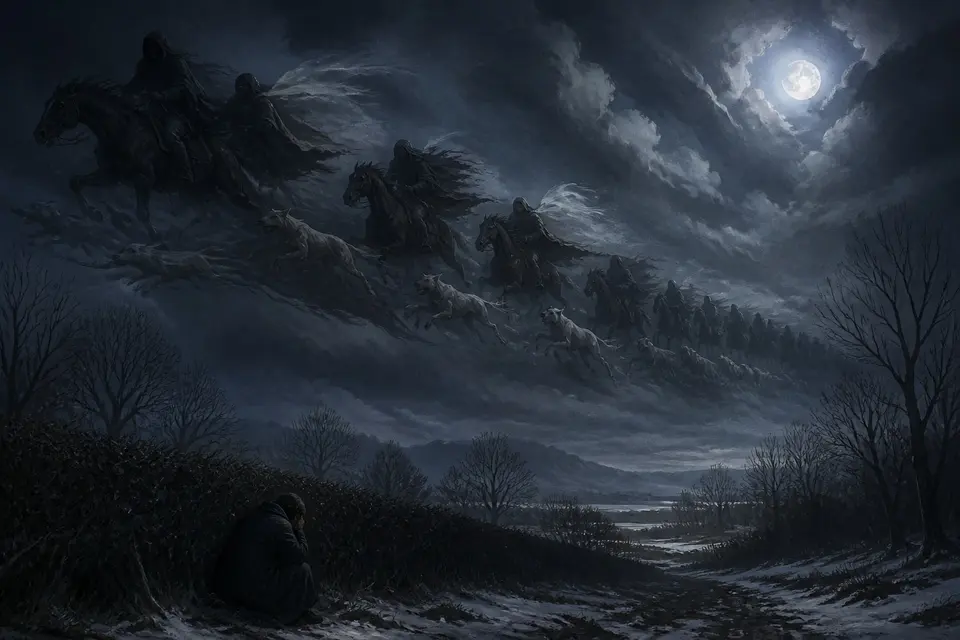
The Wild Hunt is the name for tales of a ghostly host that sweeps through the night, sometimes with hounds, sometimes made up of the dead. It is an umbrella term for several medieval and later traditions, not one ancient Norse myth, and its famous link to Odin is a nineteenth-century theory.
What do the earliest accounts describe?
On the moonlit evening of 1 January 1091, a priest named Walchelin was walking home at Bonneval, in the diocese of Lisieux, when he heard a sound like a great army. The chronicler Orderic Vitalis wrote the story down in the 1130s, from the priest's own report, and says he saw the scar on Walchelin's neck. The host Walchelin saw was called the familia Herlechini, the household of Herlechin. Scholars such as Jean-Claude Schmitt treat this as the first clear, explicit mention of the familia Herlechini.
It is not a hunt. The riders are the punished dead: women on saddles studded with burning nails, clergy, knights. Orderic mentions no hounds and no quarry.
Hunters appear in the Peterborough Chronicle for 1127. The monks resented their new abbot, Henry of Poitou, and soon after he arrived people reported seeing and hearing huntsmen. They were black and huge, riding black horses and black he-goats, with black hounds whose eyes were as wide as saucers. The sightings were said to last from his arrival through Lent to Easter. This is the earliest English account that actually has huntsmen and hounds.
Walter Map, writing between about 1182 and 1191, tells of a silent night-riding company, the "Herlethingus." Its origin story begins with an ancient British king, Herla, who visits the otherworld at the invitation of a pygmy-like king. When Herla returns, about two hundred years have passed and the Saxons hold the kingdom. His party cannot dismount. They were last seen on the borders of Wales and Hereford in 1154. One scholar argues that Map's longer version is his own blend of traditional material, so how old the story is remains open.
Did Odin lead the Wild Hunt?
That claim goes back to Jacob Grimm, who gathered tales of the host in Deutsche Mythologie (1835) and popularised the label (some scholars say he coined it). Grimm believed the stories were a survival of Germanic paganism and suggested the leader was Wodan, or Odin, or a female figure such as Holda or Berchta.
The Norse texts do not back him up. The Eddas contain no Wild Hunt tale. They do have Odin on his eight-legged horse Sleipnir, the Valkyries who gather the slain, and the dead warriors who fight at Ragnarök, but these are at best a parallel, not a version of the story. For Odin as the Norse sources present him, see Odin Gave an Eye for Wisdom.
Medieval German evidence is thin and ambiguous. Grimm cited a phrase, "bi Wuotunges her" ("with Wuotan's army"), from an unprinted poem, and a later charm is disputed: one reading gives "wütende" ("furious"), another "Wotan." The fair summary is that the medieval evidence is late and uncertain, not that it is absent. Odin as leader of the Hunt in pagan times is Grimm's inference, not an attested fact.
Is the Wild Hunt one myth or several?
Scholars disagree. Ronald Hutton argues that the modern idea of a single "Hunt" was built by Grimm, who merged different medieval traditions with later folklore. Hutton separates a procession of the dead, a lone spectral huntsman who is demonic or accursed, and a company of female spirits led by a supernatural woman. Claude Lecouteux, the main counterweight, still assumes there was once a unified phenomenon.
Nobody has shown a single pan-European pre-Christian Wild Hunt myth. What survives are separate medieval reports, with different leaders, different riders and different purposes.
Where do Herne and Gabriel's Hounds fit?
Herne the Hunter first appears in Shakespeare's The Merry Wives of Windsor, around 1597. It is impossible to know how far Shakespeare drew on a real local legend, and there is almost no written evidence for Herne until the 1840s. Folklorists treat him as a local version of the wild huntsman, but that is a classification, not proof of descent. The claim that he is an ancient horned god is unsupported.
Gabriel's Hounds, or Gabriel Ratchets, are a northern English tradition from Durham, Lancashire and Yorkshire. The name is first recorded around 1665. It may come from the Angel of Death, from the "gabble" of geese, or from a medieval word for a corpse. Henderson (1879) blamed the cries of migrating wild fowl. The version in which the angel Gabriel hunts the damned is known from a mid-nineteenth-century Derbyshire belief.
Why do we picture Odin on Sleipnir?
Much of that picture is modern. Peter Nicolai Arbo painted Wild Hunt of Odin in 1872, and Guerber's Myths of the Northern Lands (1895) wrote Odin and Sleipnir into the story. Both made the Odin image stick. It is a little like the horned helmet, another popular picture that comes from later art (see Vikings Never Wore Horned Helmets). For the gods who do appear in the Norse sources, start with The Norse Gods: Who Is Who in Asgard and Beyond.
What we rely on
Ancient sources
- Orderic Vitalis, Historia Ecclesiastica 8.17 (Walchelin's vision). Edited and translated by Marjorie Chibnall, The Ecclesiastical History of Orderic Vitalis, vol. IV (Oxford Medieval Texts, Clarendon Press, 1973).
- The Peterborough Chronicle, entry for 1127 (Bodleian Library MS Laud Misc. 636).
- Walter Map, De nugis curialium (Herla and the Herlethingus). Edited by F. Tupper and M. B. Ogle (Chatto & Windus, 1924).
Modern scholarship
- Jacob Grimm, Deutsche Mythologie (Dieterich, 1835).
- Ronald Hutton, "The Wild Hunt and the Witches' Sabbath," Folklore 125.2 (2014): 161-178.
- Claude Lecouteux, Phantom Armies of the Night: The Wild Hunt and the Ghostly Processions of the Undead (Inner Traditions, 2011).