The myth of Cassandra is the story of a Trojan princess, daughter of King Priam, who was given the power to foresee the future but was fated never to be believed. In the fullest ancient telling, the god Apollo is behind the curse, and she dies at Mycenae after Troy falls.
What does Homer say about Cassandra?
Less than most people expect. In the Iliad she is the most beautiful of Priam's daughters, but she is not a prophetess. A warrior named Othryoneus asks for her as his bride and offers no bride-price, only a promise to drive the Greeks from Troy. Idomeneus kills him (13.363-382). Later she is the first to see Priam bringing Hector's body home, and she calls the whole city out to look. Homer compares her to golden Aphrodite (24.699-706).
The prophecy and the curse are not in the Iliad. Homer knows one more thing about her: in the Odyssey, the ghost of Agamemnon says that Clytemnestra killed her too (11.421-423).
How did she get her gift, and why was she not believed?
The ancient sources give more than one reason, and they should be kept apart.
The handbook version is in the Library attributed to Apollodorus (3.12.5), a work probably written in the first or second century AD. Apollo wanted her and promised to teach her prophecy. She learned the art, then refused him, so he took away the power of her prophecy to persuade. The gift was not withdrawn, only the belief.
Aeschylus, in his Agamemnon (458 BC), has Cassandra say that she agreed to Apollo and then broke her word, and afterward could persuade no one (1202-1212). He says only that she agreed to Apollo and then broke her word. Some translators supply "marriage", but the text does not spell out the terms of the bargain.
The Latin mythographer Hyginus (Fabulae 93) tells a third version. She fell asleep in Apollo's shrine while the god tried to take her, did not yield, and was therefore never believed though her prophecies were true.
A fourth tradition has no bargain at all. Scholiasts, ancient commentators, say that Cassandra and her brother Helenus were left overnight in the temple of Apollo Thymbraeus and that in the morning snakes were seen licking their ears. That is a separate explanation of her gift, known only from scholia and later writers.
Is she the one who warned about the Trojan horse?
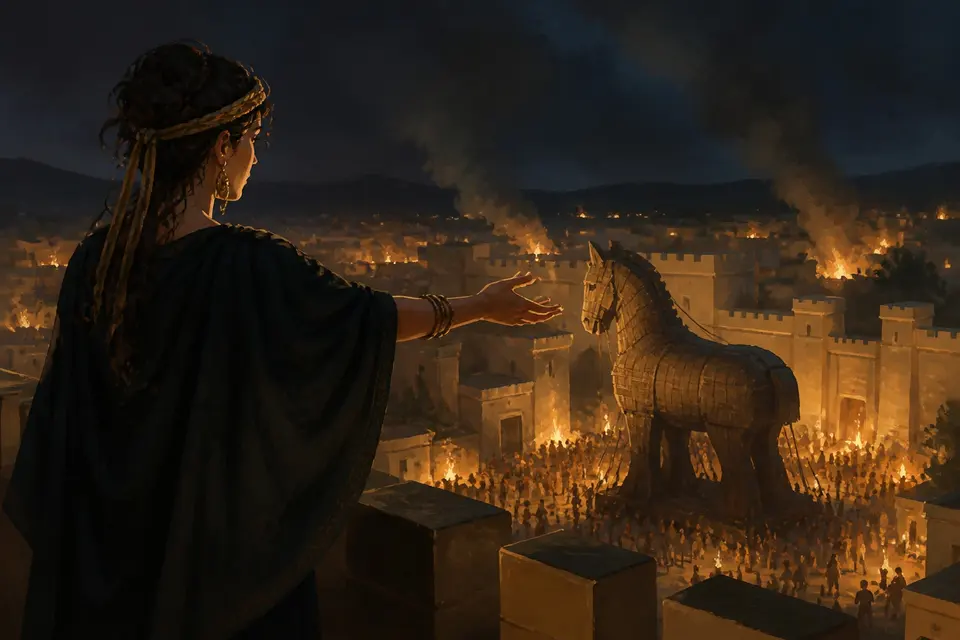
Not in the earliest sources. Virgil already has her speaking of the coming doom as the horse is brought in, though by a god's command the Trojans never believed her (Aeneid 2.246-247). The Epitome of Apollodorus (5.17) is the clearest surviving source in which she says armed men are inside it, with the seer Laocoön backing her. Whether she was at the horse in the lost epic Little Iliad is disputed, since she is absent from Proclus' summary of it.
"Beware of Greeks bearing gifts" is not hers either. In the Aeneid it is Laocoön's warning (2.49).
For the war around her, see Was the Trojan War Real?. For the Roman poet who gave the horse its most famous telling, see Aeneas: The Refugee Who Founded Rome.
What happened to her when Troy fell?
Our knowledge of the lost epic Iliou Persis comes from Proclus' summary. In it, Ajax the Lesser, a Locrian leader, is accused of an outrage at the sack. The Greeks resolve to stone him, but he escapes by taking refuge at the altar of Athena. Later writers such as Pausanias add that Odysseus urged the stoning and that Ajax swore an oath. In Virgil, Cassandra is dragged from Minerva's temple with her hair streaming (Aeneid 2.403).
Whether the older tradition included sexual assault is debated. Some argue that the oldest sources only say he "seized" or "dragged" her, and that the first explicit allusion to rape is in Lycophron's poem Alexandra (3rd century BC). Other scholars say rape was already in the older tradition. In the Library (Epitome 5.22), Ajax violates Cassandra as she clings to the wooden image of Athena. As the Greeks prepare to sail, Calchas tells them Athena is angry at Ajax's impiety, and Ajax escapes being killed only by fleeing to an altar. Scholia add that the Locrians later had to send two girls to Troy every year to serve Athena, but these brief notes do not prove that such a ritual existed.
Cassandra then goes home to Mycenae as Agamemnon's captive. In Homer, Aegisthus kills Agamemnon with Clytemnestra's help. In Aeschylus, Clytemnestra does it herself, and calls Cassandra a "delicacy for my bed" (1438-1447). Aeschylus gives Cassandra the longest scene. She is silent until she is alone with the Chorus, then cries out to Apollo and foretells both murders. She tears off the sceptre and fillets of a seer and walks into the palace knowing she will die (1264-1330).
Euripides' Trojan Women (415 BC) gives her a different role. Sabina Mazzoldi argues that Euripides presents Cassandra differently from Aeschylus. He uses maenadic vocabulary for her but treats her divination as mediated clairvoyance more than as ecstatic inspiration.
Where does the name come from, and what is the "Cassandra complex"?
She is also called Alexandra. Pausanias reports cults of Alexandra at Amyclae and Leuctra, identified with Cassandra (3.19.6, 3.26.5).
The "Cassandra complex" is modern, not an ancient or clinical term. It is usually credited to the French philosopher Gaston Bachelard in 1949, though the original passage is hard to pin down. Melanie Klein read Cassandra as a figure of the moral conscience in 1963. Laurie Layton Schapira gave the Jungian sense in 1988. It is not a formally recognised diagnosis. The adjective is older: the OED is reported to record "Cassandra like" from 1670 and the hyphenated "Cassandra-like" from 1863.
Apollo was a god of prophecy, and his oracle at Delphi was the great Greek centre of the art. See The Oracle of Delphi: Who Spoke for Apollo? and, for the god and his family, The Twelve Olympian Gods: Who They Are and How They Are Related. The goddess whose statue Cassandra clung to is Athena, and the Roman Minerva of Virgil is not simply a renamed Athena: see Greek and Roman Gods, Side by Side (and Why They Are Not Just Renamed).
What we rely on
Ancient sources
- Homer, Iliad 13.363-382 and 24.699-706; Odyssey 11.421-423.
- Aeschylus, Agamemnon (458 BC), lines 1072-1330 and 1438-1447. Translation: Herbert Weir Smyth.
- Apollodorus, The Library, 3.12.5 and Epitome 5.17, 5.22 and 6.23. Translation: J. G. Frazer, Loeb Classical Library 121-122 (Harvard University Press, 1921), or Robin Hard, The Library of Greek Mythology (Oxford World's Classics, 2008).
- Virgil, Aeneid 2.
Modern scholarship
- Sabina Mazzoldi, Cassandra, la vergine e l'indovina: identità di un personaggio da Omero all'ellenismo (Pisa and Rome, 2001).
- Laurie Layton Schapira, The Cassandra Complex: Living with Disbelief (Inner City Books, 1988).