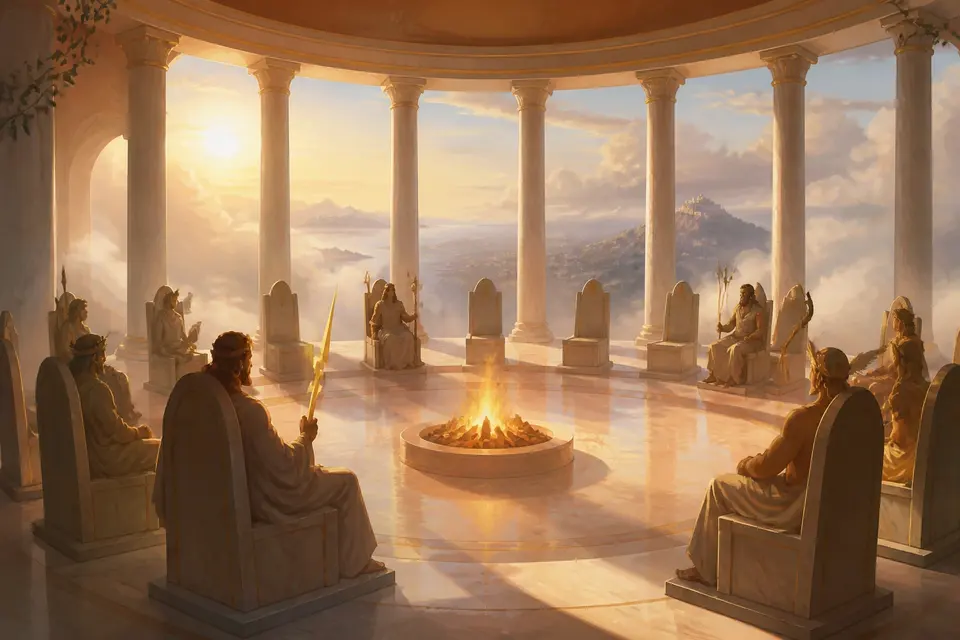
The twelve Olympians are the main gods of Greek religion, the ones imagined as living on Mount Olympus under Zeus: Zeus, Hera, Poseidon, Demeter, Athena, Apollo, Artemis, Ares, Aphrodite, Hephaestus, Hermes, and either Hestia or Dionysus. The Greeks agreed on the number twelve far more than they agreed on the names.
Around 522 BCE, in the northwest corner of the Athenian marketplace, a man named Peisistratos, the grandson of the tyrant of the same name, dedicated an altar to the Twelve Gods during his year as the city’s chief magistrate. Thucydides, writing about a century later, tells us so. It became the center of Athens in a very literal way: Herodotus uses it as the starting point when he measures a journey, and he describes a group of refugees, the people of Plataea, who sat down at it as suppliants and asked Athens for protection. And yet the surviving accounts of the altar, by Thucydides and Herodotus, do not say which twelve gods it honored, and modern scholars treat the list as uncertain. Thucydides adds that the Athenians later enlarged the altar and covered up its inscription.
That is the first thing to know about the Olympians. The number was a fixed point of Greek worship. The roll call was not.
The twelve at a glance
This table follows the usual account, the one in Hesiod’s Theogony (about 700 BCE). Where the sources disagree, the next sections say so.
| God | Best known for | Parents |
|---|---|---|
| Zeus | Sky, thunder, kingship | Cronus and Rhea |
| Hera | Marriage, queen of the gods | Cronus and Rhea |
| Poseidon | The sea, earthquakes, horses | Cronus and Rhea |
| Demeter | Grain, harvest, the Eleusinian Mysteries | Cronus and Rhea |
| Athena | Wisdom, crafts, strategy in war, the city of Athens | Zeus (born from his head) |
| Apollo | Music, prophecy, healing, archery | Zeus and Leto |
| Artemis | The hunt, wild animals, girls and childbirth | Zeus and Leto |
| Ares | War as frenzy and bloodshed | Zeus and Hera |
| Aphrodite | Love and desire | Born from the sea foam (Hesiod), or Zeus and Dione (Homer) |
| Hephaestus | Fire, metalwork, craftsmen | Hera alone (Hesiod), or Zeus and Hera (Homer, according to Apollodorus) |
| Hermes | Messengers, travelers, boundaries, thieves, guide of the dead | Zeus and Maia |
| Hestia or Dionysus | The hearth; or wine, ecstasy and theater | Cronus and Rhea; or Zeus and Semele |
Who is the twelfth?
Count the names in the opening paragraph and you get thirteen. The reason is that Hestia and Dionysus compete for one seat, and the ancient evidence does not settle it.
Plato, in the Phaedrus, pictures the gods riding across the sky behind Zeus in eleven companies while Hestia alone stays at home in the house of the gods. On the east side of the Parthenon, carved about 440 BCE, twelve gods sit in two groups of six; the usual reading finds Dionysus among them and no Hestia, though the identity of some figures is still argued. At Olympia, the great sanctuary of Zeus, the travel writer Pausanias saw altars shared by pairs of gods. Some pairs are Olympians (Zeus and Poseidon, Apollo and Hermes), but others are not: Artemis shared an altar with a river god, Alpheios, and Dionysus with the Graces.
So the twelve was a convention that different places filled in differently. A list that claims to be “the official one” is a tidy-up made by later writers, and a useful one for beginners, but not something any Greek would have recognized as the only version.
The family tree
Almost all of them are one family, and the family is a strange one.
At the top are Cronus and Rhea. In Hesiod’s story, Cronus swallowed each child as it was born, so that none of them could overthrow him. The first six were Hestia, Demeter, Hera, Hades, Poseidon and, last, Zeus. Rhea hid the youngest on Crete, gave Cronus a stone wrapped in cloth to swallow instead, and Zeus grew up, forced his father to bring the others back up, and led them in a ten-year war against the Titans. The winners divided the world. In Homer’s version of the division, told by Poseidon himself, the three brothers drew lots: the sea went to Poseidon, the dark underworld to Hades, and the wide sky to Zeus, while the earth and Olympus were left to all of them in common.
Four of the twelve belong to that first generation: Zeus, Hera, Poseidon and Demeter, along with Hestia if she takes the twelfth seat. Hades, the sixth sibling, is the one who is not on the list, and the reason comes in a moment. Most of the others are Zeus’s children, and their births are not ordinary:
- Athena has no mother. Zeus swallowed his first wife, Metis, whose name means “cunning counsel,” and Athena came out of his head.
- Apollo and Artemis are twins, children of Zeus and the Titan Leto.
- Hermes is the son of Zeus and Maia, a daughter of the Titan Atlas.
- Dionysus is the son of Zeus and a mortal woman, Semele, which makes him the only Olympian with a human parent.
- Ares is the son of Zeus and Hera.
- Hephaestus is Hera’s son, but the sources disagree about the father. Hesiod says she bore him without Zeus, as a reply to Athena’s birth. The later handbook of Apollodorus says that in Homer he is the son of both.
- Aphrodite has two origins. In Hesiod she is born from the foam that gathered around the severed genitals of the sky god Uranus, which makes her older than Zeus. In Homer she is simply the daughter of Zeus and a goddess named Dione.
One more strange fact: the Greeks did not agree on who was oldest. In Hesiod, Zeus is the last-born. In the Iliad, the narrator says that Zeus and Poseidon share the same parentage, but that Zeus was the elder born and the wiser (13.354-355).
Why Hades is not on the list
Hades is Zeus’s brother and a son of Cronus and Rhea, so by birth he belongs. He is missing because he does not live on Olympus. The god of the dead rules a kingdom under the earth, and Greek worship kept his cult apart from that of the gods of the sky. Greek speakers often used softer names for him instead of his own, such as Plouton, “the Rich One,” or “the Host of Many.” If you want his story, it is not the one the devil’s reputation suggests; see Hades Is Not the Devil.
The twelve, one at a time
This is a map of the other stories on this site. Each paragraph names one fact and sends you to the full story.
Zeus. Ruler of the gods and, depending on the poem, the only one who could not quite escape fate. The Greeks honored him with one of their greatest Panhellenic festivals, the Olympic Games (The Ancient Olympics Were a Festival for Zeus), and Greek poets never settled whether he or the Fates held the higher power (The Three Fates Who Even Zeus Obeyed).
Hera. Queen of the gods, protector of marriage, and one of the three goddesses who competed to be “the fairest” and lost to Aphrodite (The Apple of Discord). Her anger shapes most of the life of Hercules, from his madness to his labors (Why Hercules Really Had to Do the Twelve Labors).
Poseidon. Lord of the sea, but also of earthquakes and of horses. A bull he sent from the sea is behind the monster in the labyrinth of Crete (The Minotaur and the Real Labyrinth of Knossos).
Demeter. The goddess of grain, and the mother who turned the world to winter when her daughter was taken (Persephone and the Pomegranate).
Athena. The patron of Athens, of weaving and of clever plans. In one Roman version of the Medusa story she is also the one who changes Medusa’s hair into snakes (The Real Story of Medusa).
Apollo. The god of prophecy, whose oracle at Delphi was consulted by kings and cities for centuries (The Oracle of Delphi: Who Spoke for Apollo?).
Artemis. Apollo’s twin and the goddess of the wild. She is still at work in the modern world: when NASA named its program to return people to the Moon, it chose her name, as it had chosen her brother’s for the first landings (Nike, Pandora, Versace and Starbucks: Brands Hiding Myths in Plain Sight).
Ares. The god of war, and not a favorite. In the Iliad, Zeus tells him to his face that he is the most hateful of all the gods who live on Olympus. Ares had far fewer major cults than Athena, who stood for strategy where he stood for slaughter.
Aphrodite. The goddess of love, and one of the three goddesses in the contest that began the Trojan War (The Apple of Discord). Her jealousy sets the trials of a mortal girl in Cupid and Psyche, a story the Romans told.
Hephaestus. The god of the forge, who works with his hands. In Hesiod, he molds the first woman out of clay on Zeus’s orders (Pandora’s Box Was Never a Box).
Hermes. The messenger, the god of travelers and thieves, and the one who guides the dead to the underworld, which makes him the Olympian most often seen moving between the two worlds. The Greeks matched him with the Egyptian god of writing, Thoth (Thoth and the Invention of Writing).
Dionysus (or Hestia). Dionysus is the god of wine and of the theater, and he is the god who grants the king in the story of Midas his famous, disastrous wish (King Midas Was a Real Name). Hestia, the goddess of the hearth, almost never appears in myths at all, because her job was to stay put: she was honored with the first offering in a Greek household.
Quick answers
- Did all the gods live on Olympus? No. Olympus was a mountain in northern Greece, about 2,900 meters high, and in the poems it is the gods’ palace, but the other gods came and went. In the Iliad, Hebe pours the nectar and the Muses sing at the gods’ feast, and neither is counted among the twelve.
- Why twelve? Nobody knows. Twelve was a favorite number for Greek groups: the Ionian cities of the Aegean coast formed a league of twelve, for example. The Athenian altar of about 522 BCE is one of the earliest dated monuments to a group of twelve gods.
- Are the Roman gods just these twelve with new names? Not exactly. The Romans had their own gods, and later matched many of them with Greek ones. The differences are bigger than the table suggests; we cover them in the next guide, Greek and Roman Gods, Side by Side.
- Who are the Titans, and how are they different? The Titans are the older generation, the children of Uranus and Gaia, among them Cronus and Rhea. The Olympians are their children, and the story of how the younger generation took power is the first great war in Greek myth.
What we rely on
Ancient sources
- Hesiod, Theogony (about 700 BCE): the births of the gods, lines 116-1022. Translation: Glenn W. Most, Loeb Classical Library 57 (Harvard University Press, 2006).
- Homer, Iliad (the division of the world, 15.187-193; Zeus on Ares, 5.889-898; Zeus “elder born,” 13.354-355; the feast on Olympus, 1.595-604 and 4.1-4). Translation: A. T. Murray, rev. William F. Wyatt, Loeb Classical Library 170-171 (1999).
- Plato, Phaedrus 246e-247a (the procession of the gods).
- Herodotus, Histories 1.142 (the Ionian league of twelve cities), 2.7 and 6.108 (the altar of the Twelve Gods as a starting point for measuring and a place of refuge).
- Thucydides, History of the Peloponnesian War 6.54 (the dedication of the altar).
- Pausanias, Description of Greece 5.14 (the altars at Olympia). Translation: W. H. S. Jones, Loeb Classical Library (1918-1935).
- Apollodorus, Library 1.3.5 (the two accounts of Hephaestus’s parentage). Translation: J. G. Frazer, Loeb Classical Library (1921).
Modern scholarship
- Walter Burkert, Greek Religion, translated by John Raffan (Harvard University Press, 1985): the standard survey of Greek cult, including the Twelve Gods.
- Jenifer Neils, The Parthenon Frieze (Cambridge University Press, 2001): the identification of the figures on the east frieze, and the debates around them.
- Timothy Gantz, Early Greek Myth: A Guide to Literary and Artistic Sources (Johns Hopkins University Press, 1993): the sources for every genealogy in this guide.
- M. L. West, ed., Hesiod: Theogony (Oxford University Press, 1966): the commentary on the births of the Olympians.
- Robert Parker, Polytheism and Society at Athens (Oxford University Press, 2005): how Athenian cults were organized.