Many Roman gods were matched with Greek ones: Jupiter with Zeus, Juno with Hera, Neptune with Poseidon, Minerva with Athena. But they were not copies with new names. Each Roman god had its own origin, its own cult and its own job in the life of the city, and some, such as Janus, had no Greek counterpart at all.
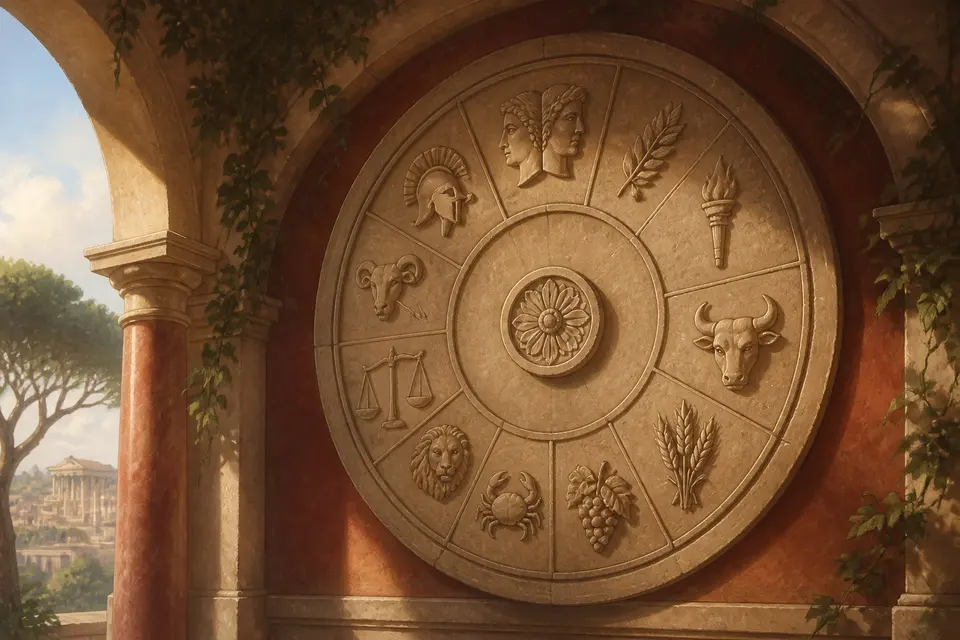
In the summer of 217 BCE, the Roman army had just been destroyed at Lake Trasimene by Hannibal, and the city was frightened. The Senate looked to the gods. According to the historian Livy, it ordered, among other rites, a lectisternium, a banquet laid out for the gods themselves, with statues placed on couches. Six couches were set out, for six pairs of gods: Jupiter and Juno, Neptune and Minerva, Mars and Venus, Apollo and Diana, Vulcan and Vesta, Mercury and Ceres.
Look closely and you can see two things at once. These are the twelve gods the Greeks call Olympians, in Roman dress. But only three of the pairs match a Greek relationship: Jupiter and Juno are husband and wife, Mars and Venus are lovers in Greek myth, and Apollo and Diana are twin siblings, as Apollo and Artemis are. The other three do not. Neptune and Minerva are rivals in Athenian myth. Vulcan and Vesta have no such link in Greek stories, and Mercury and Ceres share only a minor one, Hermes’ part in bringing Persephone back to Demeter. In 217 BCE the Romans were not copying a Greek list. They were arranging their own gods, in a Greek-style ritual, in their own way.
The table
Treat every match in this table as approximate. It is the Roman side of the matching, as it was done by Roman poets and by the Romans who wrote about religion, and it was done in more than one way over the centuries.
| Greek | Roman | What Rome did with it |
|---|---|---|
| Zeus | Jupiter | The god of the state, worshipped on the Capitoline Hill with Juno and Minerva |
| Hera | Juno | Guardian of women and, as Juno Moneta, a goddess whose temple housed the mint |
| Poseidon | Neptune | Lord of the sea; his festival fell in the dry heat of July |
| Demeter | Ceres | A grain goddess with her own temple on the Aventine, the plebeians’ hill |
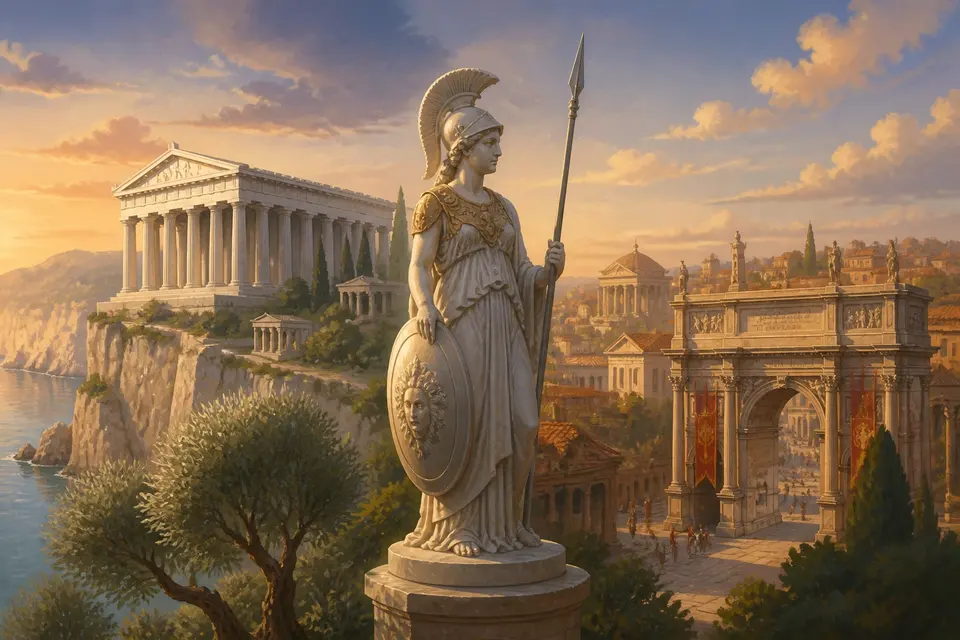
| Athena | Minerva | Matched with the Etruscan goddess Menrva; patron of craftsmen and teachers |
| Apollo | Apollo | The only one of the twelve Olympians the Romans never renamed; first honored in Rome as a healer |
| Artemis | Diana | Worshipped in a sacred grove at Nemi, near Rome |
| Ares | Mars | Rome’s great god, father of Romulus and Remus, and a god of farms as much as of war |
| Aphrodite | Venus | Mother of Aeneas, and so ancestor of Julius Caesar’s family |
| Hephaestus | Vulcan | A fire god, asked at a yearly festival to spare the city from fire |
| Hermes | Mercury | His name comes from the Latin for “merchandise”: the god of traders |
| Hestia | Vesta | The hearth of the whole state, tended by the Vestal Virgins |
| Dionysus | Bacchus (also Liber) | The wine god, whose cult the Senate cracked down on in 186 BCE |
| Hades | Pluto, or Dis Pater | The ruler of the dead, “the Rich One” in both languages |
| Cronus | Saturn | An old god of farming, with his own December festival |
For the stories of the Greek twelve, see The Twelve Olympian Gods.
How the matching happened
Greeks and Romans were doing the same thing that people in many ancient cultures did: when you meet someone else’s god, you ask which of your own gods it must be. Herodotus does it with the gods of Egypt. Centuries later, the Roman historian Tacitus uses a phrase that scholars turned into a term, interpretatio Romana, “Roman interpretation,” when he explains that a pair of Germanic gods are, in Roman terms, Castor and Pollux.
With Greek gods, the process began early and from several directions. Greek cities lived in southern Italy, close to Rome. The Etruscans, whose kings ruled Rome in its early days according to tradition, and whose own gods were strongly shaped by Greek ones, had a triad of Tinia, Uni and Menrva; Rome’s Capitoline triad of Jupiter, Juno and Minerva, in a temple built in the Etruscan style, matches it. Around 240 BCE, a Greek-speaking freedman named Livius Andronicus translated Homer’s Odyssey into Latin. The first line asks for help from “Camena,” an Italian goddess of springs, where Homer says “Muse.” From then on Roman poets such as Ennius and, later, Virgil and Ovid told Greek stories with Roman names.
Poets gave Rome a shared story, but the cult kept going on its own terms. A Roman who prayed to Mars was not praying to the god of the Iliad.
Four gods who changed the most
Mars. In Homer, Ares is a brute. Zeus himself tells him that he is the most hateful of the gods on Olympus. In Rome, Mars is the father of the city’s founders and its greatest protector, and the month of March, the first month of the old Roman year, is named for him. He is also a farmer’s god. The Roman writer Cato, in a handbook on farming, gives the prayer to say to Mars when you walk the boundaries of your fields with a pig, a sheep and a bull, asking him to keep away sickness and blight and to let crops, vines and flocks thrive. The Greek god of slaughter and the Roman god of fields and soldiers are not the same figure. See Romulus and Remus for the story of Mars’s sons.
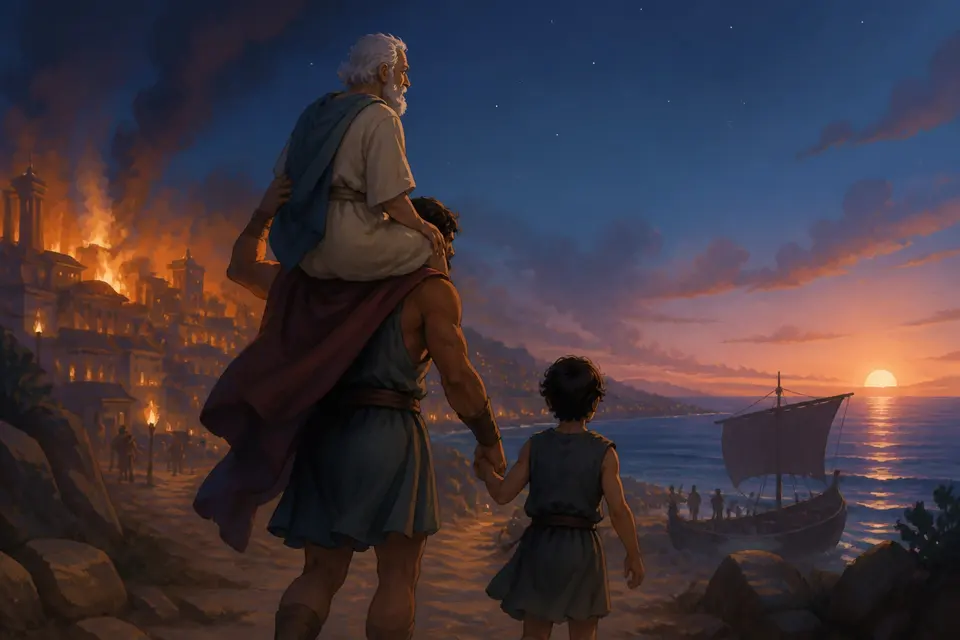
Venus. Aphrodite is the goddess of desire. Venus is that, and in addition a goddess with a family to defend. In Virgil’s Aeneid, she is the mother of Aeneas, the Trojan refugee who founded the line of Rome (Aeneas: The Refugee Who Founded Rome), and Julius Caesar claimed descent from her through Aeneas’s son. Caesar vowed a temple to Venus Genetrix, “Venus the Ancestress,” before a battle in 48 BCE and dedicated it in 46 BCE, in a new forum of his own beside the old one.
Vesta. Hestia is almost absent from Greek myths. Vesta was the center of the Roman state’s religion. Her fire in the Forum burned, according to tradition, without interruption, and was tended by six priestesses who gave up thirty years of their lives to it (Vesta’s Fire: The Priestesses Who Kept Rome’s Flame). If the fire went out, Romans feared for the city itself.
Apollo. Apollo is the only Greek god of the twelve whom the Romans never renamed, and the story of why is a story about fear. During a plague in 433 BCE, according to Livy, the Romans vowed a temple to Apollo as a healer, and it was dedicated two years later. For centuries he was a foreign god, called on in a crisis. That changed when the first emperor, Augustus, credited Apollo with his victory at Actium in 31 BCE and built a temple to him next to his own house on the Palatine Hill. Apollo went from a stranger the city asked for help to the patron of the new regime.
Gods with no Greek twin
The Romans had gods who had no match. The poet Ovid, in his poem on the Roman calendar, imagines himself asking Janus, the god with two faces, who he is, since “Greece has no god to compare with you.” Janus presides over doors and beginnings (Janus: The Two-Faced God Who Opened and Closed the Year). Others include Terminus, the god of boundary stones, who in Ovid’s story refused to leave his place even when Jupiter’s temple was built around him, and Quirinus, a god of the Roman people, with whom Romulus was identified after his death. The household gods, the Lares and Penates, were also Roman (Lares and Penates: The Gods Who Lived in a Roman Kitchen). A Greek family had gods of the hearth too, but not these.
Gods who arrived later
The set of gods grew with each crisis. In 291 BCE, during a plague, the Romans brought the healing god Asclepius from his sanctuary at Epidaurus. In 204 BCE, during the war with Hannibal, they brought the Great Mother, Cybele, from Anatolia, in the form of a black stone. In 186 BCE the Senate cracked down on the cult of Bacchus after reports of secret nightly gatherings. Rome treated the gods of other peoples as a resource, and as a risk.
More Roman gods on this site
Several of the gods in the table have their own guides. For the gods hidden in the calendar, see The Roman Gods Behind the Months of the Year. For the party of Saturn, see Saturnalia: The Roman Winter Party That Looks a Lot Like Christmas, and for a festival of the wild, Lupercalia: The Wild Roman Festival Behind Valentine’s Day. A Roman story of Venus’s jealousy is told in Cupid and Psyche: The Story Behind the Word “Psychology”, and the way Roman god names ended up on the planets is in Why the Planets and Stars Have Mythological Names.
Quick answers
- Why is Hades called Pluto? “Pluto” is the Latin form of the Greek Plouton, “the wealthy one,” a name used for Hades in Greek too. The Romans also called him Dis Pater, and the Roman writer Cicero explained Dis as a form of the Latin word for rich, dives. Many scholars still accept that explanation.
- Whose names should I use? In Greek myth, use the Greek names; in Virgil, Ovid and the Roman festivals described on this site, the Roman ones. The names are the clue to which tradition a story belongs to.
- When did the Romans take over the Greek myths? Gradually. The cult of Apollo goes back to the fifth century BCE. The poets from about 240 BCE onward made the Greek stories part of Roman literature. Ovid’s Metamorphoses (about 8 CE) tells them in Latin with Roman names, and it is where many readers today first meet them.
- Did the Romans believe the Greek stories? Educated Romans treated them as a shared literary inheritance, while the practical worship of the gods followed Roman rules, calendars and priesthoods.
What we rely on
Ancient sources
- Livy, History of Rome 22.9-10 (the crisis of 217 BCE and the six couches), 4.25 and 4.29 (the temple of Apollo), 39.8-19 (the Bacchanalia). Translation: B. O. Foster and others, Loeb Classical Library.
- Ennius, Annales, the two verses naming twelve gods, preserved in Apuleius, On the God of Socrates 2. Edition: Otto Skutsch, The Annals of Q. Ennius (Oxford University Press, 1985).
- Ovid, Fasti 1.89-90 (Janus) and 2.639-684 (Terminus). Translation: J. G. Frazer, rev. G. P. Goold, Loeb Classical Library 253 (1931).
- Cato, On Agriculture 141 (the prayer to Mars). Translation: W. D. Hooper and H. B. Ash, Loeb Classical Library 283 (1934).
- Cicero, On the Nature of the Gods 2.66 (the name of Dis Pater).
- Homer, Iliad 5.889-898 (Zeus to Ares). Virgil, Aeneid. Tacitus, Germania 43 (interpretatio Romana).
Modern scholarship
- Mary Beard, John North and Simon Price, Religions of Rome, vol. 1: A History and vol. 2: A Sourcebook (Cambridge University Press, 1998): the standard introduction, including the crisis of 217 BCE and the arrival of foreign cults.
- John Scheid, An Introduction to Roman Religion, translated by Janet Lloyd (Edinburgh University Press, 2003).
- Jörg Rüpke, Religion of the Romans (Polity, 2007).
- Georges Dumézil, Archaic Roman Religion (University of Chicago Press, 1970; Johns Hopkins University Press, 1996): on Mars, Jupiter and Quirinus.
- Eric M. Orlin, Foreign Cults in Rome: Creating a Roman Empire (Oxford University Press, 2010): on Asclepius, Cybele and Apollo.