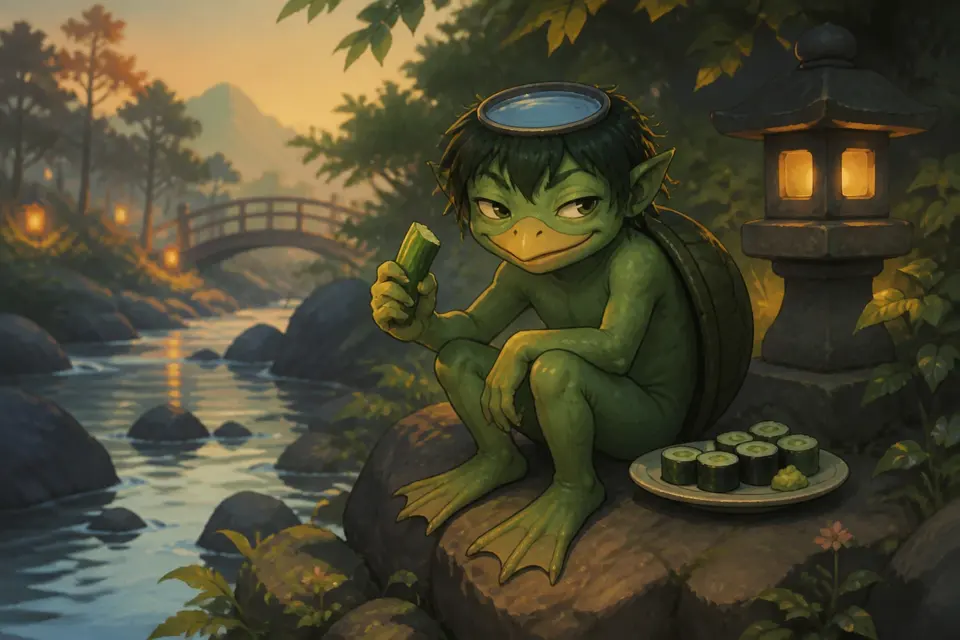
The next time you are in a sushi restaurant in Japan, look at the menu near the bottom. In the section of simple rolls, among the tuna and the pickled radish, you will find kappa-maki: a thin roll with a strip of cucumber in the middle. It is a cheap, refreshing little item, often ordered at the end of the meal. And the name is not a joke. A kappa is a kind of water monster, and it is supposed to love cucumbers.
Meet the kappa
The word kappa is thought to come from kawa, “river,” and warawa, an old word for a child. A river child. It is one of the best-known creatures in Japanese folklore, known all over the country by many different regional names. The usual description is of a small humanoid, about the size of a child, with green or yellowish skin, a beak, webbed hands and feet and a shell on its back like a turtle. On top of its head is a shallow depression, a dish, which holds water.
That dish is the source of its power. As long as it is full, the kappa is incredibly strong. Folklore says that it can pull a horse into the river, or beat a sumo wrestler. If the water spills or dries out, the kappa loses all its strength, and can even die.
How to defeat one
That leads to the most charming bit of kappa lore. The creature is also remarkably polite. Traditional wisdom says that if you meet a kappa, you should bow deeply. The kappa, unable to resist, will bow back, and the water spills out of its dish. It is helpless. In some versions, you can even make it a servant: a kappa that was beaten by a human and had its dish emptied might promise never to harm anyone, and some stories end with it doing chores or teaching bone-setting as a reward for being refilled.
Another detail is that kappa are fond of sumo. Many tales have them challenging travelers to a match. They are said to have an unusual weakness: their arms are connected, so that if one is pulled, the other comes off. That is a reason for the legendary kappa hand in a temple near Tokyo, said to be a relic from a kappa that apologized.
The cucumber
Folklore says that the kappa’s favorite food is the cucumber. In many regions, people made offerings of cucumbers to the river in summer, sometimes with the names of family members carved into the skin, to ask the kappa to spare them. Summer was the time when children went swimming and drowned, so the offerings were a kind of insurance.
That is why the cucumber roll is called kappa-maki. The name seems to be relatively modern. A thin roll of rice and cucumber is a kind of joke: if you want to feed a kappa, this is what it would eat. It is also traditionally eaten at the end of a meal, to refresh the palate, and some sushi chefs point out that it is a kind of break between more expensive pieces.
More than a monster
The kappa can be dangerous. Stories blame them for drownings, and for dragging victims underwater to steal an organ that the old tales call the shirikodama, a mythical ball in the body. But it is not only a villain. Stories also describe kappa that befriend farmers, or help fishermen, or offer medical secrets in return for a favor. In the folklorist Yanagita Kunio’s Tōno Monogatari (1910), a collection of tales from the mountains of northern Japan, there is a story of a red-faced kappa child born to a woman.
The kappa also appears in literature. The writer Akutagawa Ryūnosuke published a short novel called Kappa in 1927, in which a man wanders into a society of kappa and finds a satire of human life. It is regarded as one of his most unusual works.
A friendly warning
Some of the kappa’s popularity may be practical. Parents used to tell children about kappa to keep them away from dangerous water. It is a very effective kind of safety message: you do not need to explain the current of a river if you can say there is a monster in it.
In Tokyo, there is a street called Kappabashi, famous for shops that sell kitchenware and plastic food. A statue of a kappa stands on the street. One story says the area is named after a merchant who built a drainage channel there, and was nicknamed “Kappa” by the locals. Another links it to the creature. Either way, the shops use the kappa as a mascot, and they say he brings luck to business.
That is the charm of the kappa. In a single legend you get a river monster, a lesson in manners and a roll of sushi. It is a good reminder that folklore does not always stay in books. Sometimes it shows up on your plate.