In March 2022, a rock in a field near the town of Nasu, in Tochigi Prefecture, split in two. This was big news. It made headlines in Japan and abroad, and thousands of people went to look at it. The rock was called the Sesshō-seki, the “Killing Stone,” and according to legend it had been holding something in for about eight hundred years. The stone was famous because, in the story, it was the body of a nine-tailed fox.
The story of Tamamo-no-Mae
The legend goes that, in the twelfth century, a beautiful and clever woman named Tamamo-no-Mae arrived at the court of the retired Emperor Toba. She was astonishingly learned and had a wonderful fragrance. But the emperor began to sicken, and a court diviner revealed that Tamamo was really a nine-tailed fox who had previously ruined kingdoms in India and China. She fled to the Nasu plain, where she was hunted down and killed by warriors. Her spirit turned into a stone that poisoned anything that touched it, birds, insects and travelers, until a monk, centuries later, struck it and released her spirit. In 2022, long after anyone had expected anything to happen, the stone cracked open. The news went viral. People who saw the rock joked that the fox had been freed again.
The fox in Japanese folklore
The kitsune, the fox, has been part of Japanese tradition for more than a thousand years. Foxes were common in the countryside, and they behave in ways that look intelligent: they are sly, they hunt at night, they live near human settlements. An old folk belief says that foxes can bewitch people, and that they can take human form, usually that of a beautiful woman, to trick or marry men.
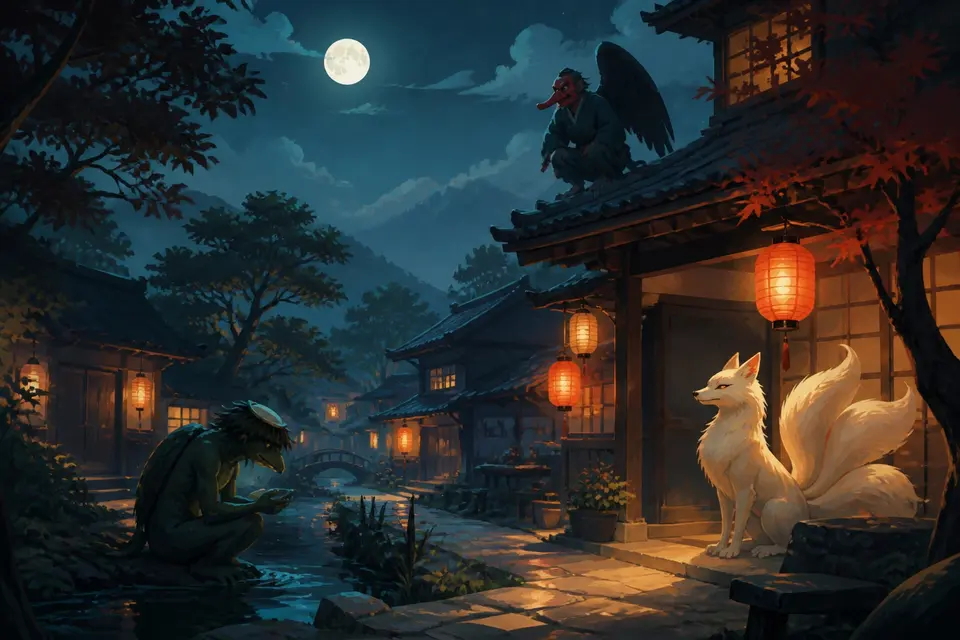
A fox grows more powerful with age. According to tradition, after fifty years it can take human form, after a hundred it gains supernatural abilities, and at a thousand years it becomes a celestial fox with nine tails and a golden or white coat. The number of tails measures its power and wisdom. Nine tails is the maximum.
Good fox, bad fox
Foxes are not consistently good or evil. A common distinction is between zenko, “good foxes,” who are protective and benevolent, and yako, “field foxes,” who are mischievous and often malicious. Another phenomenon, kitsune-tsuki, “fox possession,” was an explanation for strange behavior or illness in the pre-modern period. Victims were said to act oddly, speak in strange voices and crave fried tofu.
A frequent detail in the stories is that foxes are very good at imitating people, but often make small mistakes. A fox in human form might have a tail peeping out from under a kimono, or might be frightened by dogs, or cast a fox-shaped shadow in the water. A hunter once spotted a beautiful woman’s reflection in a pond that showed the head of a fox.
The fox wife
A favorite theme is the fox who marries a human. The best-known story is that of Kuzunoha, in which a man saves a white fox from hunters and later meets a woman who nurses him back to health. They marry and have a son. Years later, the son sees his mother’s tail, and she is forced to return to the forest. She leaves a poem behind: “If you love me, come and see me in the forest of Shinoda, in the land of Izumi, where the arrowroot leaves show their white backs.” The son grows up to become Abe no Seimei, the famous Heian-period court diviner, who in legend and in many modern fantasy stories is a master of magic.
Foxfire and tofu
Foxes are associated with a mysterious light, kitsunebi, “fox-fire,” a row of floating lights seen in fields at night, said to be fox breath or fox weddings. A famous woodblock print by the artist Hiroshige, New Year’s Eve Foxfires at the Changing Tree, Ōji (1857), shows foxes in the woods near Edo with lights floating above their heads, gathering to put on their official robes for the new year.
Another part of the lore is food. Foxes are said to love aburaage, fried tofu pouches, and that is why a bowl of udon with a sheet of fried tofu on top is called kitsune udon. At shrines dedicated to the grain deity Inari, such as the famous Fushimi Inari in Kyoto, there are statues of foxes, often holding a key or a jewel in their mouths. The fox is seen as the deity’s messenger.
Fox in the neighborhood
Foxes with many tails are a familiar sight in modern Japanese entertainment. Naruto’s nine-tailed fox, Kurama, is a major character in the manga and anime. The Pokémon Ninetales is a clear reference. Games, anime and novels have many kitsune characters. There are related figures in China (the huli jing) and Korea (the gumiho), which also have nine tails and also appear as women, though in Korea the gumiho is more fearsome.
Why it works
The fox is a perfect folklore figure. It is a real animal, close to people and slightly mysterious, and it is clever enough to be believable as a trickster. The idea that a fox can grow, learn and change, over centuries, taking human form while keeping a trace of its animal nature, is fascinating. The kitsune is not just a monster or a spirit. It is an intelligence that lives on the edge of our world, watching.