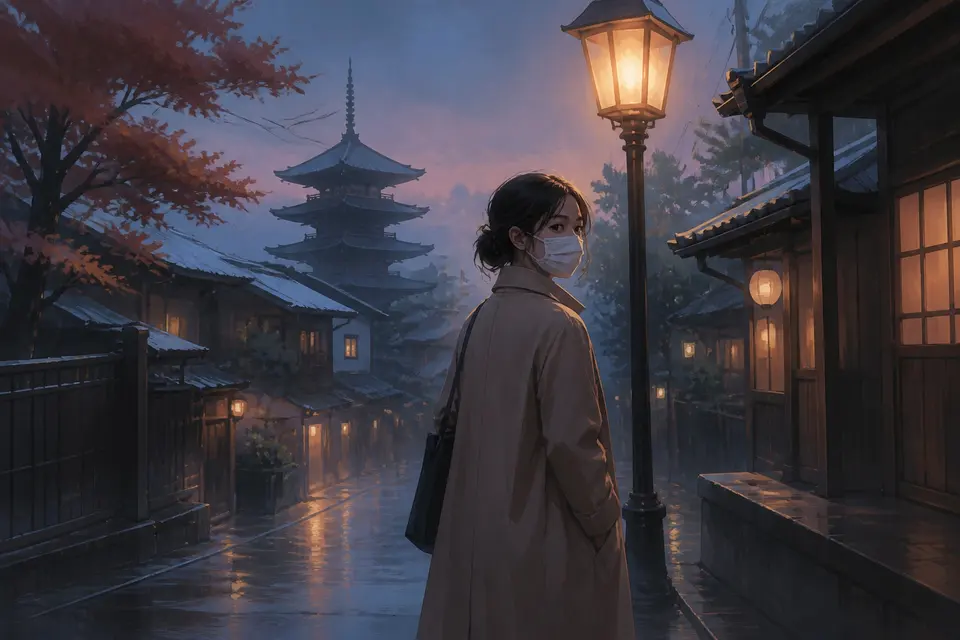
In the winter and spring of 1979, according to Japanese newspapers and later accounts, something strange happened to the children of Japan. They began to walk home from school in groups. Parents drove their kids to class. In some towns the police were said to patrol the streets in the afternoon, and schools sent notes home. The reason was a rumor: a woman in a surgical mask was stopping children and asking them a question, and nobody who answered wrong was safe. The legend is known as Kuchisake-onna, the slit-mouthed woman, and it may be the best-documented panic in modern Japanese folklore.
The question
The story has a fixed form. You are walking home alone at dusk. A woman in a long coat, carrying a bag, with a white surgical mask over her face, stops you. She asks, in a quiet voice, “Watashi, kirei?” “Am I pretty?”
If you say no, she will kill you, usually with a pair of scissors or a knife. If you say yes, she pulls down the mask. Her mouth has been slit from ear to ear. She asks again, “Even now?” If you say no, she kills you. If you say yes, she will slit your mouth to make it match hers.
How to survive
As the legend spread, so did the advice about how to escape. There were many versions. Say that she is “so-so,” or “average,” which makes her confused as she tries to decide what to do. Throw hard candy, specifically bekkō-ame, a kind of amber candy, because she will stop to pick it up. Say the word “pomade” three times. Run away, though that is usually not recommended, since she is said to be extremely fast. The elaborate set of rules is typical of urban legends: it gives the listener a sense that there is a way to win.
The 1979 wave
Folklorists date the great scare to early 1979. The details differ, but accounts say it started in Gifu Prefecture in central Japan and spread across the country in a few weeks, passing through schoolyards and neighborhood gossip. Some reports speak of schools sending children home early, and police receiving calls from worried parents. No woman was ever found. By the summer it had faded, though it has come back at intervals ever since.
The origin of the figure is older. Some scholars connect her to stories from the Edo period, in the seventeenth to nineteenth centuries, about women with torn mouths. She appears in cheap horror films, such as Carved: The Slit-Mouthed Woman (2007), and in video games and anime. Variations on the legend exist in other countries in the region, with similar masked figures.
Why a mask?
Some observers have suggested that the details reflect the anxieties of the time. In the late 1970s, many women in Japan wore surgical masks in public, to prevent spreading colds or because of pollution. A masked stranger was an ordinary sight, and a perfect disguise. The legend also reflects concerns about appearance and social pressure, and about the safety of children walking home alone, as more mothers worked outside the home.
The ghost in the stall
A very different kind of urban legend is Toire no Hanako-san, “Hanako of the toilet.” It is usually set in a school. The story goes that in the third stall of the girls’ bathroom, usually on the third floor, lives the ghost of a girl named Hanako. To summon her, you go to the bathroom, knock on the door of the third stall three times and say, “Hanako-san, are you there?” A small voice answers, “Yes.” If you open the door, you may see a little girl in a red skirt and a bobbed haircut, or a hand reaching out, or something worse.
The legend appears to date to the 1950s, and spread widely in Japan’s postwar school system. There are many versions: she was a girl who was killed during an air raid, or who was hiding from her parents, or who died in the bathroom. Some give her a boy counterpart, Taro-kun. The legend has been adapted for films, manga and a series of television programs, including a 1995 film. School toilets, which are shared, private and a little frightening, are an ideal setting.
The pleasure of being scared
What both legends have in common is that they are told by children, to each other, in a place where adults are not watching. They have rules, ritual language and a sense of danger. They are a way of practicing fear, in a safe setting, and of building bonds. The group walk home was probably a little scary, and also a lot of fun.
It is also why they last. Each generation adds a detail. The woman in the mask has been seen with a smartphone and in a car. Hanako-san has learned to text. The old ghosts adjust to the new world, as they have always done.