In the Edo period, around the 1700s, a game became popular among samurai and townspeople in Japan. It was called Hyakumonogatari Kaidankai, “a gathering of a hundred supernatural tales.” You lit a hundred candles in a room and each guest told a ghost story. After each story you blew out one candle. As the room got darker, the stories got scarier. By the time the hundredth candle went out, it was said, something supernatural would appear. The point of the game was to get right to the edge of that moment, and see who flinched.
It is a good way into the world of the yōkai, the strange creatures of Japanese tradition. The word is written with two characters, 妖怪, which mean something like “bewitching” and “mystery.” It covers an enormous range of beings and phenomena, and it has proven stubbornly hard to define.
What counts as a yokai
The broadest definition is: anything strange that cannot be easily explained. A voice that calls your name from empty woods. A flickering light over a marsh. An old umbrella that sprouts an eye and a tongue and hops down the road. A baby’s cry in the night that turns out to be something else. Yōkai can be monstrous, mischievous, helpful or just odd. They can look like animals, humans, objects or nothing at all. Many are tied to a particular place: a river, a mountain pass, a house.
Ghosts, called yūrei, are usually considered a separate category, since they are the souls of dead people, though the border blurs. Gods, kami, are another matter altogether. Yōkai occupy the huge middle ground: beings that belong to the natural and supernatural world, and who are more often a nuisance than a threat.
A tour
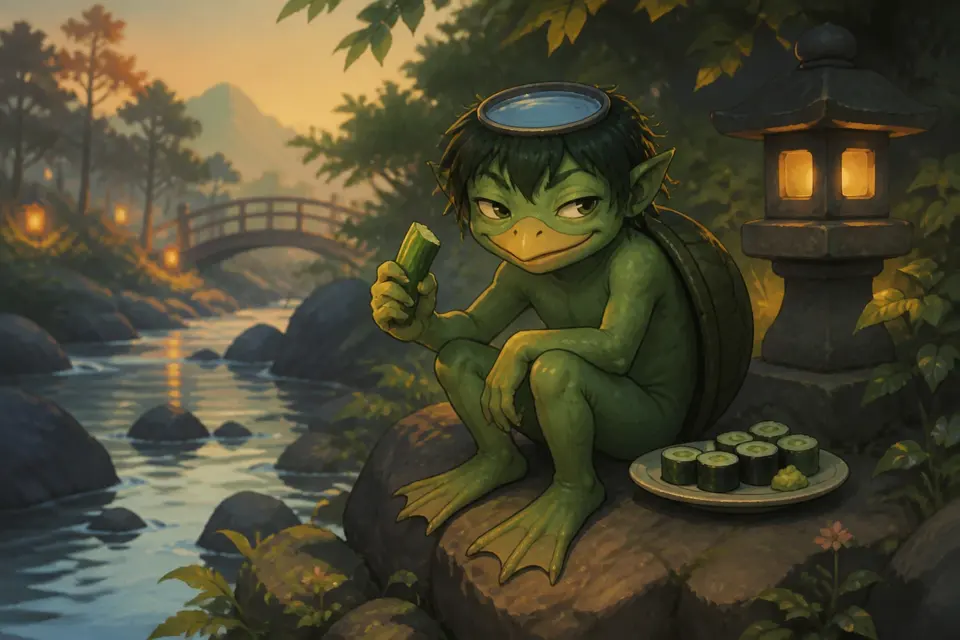
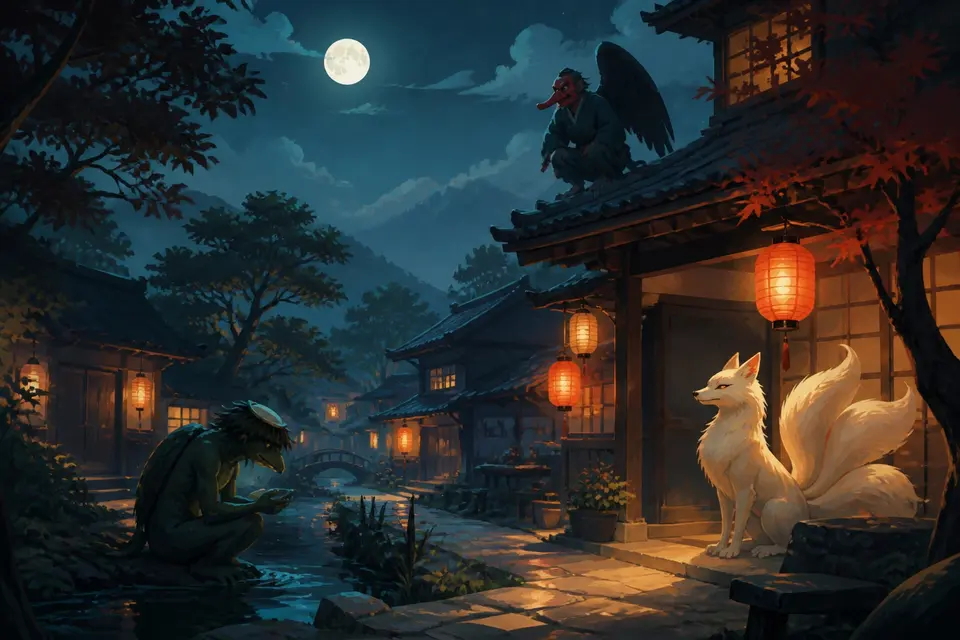
- Kappa: a water creature, about the size of a child, with a dish on its head and a love of cucumbers. It is known for pulling people into rivers, and also for its odd politeness.
- Tengu: a mountain being with a red face and a long nose, or a beak, who wears the clothes of a mountain ascetic and is a master of swordsmanship. Early tengu were dangerous; later they were more often shown as proud and meddlesome.
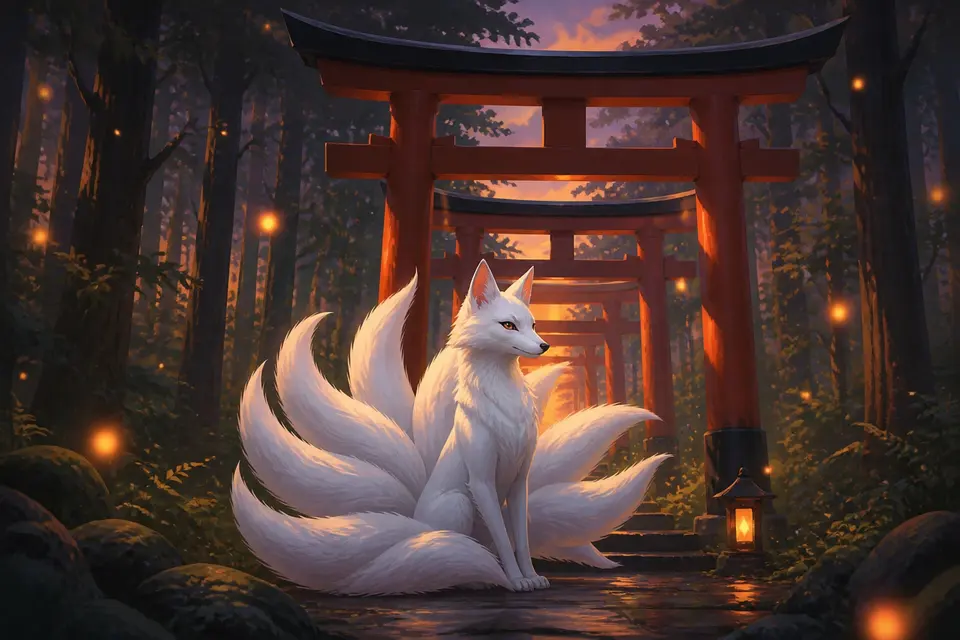
- Kitsune: the fox, a shape-shifter that gains more tails as it ages.
- Tanuki: the raccoon dog, a jolly trickster in art who has an enormous belly, and who uses leaves to disguise himself.
- Oni: horned ogres in red or blue, with iron clubs and tiger-skin loincloths, who are the stock villains of old tales. Even they have a sense of humor in modern celebrations.
- Tsukumogami: household objects that come alive after 100 years of use. The idea is a good reason to treat your tools with respect.
- Nopperabō: a faceless being who looks like a person until they turn around. The best-known story about it was written down by the writer Lafcadio Hearn in 1904.
The parade
Yōkai have been drawn for centuries. A famous scroll from the Muromachi period, in the fifteenth or sixteenth century, shows a procession of strange creatures marching at night, the Hyakki Yagyō, the “Night Parade of One Hundred Demons.” Many of them are household objects that have come to life, and the scroll is thought to be the origin of the tsukumogami idea. In the 1770s, the artist Toriyama Sekien published a series of illustrated catalogs of yōkai, including Gazu Hyakki Yagyō (1776), which gave names and faces to many creatures and became a foundation for later artists. He took stories from folklore and also invented some of his own.
Why they existed
Scholars often explain yōkai as a way to name the unexplained. Before there was science, a mysterious death at a river needed a cause. A kappa was a handy way to explain drownings, and to keep children away from dangerous water. A strange noise in the night could be a tanuki drumming on his belly. A forgotten tool left out in the rain could be a tsukumogami. The stories gave a name and a face to fear, which makes it a bit easier to live with.
In the late nineteenth century, a philosopher named Inoue Enryō collected folk beliefs and tried to debunk them using the new science, an effort that earned him the nickname “Dr. Specter.” He founded a field called yōkaigaku, “yōkai studies.” He was, in a way, the first scholar to treat the subject seriously.
Yokai in pop culture
In the twentieth century, the manga artist Shigeru Mizuki, who had lost an arm in World War II, brought yōkai to a wide audience with his series GeGeGe no Kitarō, about a one-eyed boy who is a yōkai and who protects humans from spirits. It began in the 1960s and ran for decades. Mizuki also spent years studying and drawing the creatures.
Since then, yōkai have been woven into Japanese popular culture: Studio Ghibli films such as Spirited Away and Pom Poko, where tanuki fight developers, the Pokémon franchise, in which many creatures are directly inspired by yōkai, and the 2013 game and anime series Yo-kai Watch, which became an enormous hit with children. Western readers first met them in the stories of Lafcadio Hearn, whose book Kwaidan appeared in 1904.
A world that is not empty
A yōkai story is rarely about good defeating evil. More often it is about living alongside strange things. The creatures are not necessarily destroyed. They are avoided, appeased, tricked or even befriended. It is a view of the world as a place that is more crowded than it looks, and where something is always watching from the edge of the lamplight.