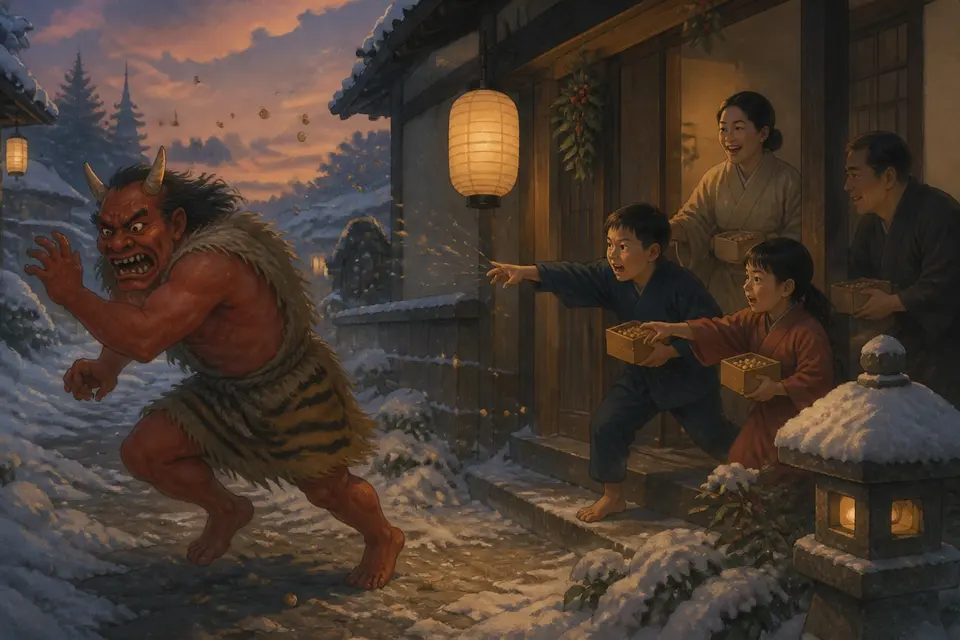
On the evening of February 3, in homes, schools and shrines across Japan, someone puts on a red or blue mask with horns, a tiger-print kilt and a plastic club, and plays the demon. Everyone else, children especially, pelts him with roasted soybeans, shouting “Oni wa soto! Fuku wa uchi!” which means “Demons out! Luck in!” The demon pretends to flee. Afterward, each person eats as many beans as their age, plus one, to ensure health for the year. It is called Setsubun, and it may be the most good-natured exorcism in the world.
The day before spring
Setsubun means “seasonal division.” It originally marked the day before the beginning of each of the four seasons in the old lunar calendar. Over the centuries, the one that stuck is the day before the start of spring, risshun, which in the old calendar was close to New Year. It was a moment of transition, when, in many traditions, the boundary between the worlds thins and evil spirits are able to slip through. Chinese customs of driving off evil at the turn of the year were adopted at the Japanese court in the Heian period, more than a thousand years ago, in a ritual called tsuina. In time, it spread to ordinary households as the bean-throwing we know today.
Why beans?
Soybeans have long been seen as a cleansing grain. The Japanese word for bean, mame, can also be read as ma-me, “demon’s eye,” and there is a pun with ma-metsu, “to destroy demons.” So beans become a weapon. They must be roasted, because a raw bean that sprouts would bring bad luck. The beans are traditionally thrown from the house at the doorway, and the door is shut firmly after the demon has left.
Another custom is to hang a sprig of holly with the head of a sardine on the door, called hiiragi iwashi. The sharp holly leaves and the strong smell of the grilled fish are said to keep the demons away. It is not a decoration you see in many modern city apartments, but in some old neighborhoods it is still done.
The demon gate
Here is the part that explains how an oni looks. In the ancient Chinese system of geomancy, which Japan also adopted, the northeast was an unlucky direction, the kimon, “demon gate,” through which evil spirits were supposed to enter. The directions were marked with the twelve animals of the zodiac, and the northeast fell between the ox and the tiger, ushi-tora. Therefore, the oni, creatures from the northeast, have the horns of an ox and wear the skin of a tiger.
It is one of those tidy details that make Japanese folklore so satisfying. The ogre’s costume is a map.
In Kyoto, the Enryaku-ji temple on Mount Hiei, to the northeast of the old capital, was built partly to guard that gate. The same logic influenced the placement of buildings and even the shape of rooms. Some older Japanese houses have a notched corner on the northeast side, to deny entrance to the demons.
What an oni is
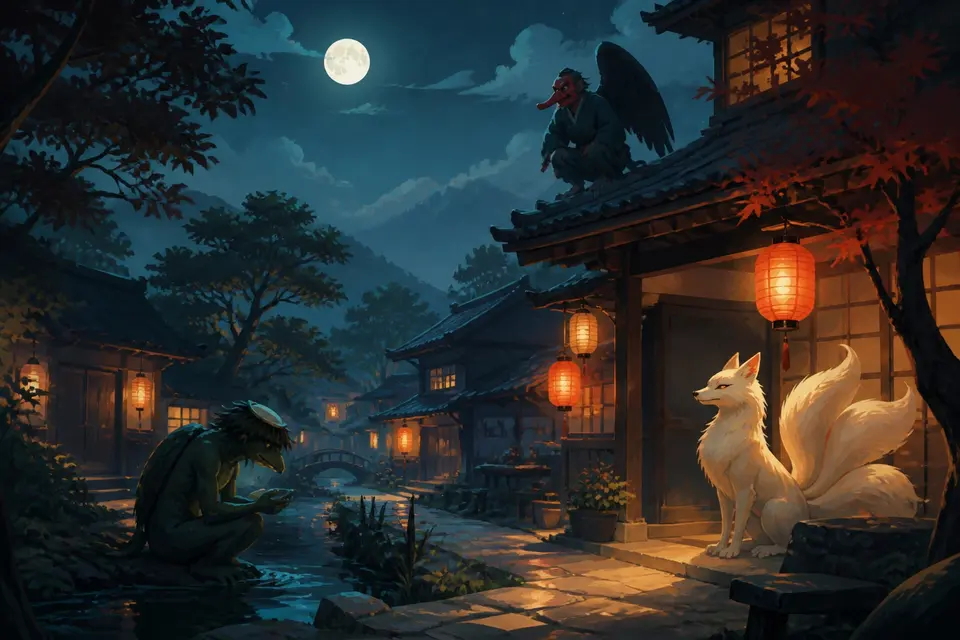
The oni are, broadly, ogres: huge, strong, horned creatures with sharp teeth and iron clubs. They are red, blue, green or black. In the earliest records, the word oni could mean an invisible spirit or the ghost of the dead. By the Middle Ages, it had settled into the image we know: a fierce monster in a loincloth. They are often the villains of folktales.
The most famous oni-slayer is Momotarō, “Peach Boy.” In the story, an old couple find a huge peach floating down a river. They take it home, and when they cut it open, a baby boy is inside. When he grows up, Momotarō sets out to the island of the oni, Onigashima, to defeat the demons who have been raiding the countryside. On the way he recruits a dog, a monkey and a pheasant, by sharing his millet dumplings, and together they defeat the demons and bring home their treasure. The story is told to every Japanese child, and has been retold in countless books and films.
Not always a villain
Not all oni are evil, and there are regions where the festival is reversed. At a few shrines and temples across Japan, people chant “Oni wa uchi,” “Demons in,” and welcome the oni as protectors or even as ancestors. In some places, the oni is considered a guardian figure, and it is a mistake to throw anything at him. The tradition is not uniform, and local variations are part of its charm.
A modern demon slayer
The oni remain a vigorous part of popular culture. The manga series Demon Slayer: Kimetsu no Yaiba, by Koyoharu Gotōge, began in 2016, and its 2020 film Mugen Train became the highest-grossing film in Japanese history, earning over 40 billion yen. The villains are oni, creatures created from humans, and the story is a tragic one, with demons who retain memories of what they once were. It is a good example of how an old idea can find a new life.
The festival today
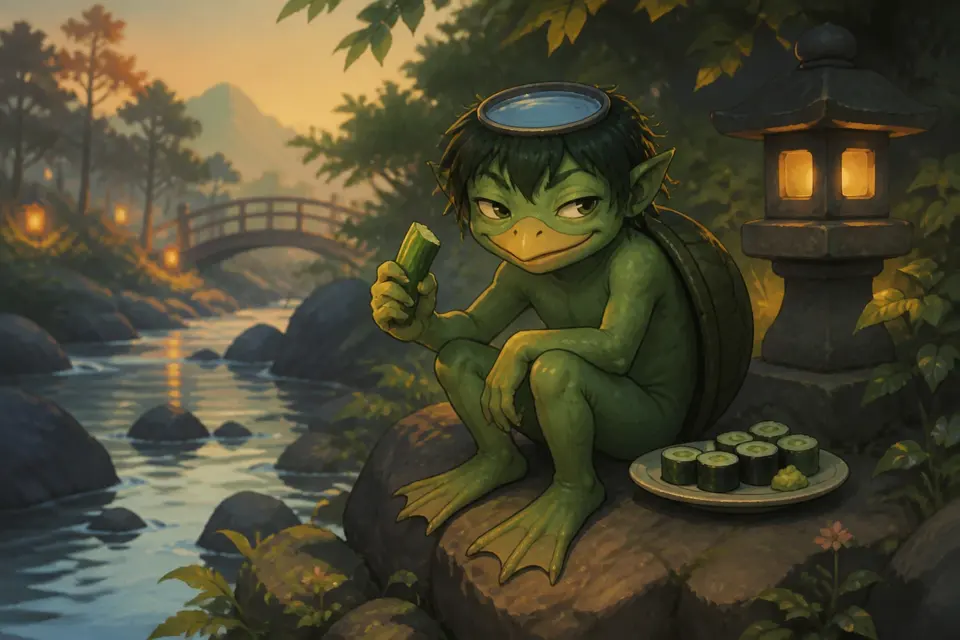
Setsubun is also celebrated with a custom involving food. In the Kansai region, people eat an uncut sushi roll, ehōmaki, in silence while facing the year’s lucky direction. The custom spread nationwide in recent decades through convenience-store marketing, a reminder that traditions can be both ancient and invented.
At large shrines, celebrities and sumo wrestlers throw beans to the crowd from a stage, and people jostle to catch them. At home, the best part is often the father or an older brother in a mask, being chased out of the front door by a squealing crowd of children, only to creep back and be chased out again.
It may be the only holiday where the monster is in on the joke.