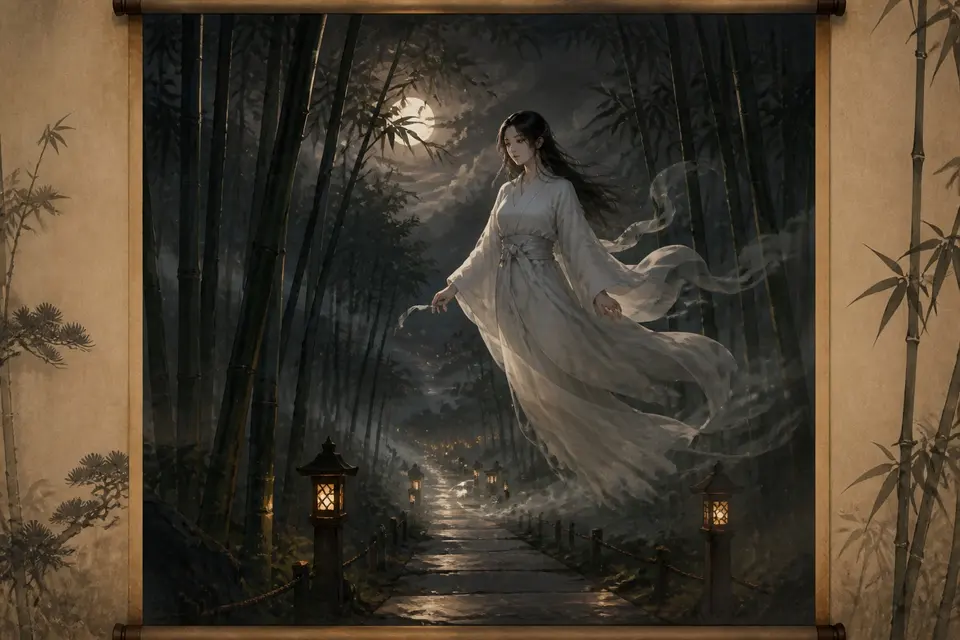
At the end of the 1998 Japanese horror film Ringu, a young woman in a white dress, with long black hair covering her face, climbs out of a well, crawls across the floor and out of a television set. She is Sadako, one of the most famous ghosts in modern cinema, and she belongs to a very old tradition. Everything about her look, the pale dress, the loose hair and the way she seems to drift, comes from stage and print conventions that were set about three hundred years earlier. She is a yūrei.
What a yūrei is
The word yūrei is written with characters that mean “faint” or “dim” and “spirit.” In the traditional view, a yūrei is the spirit of a dead person who cannot find peace. Usually it is because of something unfinished: a violent death, a betrayal, a deep love or hatred, or a funeral that was not done properly. A woman who was murdered by her husband, a servant who was abused, a lover who died waiting. The ghost lingers to fulfill a purpose, usually revenge.
Japan has a long tradition of ghost stories, and the boundary between a yūrei and other kinds of spirits is blurry. In general, a yūrei is a ghost, a person who has died. A yōkai is another sort of strange creature altogether. Yūrei haunt specific people and places. They can usually be put to rest by resolving the cause of their anger, by performing the proper rites or by finding the one who wronged them.
The uniform
The classic yūrei costume is not random. The white robe is the kyōkatabira, a burial kimono. In traditional Japanese funerals, the dead were dressed in white, often with a white triangular cloth, the hitaikakushi, tied around the forehead. The ghost is simply dressed as a corpse. The hair is loose and long because, for the living, women kept their hair tied up, and only for burial was it let down. Hair hanging loose is a sign of death.
Often the ghost is accompanied by a small flame, a hitodama, “soul-fire,” that floats near her. The hands are held limply in front of the chest, with the wrists drooping, in a gesture that is still used by actors who play ghosts. Even the sound that goes with the ghost, a faint, hollow wooden rattle in kabuki theater, has been preserved.
The missing feet
How did the feet vanish? The most popular answer credits a painter named Maruyama Ōkyo, who lived in the eighteenth century. According to the story, he was a master of realistic painting, and when he made a portrait of a dead woman, a lover or his wife, depending on the version, he painted her without legs, ending in a wisp of mist. The painting, usually called Yūrei-zu or Ghost of Oyuki, is attributed to him, and is kept at a temple in Tokyo. Whether or not he invented the convention, the image caught on. Prints and later theater followed.
Historians are cautious. Before the Edo period, there were ghost pictures that showed feet, and some of Ōkyo’s attributed works may be by followers. But the idea that this look became standard in the middle of the Edo period is generally accepted. It also made sense: a ghost without feet looked as if it were floating, and floating was a way of showing that it did not belong to the world of the living. It is very easy to draw. It is also very hard to forget.
The theater effect
The greatest influence on how Japan imagines ghosts is the kabuki play Tōkaidō Yotsuya Kaidan, written by Tsuruya Nanboku IV and first performed in Edo in 1825. It is about Oiwa, a faithful wife who is poisoned by her husband, Iemon, so that he can marry a rich woman. The poison disfigures her face, and one half of it droops grotesquely. She dies cursing him. After that, her ghost haunts him, appearing in the guise of lanterns, in dreams and in the faces of his new bride. By the end, Iemon is a wreck.
The play is still performed, and it has been filmed dozens of times. Actors traditionally pray at Oiwa’s shrine before performing in it, and some say that accidents have happened when this was neglected. It also helped fix the image of a wronged woman as a vengeful spirit, a type known as onryō.
From the stage to the screen
Modern horror inherited the look. Sadako’s long hair, white dress and slow, jerky walk reflect the same tradition, as do many ghosts in Japanese films. The success of Ringu, which was based on a 1991 novel by Suzuki Kōji, led to a Hollywood remake, The Ring (2002), and to a wave of Japanese horror remakes. Western audiences had never seen ghosts like these: not rattling chains or moaning in a castle, but pale women in everyday settings, whose presence is a violation of the ordinary.
The idea behind the image
The point of the feetless ghost is that something is wrong with the world. A ghost without feet cannot stand on the ground. It is a person who has lost her place. The image works because it speaks to a very human fear: not of dying, but of dying unfinished, and being unable to leave.
It is a chilling thought, and also, in its way, a tender one. In the stories, the ghost rarely wants to hurt anyone for its own sake. It wants to be heard.