Yes. Norse people were in North America around the year 1000, nearly five centuries before Columbus: the excavated site at L'Anse aux Meadows in Newfoundland dates to the 11th century. Where the sagas' "Vinland" lay, and who found it first, is still debated.
What did archaeologists find at L'Anse aux Meadows?
L'Anse aux Meadows sits on the tip of Newfoundland's Great Northern Peninsula. In 1960 the Norwegian explorer Helge Ingstad was led to a set of grass-covered mounds. His wife, the archaeologist Anne Stine Ingstad, directed the excavations from 1961 to 1968, and they showed the site was Norse and from the 11th century. Later digs followed under Bengt Schönbäck (1973-75) and Birgitta Wallace (1976 and 2002).
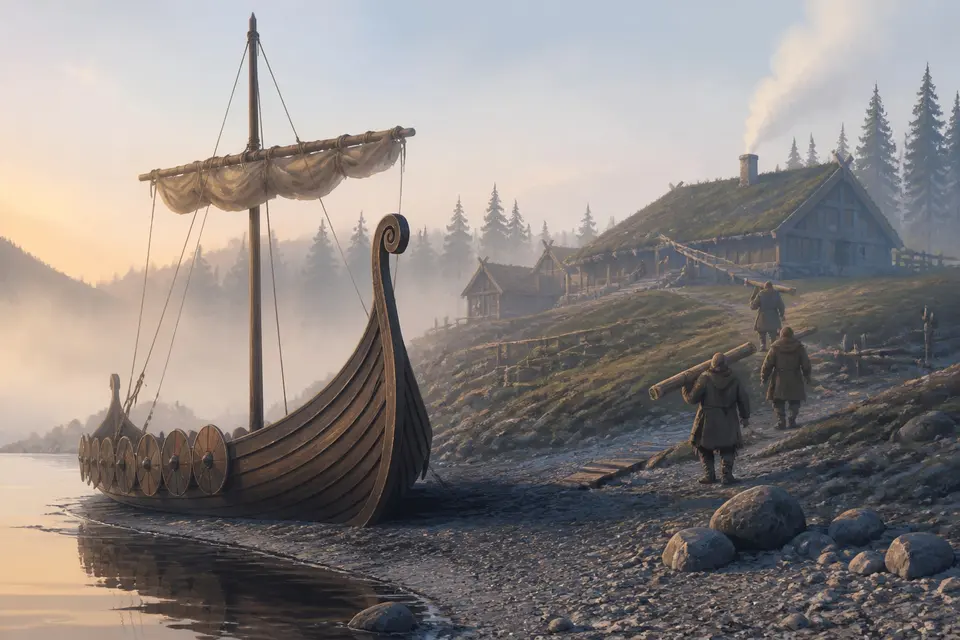
The site has eight buildings of sod laid over wooden frames, more than 800 Norse objects and traces of iron production. Finds include a bronze cloak pin, a stone spindle whorl and the remains of rough ironworking. This is a workshop and camp, not a battlefield. It looks like a specialised base for repairing boats and gathering resources, housing perhaps 70 to 90 people, not a full colony.
How do we know the date is 1021?
In 2021 a team led by Margot Kuitems published a precise date in Nature. They identified three pieces of wood cut with metal tools, which the Norse used and the Indigenous peoples of the region did not. A burst of cosmic radiation in AD 993 left a radiocarbon spike in tree rings. In each of the three objects that spike sat 29 growth rings before the bark edge, so the trees were cut in 1021. The team took 127 radiocarbon measurements across 83 rings from four objects; one object had too few rings to date.
This is a year when Norse people cut wood at this site. It is not the year Leif Erikson arrived, and it does not say when Vikings first set foot in the Americas. Earlier radiocarbon work had given a range of 990 to 1050 CE, with a mean of 1014.
What do the Vinland sagas say?
Two Icelandic sagas tell the story: the Saga of the Greenlanders and the Saga of Erik the Red. They were written down in 13th-century Iceland (roughly 1220 to 1280, with the exact dates and the relationship between the two texts debated) and describe events around 970 to 1030. That is roughly two centuries after the events, so they are not eyewitness accounts, and they contain legendary material.
They also disagree. In the Saga of the Greenlanders, a merchant named Bjarni Herjólfsson is blown off course and sights land but does not go ashore. Leif hears of it, buys Bjarni's ship, and names Helluland, Markland and Vinland. In the Saga of Erik the Red, Leif finds Vinland after his own ship is blown off course. So "Leif discovered America" is only one saga tradition, and whether either version is historical is debated. Indigenous peoples had lived on the continent for millennia.
The earliest widely cited written mention of Vinland comes from outside Iceland. Around 1075 Adam of Bremen, a German churchman, wrote in Book 4 of his history of the archbishops of Hamburg-Bremen that a land called Vinland lay in the northern ocean and was named for its wild vines. His main source appears to have been the Danish king Svend Estridson.
Where was Vinland?
Nobody knows for certain. Butternuts and butternut wood found at L'Anse aux Meadows grow no farther north than eastern New Brunswick, so some Norse must have explored into the Gulf of St Lawrence. The site itself is too far north for wild grapes.
The mainstream view, held by Wallace, is that L'Anse aux Meadows was a gateway, perhaps the saga's Straumfjörð, and that the grape and timber country lay farther south. Kirsten Seaver argues that Vinland was a broad region, possibly reaching as far south as the St. Lawrence. Calling L'Anse aux Meadows "definitely Vinland" goes beyond the evidence.
Even the name is disputed. "Wine land" is the usual reading, and Adam of Bremen says grapes. But some scholars take the first part as the homophone vin, "pasture" or "meadow." Seaver rejects that as long discarded, though the "meadow" idea guided the Ingstads' search.
Which "Viking in America" claims do not hold up?
The Vinland Map, unveiled by Yale in 1965, is a forgery. A Yale study in 2021 found a titanium compound first made in the 1920s throughout its ink, and a Latin note on the back had been overwritten in modern ink. Doubts go back to the 1970s: Yale sent the map to the chemist Walter McCrone in 1972, and his analysis found anatase in the ink, which Yale made public in 1974. The map never supported the Newfoundland case, which was dug independently from 1961.
Scholars consider the Kensington Runestone a fraud. The only genuine Norse runestone found in North America is the Kingittorsuaq stone from Greenland, found in 1824. The Maine (Goddard) penny is a real Norse coin from the reign of Olaf III (1067-1093), but its site shows no Norse settlement, its provenance is questioned, and it could have arrived by trade. Point Rosee in Newfoundland, once proposed as a second Norse site, is doubted by the provincial archaeologist, and the 2017 excavation report found no evidence of a Norse presence there.
Is there a catch in the question?
Yes, a geographical one. Greenland is part of North America, and the Norse were settled there before the Vinland voyages. L'Anse aux Meadows is usually described as the only undisputed pre-Columbian European site in the Americas outside Greenland.
Leif Erikson Day in the United States falls on 9 October. Congress authorised it in 1964, and the date marks the 1825 arrival of the sloop Restauration in New York Harbor, not any day in Leif's life.
The seafarers of the sagas shared a literary world with the myths of Asgard. For the gods themselves, see The Norse Gods: Who Is Who in Asgard and Beyond and The Nine Realms of Norse Mythology, Explained. For another popular image corrected by the evidence, see Vikings Never Wore Horned Helmets, and for the god Vikings most often wore as a pendant, see Thor in Myth vs. Thor in the Movies.
What we rely on
Ancient sources
- The Saga of the Greenlanders and The Saga of Erik the Red (13th century). Translation: Magnus Magnusson and Hermann Pálsson, The Vinland Sagas: The Norse Discovery of America (Penguin Classics, 1965).
- Adam of Bremen, Gesta Hammaburgensis ecclesiae pontificum, Book 4 (c. 1075). Edition: Bernhard Schmeidler (Monumenta Germaniae Historica, 1917).
Modern scholarship
- Margot Kuitems and others, "Evidence for European presence in the Americas in AD 1021," Nature 601 (2021): 388-391.
- Birgitta Linderoth Wallace, Westward Vikings: The Saga of L'Anse aux Meadows (Historic Sites Association of Newfoundland and Labrador, 2006).
- Anne Stine Ingstad, The Discovery of a Norse Settlement in America: Excavations at L'Anse aux Meadows, Newfoundland, 1961-1968 (Universitetsforlaget, 1977).
- Yale University, "Analysis unlocks secret of the Vinland Map: it's a fake," Yale News, 1 September 2021.