Probably yes, in some settings. Did the Vikings make human sacrifices? Several lines of evidence suggest they did: foreign accounts, a funeral on the Volga, and deposits in Danish wells. None is airtight, and no source supports the idea that sacrifice was routine.
What do the written accounts say?
Nobody who wrote about Viking sacrifice was a Viking priest. The reports come from outsiders and from later Christian writers.
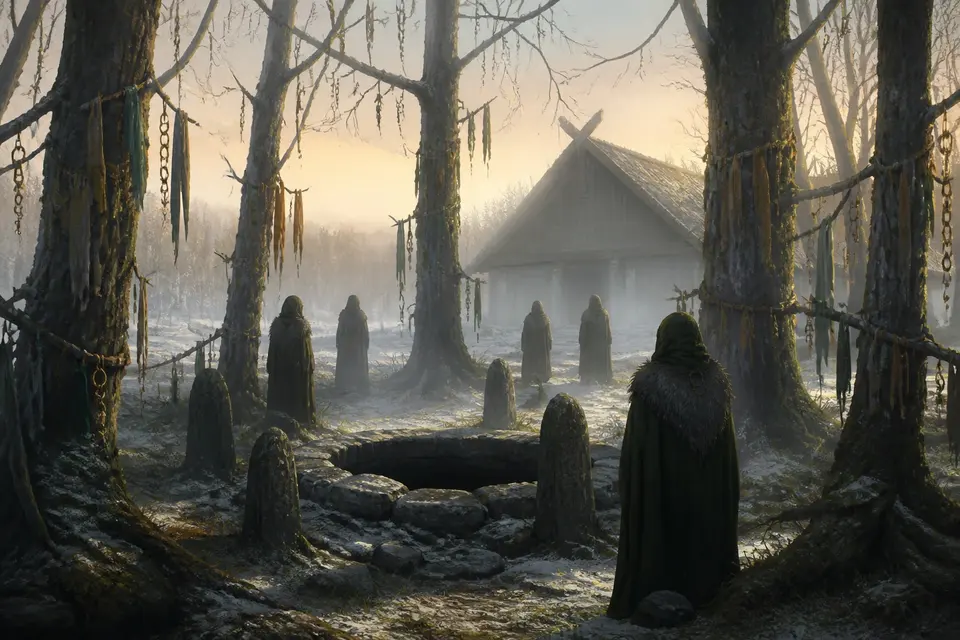
Adam of Bremen wrote his history of the archbishopric of Hamburg-Bremen between 1073 and 1076 and kept adding notes until his death. He describes a festival at the temple of Uppsala in Sweden, held every nine years. Of every male creature, he says, nine heads are offered, and the bodies are hung in the sacred grove beside the temple. Dogs and horses hang there with men (Gesta, book IV).
Adam was not there. His most explicit human details sit in added notes, including a Christian informant who claimed to have seen 72 bodies hanging. That is hearsay from an unnamed man. One scholar argues that the nine-year cycle and the human victims come straight from an earlier writer, Thietmar of Merseburg.
Thietmar (Chronicon I.17, written about 1012-18) describes a nine-year sacrifice in January at Lejre in Denmark: ninety-nine people, as many horses, and dogs and cocks. Many scholars treat the figure of ninety-nine, a multiple of nine, as literary exaggeration, and Thietmar was not an eyewitness, so the number should not be trusted. Some Danish scholarship has long dismissed both accounts as fabrication.
What happened at the funeral Ibn Fadlan saw?
In 921-22 the Arab envoy Ibn Fadlan met a group called the Rus on the Volga, probably mainly Scandinavian in origin. He describes the funeral of a chief. A slave girl volunteered to die with him. A woman called the Angel of Death put a rope round the girl's neck, two men pulled it, and she was stabbed between the ribs with a broad dagger. Six men had intercourse with her first.
This is one account of one Rus funeral, not "the Viking funeral." Ibn Fadlan's report mixes what he says he saw with what he was told, and the text is not an unmediated eyewitness record. James Montgomery notes inconsistencies in the text, and both surviving manuscripts are abbreviated versions of a longer original. The identity of the Rūsiyyah has long been debated, and some scholars doubt that the funeral reflects a purely Scandinavian rite. Other scholars accept the killing as a human sacrifice.
What does archaeology add?
The strongest evidence is not in graves. At Trelleborg on Zealand, Denmark, a ritual site older than the fortress of 980-81 held a series of wells. Human remains, five individuals in all and four of them children aged about 4 to 7, were found in some of them, alongside animal remains and objects. The Danish National Museum says finds there and at Tissø changed how archaeologists think. That the remains are human is firm. That they were sacrificed, to whom, and why is interpretation, though widely accepted.
Graves are harder to read. At Ballateare on the Isle of Man (late 9th or 10th century), a woman lay on top of a mound over a high-status man. A sharp blow, probably from a sword, had removed the back of her head. A review of Britain and Ireland found one certain and some probable cases, though contemporary writers say nothing.
Two famous cases are weaker than they sound:
- Oseberg. The ship burial dates to AD 834 and holds two women. A broken collarbone was once read as a sacrificial wound, but it had been healing for several weeks. Sacrifice is unproven.
- Birka. The relevant grave is the "Elk Man" burial, where a decapitated second person lies across an armed man. It dates to the Vendel Era (550-800 CE), before or at the very start of the Viking Age. The much-discussed "warrior woman" grave has no link to sacrifice.
Several decapitated-companion graves exist in Scandinavia. Scholars allow different readings: slaves, prisoners or convicts offered as gifts to the gods, ritual scapegoats, or servants for the afterlife.
Do the myths prove it?
No. In Hávamál stanza 138, Odin hangs on a tree and says he was given to himself. That is a myth about a god, not a record of ritual. The story is told in Odin Gave an Eye for Wisdom (and Hanged Himself for the Runes).
Snorri Sturluson's Ynglinga saga (13th century, part of Heimskringla, not Eddic) tells of King Aun, a legendary Swedish king who sacrificed sons to Odin to prolong his life. It also tells of King Dómaldi, sacrificed after three years of famine, when oxen and then people had been offered without result (ch. 15). Snorri wrote some two centuries after the conversion about legendary kings. Stories of Jarl Hákon sacrificing a son before the battle of Hjörungavágr are in Jómsvíkinga saga and other late sources.
And the blood eagle?
It is probably the best-known "Viking sacrifice" and the least secure. No contemporary account exists, and the references come centuries after the conversion. Roberta Frank argued in 1984 that the skaldic stanza about Ívarr and King Ælla only says Ívarr gave Ælla's body to the eagle as carrion. A later study agrees with Frank that the eagle can be read as the agent in the stanza, but argues that the syntax is ambiguous, probably deliberately, so a carving reading cannot be ruled out. Orkneyinga saga calls it a sacrifice to Odin. The gruesome ribs-and-lungs version appears only in much later prose.
What is the safest conclusion?
Neil Price's view is that Viking religion included performative rituals that may have included human offerings. Sacrifice probably happened at certain times and places, in funerals and at cult sites, and it was not an everyday event. The picture also varied over a long period across Norway, Denmark, Sweden and the Atlantic settlements. For the gods who may have been the recipients, see The Norse Gods: Who Is Who in Asgard and Beyond. For Thor, whom Adam places at the center of Uppsala, see Thor in Myth vs. Thor in the Movies. For another popular image that needs checking, see Vikings Never Wore Horned Helmets (So Where Did the Idea Come From?).
What we rely on
Ancient sources
- Adam of Bremen, Gesta Hammaburgensis ecclesiae pontificum (written 1073-76, with later notes), book IV, the chapters on Uppsala.
- Thietmar of Merseburg, Chronicon I.17. Translation: David A. Warner, Ottonian Germany: The Chronicon of Thietmar of Merseburg (Manchester University Press, 2001).
- Ibn Fadlan, Risala (921-22). Translation: Paul Lunde and Caroline Stone, Ibn Fadlān and the Land of Darkness: Arab Travellers in the Far North (Penguin, 2012).
Modern scholarship
- Neil Price, Children of Ash and Elm: A History of the Vikings (Basic Books, 2020).
- Roberta Frank, "Viking Atrocity and Skaldic Verse: The Rite of the Blood-Eagle," English Historical Review 99 (1984), pp. 332-43.
- James E. Montgomery, "Ibn Fadlān and the Rūsiyyah," Journal of Arabic and Islamic Studies 3 (2000), pp. 1-25.