The Greek gods do not bleed gold in Homer. He says they bleed "immortal blood," which he also calls ichor, and he gives it no colour. The golden look appears in modern popular retellings, and no ancient passage is known to describe ichor as gold.
What does Homer say ichor is?
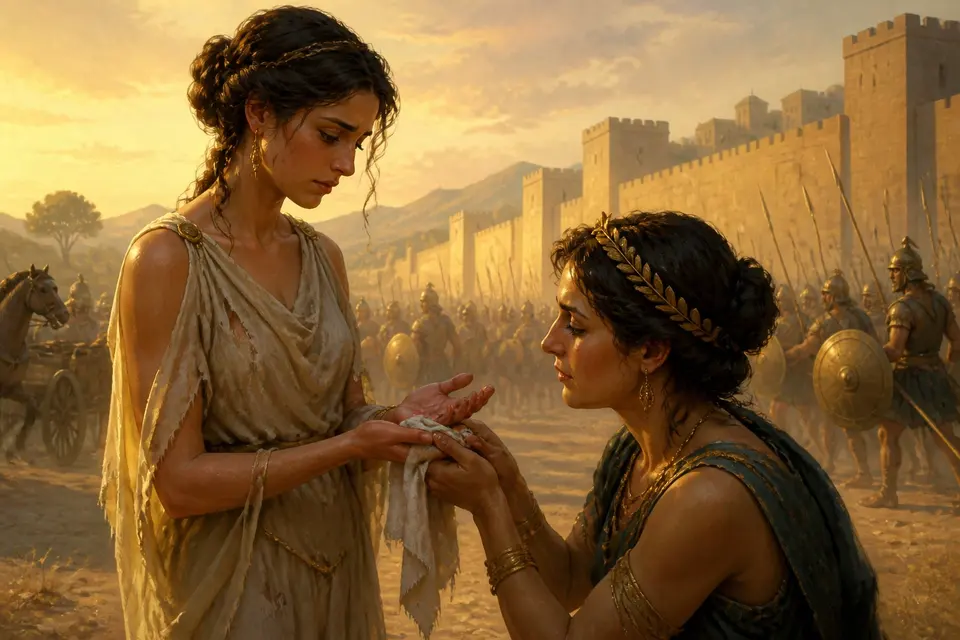
The famous scene is in Book 5 of the Iliad. The hero Diomedes, fighting at Troy, chases Aphrodite through the crowd and stabs her with a spear. The point tears through the robe the Graces made for her and cuts the hand at the base of the palm. It is a hand wound, not an arm wound, and a spear, not an arrow.
Then Homer stops to explain what comes out (Iliad 5.339-342). The goddess bleeds "immortal blood," ἄμβροτον αἷμα, "ichor, such as flows in the blessed gods." The gods eat no bread and drink no wine, he says, and therefore they have no blood and are called immortal.
Aphrodite is one of the twelve, and you can see where she sits in the family in The Twelve Olympian Gods: Who They Are and How They Are Related. Her mother Dione takes her in her arms and wipes the ichor away with both hands (5.416-417). The pain eases and the hand is made whole.
Is ichor blood or something else?
A popular slogan says "ichor, not blood." That is a simplification. Homer's phrase is "immortal blood," and only then does he name it ichor. His logic is a "therefore": the gods lack ordinary blood because their diet is not human.
Notice what he names as the cause: no bread, no wine. Ambrosia and nectar do not appear in these lines. The common explanation that ambrosia and nectar produce ichor is an inference. An old scholium (an ancient note on the text) says the phrase is elliptical and should be completed with nectar and ambrosia. That is an ancient reading of Homer, not Homer's own words, and it is debated.
The word is also rare. Homer uses it for the divine equivalent of blood only twice, at Iliad 5.340 and 5.416.
Did Ares bleed ichor too?
Ares is wounded in the same book, but the text does not say "ichor." Ares shows Zeus the immortal blood flowing from his wound (5.870). Many popular pages say ichor poured from Ares, and that goes a step beyond Homer. Like Aphrodite, he recovers fast: the healer Paieon treats him (5.899-904).
Divine wounds hurt, then close. Compare Achilles in Achilles: The Hero Who Chose a Short Life, where a wound can end everything. For the war in which all this happens, see Was the Trojan War Real?.
Where did the gold come from?
Homer gives ichor no colour. He also does not say it harms mortals, though some popular sites claim it is poisonous, with no ancient source given.
The best ancient comparison points away from gold. In Apollonius Rhodius, the bronze giant Talos grazes his ankle on a rock and ichor pours out "like molten lead" (Argonautica 4). In the Library attributed to Apollodorus, a nail seals his single vein (1.9.26).
"Golden" ichor appears in modern popular retellings and fantasy, and no ancient passage is known to say it. Where the image first arose is unclear. Rick Riordan's Percy Jackson series uses ichor explicitly, and that is the modern layer most readers meet first. For why such retellings are everywhere, see Why Greek Myths Are Being Retold Right Now.
How did the word change after Homer?
Later Greeks used ἰχώρ for fluids that had nothing to do with gods. The standard lexicon (Liddell, Scott and Jones) lists a medical sense: the watery part of animal juices, or serum. Examples include Hippocrates, Plato (Timaeus 83c) and Aristotle (History of Animals 521b2). It also covers a thin discharge from a wound. In Aeschylus (Agamemnon 1480) it means simply "blood."
The Christian writer Clement of Alexandria used this medical sense against the old gods. He argued that if gods have wounds, they have blood, and that "the ichor of the poets" is even more repulsive.
The origin of the word is uncertain. R. S. P. Beekes suggests it may be pre-Greek, but other scholars call many of his pre-Greek etymologies contentious. English took the word later: the Oxford English Dictionary's earliest example is from 1638, and by the late 1600s it was used for the blood of the classical gods. For other words that crossed from myth into English, see 14 Everyday Words That Come From Greek Myths.
Who quoted ichor to Alexander the Great?
Alexander was wounded, and the story says someone answered with Homer. Our sources disagree on who.
In Plutarch's Life of Alexander (28), Alexander himself speaks. Hurt by an arrow, he tells his companions that what flows is blood, not "Ichor, such as flows from the veins of the blessed gods." In Plutarch's essay on Alexander's fortune (Moralia 341b) the wound is to the ankle (rendered "heel" in some older translations), from an Indian missile, and he smilingly says it to his flatterers.
Athenaeus tells a different version. He cites Aristobulus for the claim that Dioxippus, an Athenian wrestler and boxer, quoted the Homeric line when Alexander was wounded. The line quoted is the Homeric one, Iliad 5.340. In one account the king quips, in the other a bystander does. Both show how well known the passage was.
What we rely on
Ancient sources
- Homer, Iliad 5.334-342, 5.416-417, 5.870, 5.899-904. Translation: A. T. Murray, Loeb Classical Library (1924).
- Apollonius Rhodius, Argonautica 4.1638-1688 (Talos); [Apollodorus], Library 1.9.26.
- Plutarch, Life of Alexander 28, and On the Fortune or Virtue of Alexander (Moralia 341); Athenaeus, Deipnosophistae Book 6 (the Dioxippus anecdote), Loeb translation by C. B. Gulick.
Modern scholarship
- Liddell, Scott and Jones, A Greek-English Lexicon, s.v. ἰχώρ.
- R. S. P. Beekes, Etymological Dictionary of Greek, vol. 1 (Brill), pp. 607-608.
- Oxford English Dictionary, s.v. "ichor."