Atlantis first appears in two dialogues by Plato, the Timaeus and the Critias, written about 360-355 BCE: an island power beyond the Pillars of Heracles that attacked Athens and vanished in a single day and night of disaster. No earlier author describes it, and most scholars think Plato invented it to make a political point.
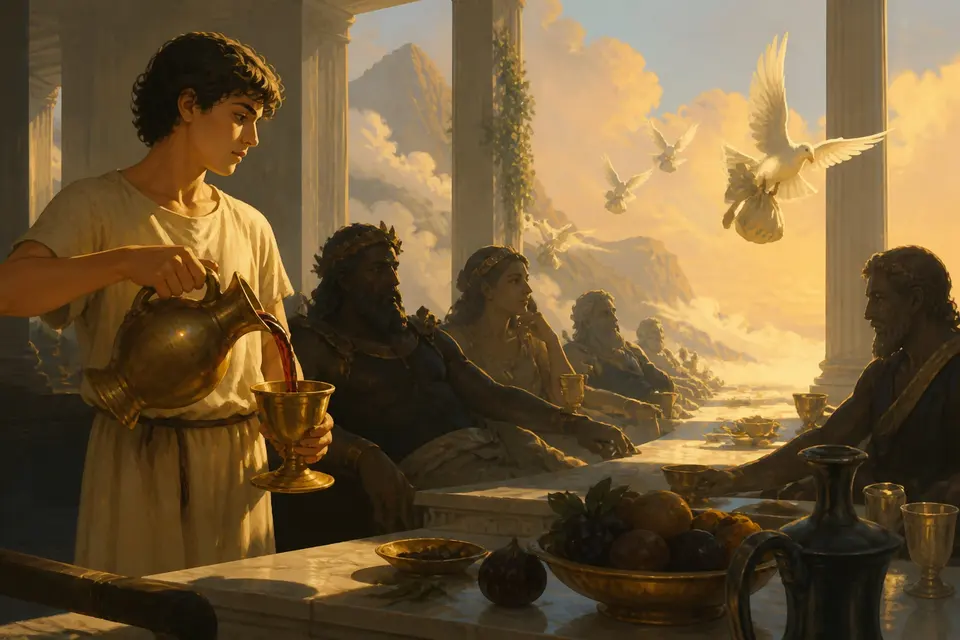
In the Timaeus, a small group of men meet for a conversation the day after a long discussion of the ideal state. One of them, Critias, offers to repay the host with a story. It is, he warns, a very strange one, but entirely true, because Solon, the wisest of the Seven Sages, vouched for it. Solon had it from priests in Egypt. He told it to a relative named Dropides, who told it to his son, the elder Critias, who told it to his grandson, the Critias now speaking. The chain is carefully built, and that care is the first thing to notice. Plato gives his tale a line of witnesses, the way a historian would, and then puts it in the mouth of a character in a dialogue.
This guide keeps four things apart: what Plato wrote, why he probably wrote it, how the ancients read it, and what modern writers added. Only the first is Atlantis in the strict sense.
What Plato wrote
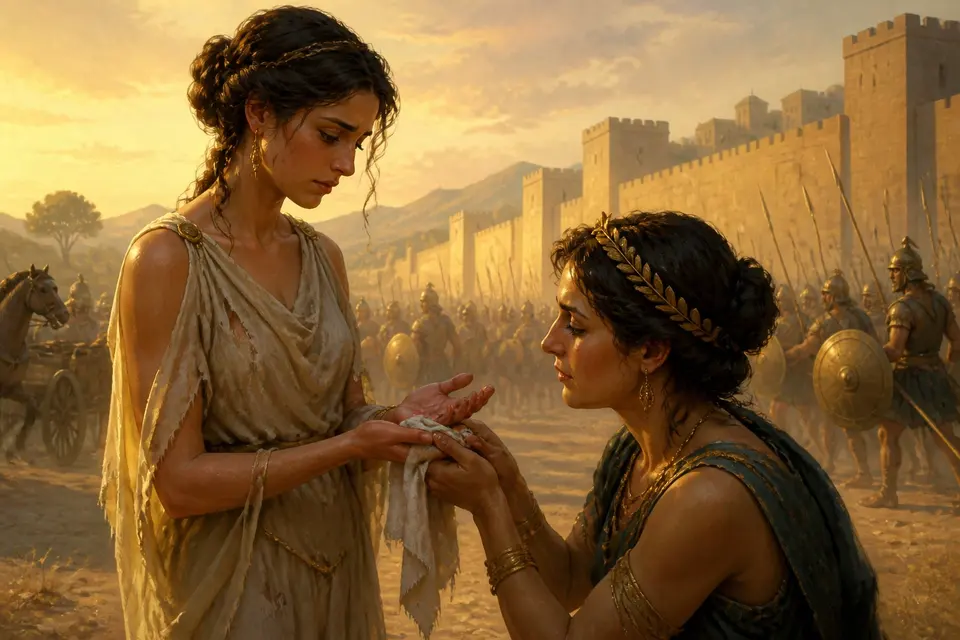
The story is told in Timaeus 20d-25d and continues in the Critias (108e-121c), which breaks off unfinished. Solon, according to the tale, visited the Egyptian city of Sais; Plato gives no date, but scholars usually place his travels around 590 BCE, soon after his reforms. A priest there told him that the Greeks were like children, because they had no old records. Greece and Egypt had both been struck many times by great catastrophes, by fire and by water, the priest said, but Egypt had been spared the worst, and so its temples kept the written memory of the past.
Among the oldest deeds recorded there was a war. Nine thousand years before Solon, according to the priest, Athens already existed, and it was a city of the ideal kind: its warriors were set apart from other classes, and its laws were good. Egypt's own city came a thousand years later, by the priests' count. Against this Athens came a power from the Atlantic. Plato calls it an island (nēsos) lying in front of the Pillars of Heracles, larger, he says, than Libya and Asia together. For the Pillars themselves, see Why Hercules Really Had to Do the Twelve Labors.
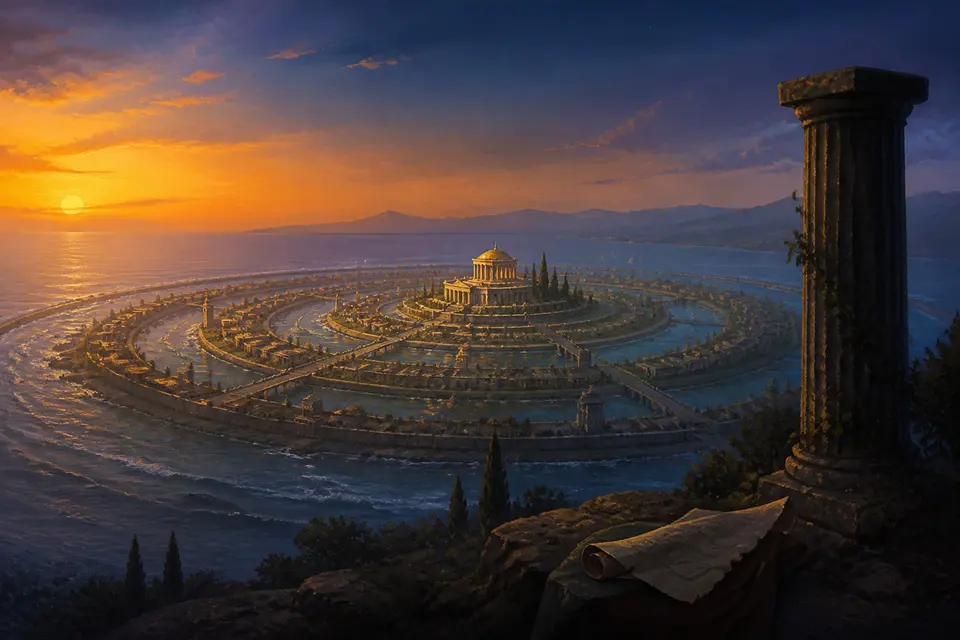
The Critias fills in the island. Poseidon, who received it as his share when the gods divided the earth, fathered ten sons by a mortal woman, and the eldest, Atlas, became its first king. This Atlas is a human, not the Titan of Hesiod. For Poseidon among the other gods, see The Twelve Olympian Gods. Plato describes a capital of concentric rings of land and water, rich in metals and harbors, and a dynasty that was good while it remembered its divine part and grew greedy when that faded.
The attack failed. According to the Timaeus (25c-d), Athens stood alone, after the other Greeks had fallen away, and won. Then came "portentous earthquakes and floods," and in "one grievous day and night" (Bury/Lamb translation) the Athenian warriors were swallowed by the earth and the island by the sea. The sea there, the priest adds, is still impassable, blocked by the mud the island left behind.
Notice what is not in Plato. He does not call Atlantis a "lost continent" (that is a modern gloss). He gives no calendar date such as "9600 BCE" (a later calculation from his numbers). He does not name the priest. Plutarch, writing centuries afterward, gives Egyptian priest names for Solon's teachers, but they come from Plutarch, not from the dialogue.
| Plato's text | Added later |
|---|---|
| An island beyond the Pillars of Heracles | A "lost continent" |
| 9,000 years before Solon | "c. 9600 BCE," a modern calculation |
| Atlas, a human king, son of Poseidon | The Titan Atlas of Hesiod |
| Earthquakes and floods, and "one grievous day and night" (Bury/Lamb translation) | A volcanic eruption (a modern proposal) |
| An unnamed Egyptian priest, speaking to Solon | Trance "readings" and secret doctrines |
Why he wrote it
The setting tells us a lot. The Timaeus opens by recalling the long conversation of the Republic about the best city, and the Critias continues the Timaeus. The story of Atlantis is offered as a way of seeing that ideal city in action. Christopher Gill reads the philosophical point as political: ancient Athens stands for the ideal state, and Atlantis is its opposite, a proud sea empire. Kathryn Morgan likewise argues that at its most basic the myth puts the Republic's model state into motion as a narrative, and she roots it in the ideology of fourth-century Athens. The Laws (676a-677c) offers a neighbouring theme, the idea that humanity has been repeatedly reduced by floods and plagues to a remnant, which is the background to the priest's lecture.
Plato's claim that the story is true is, on Gill's reading, a literary device. His method is typical of him: he gives a myth the weight of a witness chain, not the voice of a god. Greeks had other ways of asking about the past, such as the oracle at Delphi (see The Oracle of Delphi), but Plato chose an Egyptian archive and an Athenian lawgiver.
So what do scholars conclude? The majority view, held by classicists such as Broadie, Gill and Nesselrath, is that Plato invented the story as a parable or cautionary tale. Pierre Vidal-Naquet puts it sharply: Plato drew on the culture of his time, but the myth of the lost island, inseparable from an equally imaginary Athens, is his own work. A minority disagrees. Some argue for an older chain of tradition behind the tale. Others see Plato reacting to events of his own lifetime, such as the disastrous Athenian expedition to Sicily (415-413 BCE) or the destruction of the city of Helike by earthquake and wave in 373 BCE.
The name does have earlier uses, which causes confusion. Hellanicus of Lesbos wrote a lost work called Atlantis about the daughters of the Titan Atlas. Herodotus (4.184) mentions a people, the Atlantes, living near Mount Atlas, and Hesiod (Theogony 938) uses the word as an adjective ("Atlas's daughter" for Maia). None of them describes an island empire. A fragment of Hellanicus is cited by those who defend a pre-Platonic tradition, and that argument is still debated.
How the ancients read it
Ancient readers did not agree either, and that matters, because it shows that doubt about Atlantis is nearly as old as Atlantis.
The earliest known reader is Crantor, whom Proclus calls the first commentator on Plato. His own work is lost, so we know him only through Proclus, writing in the fifth century CE. According to Proclus, Crantor took the story as plain history. Crantor also reported that Plato's contemporaries mocked him for not being the true inventor of the Republic, and for copying Egyptian institutions; Plato, in answer, assigned the story of Athens and Atlantis to the Egyptians. Proclus adds that Egyptian priests testified to this, saying it was written on pillars still preserved. Take care here: Proclus does not say that Crantor himself read the pillars, and the subject of that sentence is ambiguous in the Greek. Scholars still argue about how much of this Crantor actually said.
Then there is the famous quip, "the man who invented it made it vanish." It is often credited to Aristotle. The actual evidence is thinner. Strabo (2.3.6) quotes Posidonius, who thought it better to handle the matter differently than to say, of Atlantis, "its inventor made it disappear, as the Poet did with the wall of the Achaeans." So Posidonius cites the joke in order to reject it. The attribution to Aristotle is a modern inference from another passage in Strabo (13.1.36), where Aristotle is quoted on the invented wall in the Iliad, and it remains contested. The wall belongs to Homer's world, and for a case where a Greek poem does touch a real place, see Was the Trojan War Real?.
The Neoplatonists read the Timaeus as a symbolic work. Proclus treats allegory as central to understanding the dialogue, and he cites earlier commentators, Porphyry and Iamblichus, who read it at a symbolic level.
What modern writers added
Everything in this section is later than Plato, and none of it comes from the ancient texts.
In 1882 the American politician Ignatius Donnelly published Atlantis: The Antediluvian World (Harper & Brothers), usually classed as pseudo-archaeology. He took Plato's account as basically factual and tried to prove that all civilizations descended from the lost land. According to Donnelly's critic Colavito, he also imagined a superior white race ruling it. That claim has no basis in Plato, who says nothing about race at all.
Helena Blavatsky took Donnelly up in The Secret Doctrine (1888), where the Atlanteans became the fourth "root race," followed by the fifth, the "Aryan." The Theosophical Society in America itself notes that Blavatsky's Atlantis is not Plato's. W. Scott-Elliot elaborated the scheme in The Story of Atlantis (1896). In 1932 Edgar Cayce, an American trance medium, gave a series of sixteen "readings" about Atlantis, with no independent verification, and summaries of his dates for the final destruction vary (about 10,000 BCE in some, 9,500 BCE in A.R.E. material).
The racial thread is the darkest part of the story. Vidal-Naquet, in "Atlantis and the Nations" (Critical Inquiry, 1992), shows that nationalists across Europe, from Spain to Sweden and from Italy to Germany, claimed the island as an ancestral homeland, most grimly under Hitler. In Germany, Herman Wirth published Der Aufgang der Menschheit in 1928 on an "Atlantic-Nordic" race and, in 1935, founded and directed the SS Ahnenerbe, before Himmler removed him. Alfred Rosenberg's Mythus (1930) likewise placed the origin of the "Nordic race" in Atlantis. Rosenberg's circle and Wirth's quarreled, so even the Nazi appropriation was not one doctrine. Popular articles claim that the Ahnenerbe scoured the world for the island, but those claims rest on weak sources. The same book of Vidal-Naquet records a counter-use: in the Theresienstadt camp, a poet and a musician cast the tyrant who held them prisoner as the emperor of Atlantis.
The best-known respectable-sounding proposal is the Minoan one. The Greek archaeologist Spyridon Marinatos published "The Volcanic Destruction of Minoan Crete" in Antiquity in 1939, and that article was about the end of the Minoan civilization, not about Atlantis. He tied the two together only later, in a paper published in 1950 ("On the Legend of Atlantis", Cretica Chronica). The idea has real attractions: a sea-power of the Aegean Bronze Age, struck by a volcano on Thera (Santorini), is a believable disaster, and for Minoan Crete see The Minotaur and the Real Labyrinth of Knossos. But it does not fit Plato's text. He places Atlantis beyond the Pillars of Heracles, not in the Aegean, makes it larger than Libya and Asia together, and dates it nine thousand years before Solon. The proposal explains a possible inspiration for disaster stories in general. It does not explain why Plato built this one, or what the story does in his argument. The idea of a continent-sized landmass sinking in the Atlantic within human history is not accepted by earth scientists. For a sober survey of such claims, see Kenneth Feder's Frauds, Myths, and Mysteries.
Why the story does not die
Part of the answer is in the text. Plato wrote a tale with a witness chain, a precise number, a fall, and no ending, since the Critias stops mid-story. Part is in the age: stories of drowned worlds attract readers, and for an older one, see The Flood Story Before Noah. And part is that real Greek stories sometimes do rest on real names and places, as King Midas Was a Real Name shows, so readers suspect Atlantis might too. The evidence says it is a different kind of story. It lasts because it is useful, which is also why Greek myths keep being rebuilt for new audiences: see Why Greek Myths Are Being Retold Right Now.
Quick answers
- Did Plato name the Egyptian priest? No. Plutarch (Solon 26.1) names two priests, Psenophis of Heliopolis and Sonchis of Sais, and says Solon tried to turn the story into verse. Plutarch (Solon 31.3) says Solon gave up the poem because of old age.
- Did anyone in antiquity treat it as a joke? Possibly. Theopompus of Chios wrote of a land called Meropis beyond the ocean, which may be a parody.
- Was this a Swedish idea before it was a German one? Nationalist use has a long history. Olof Rudbeck's Atlantica (1679) is the Swedish precedent that Vidal-Naquet notes.
What we rely on
Ancient sources
- Plato, Timaeus 20d-25d and Critias 108e-121c. Translations: R. G. Bury, Timaeus, Critias, Cleitophon, Menexenus, Epistles (Loeb Classical Library, 1929); Benjamin Jowett (1871). Edition: Christopher Gill, Plato: The Atlantis Story (Bristol Classical Press, 1980).
- Plato, Laws 3.676a-677c (recurring catastrophes).
- Strabo, Geography 2.3.6 and 13.1.36.
- Plutarch, Life of Solon 26.1 and 31.3.
- Proclus, Commentary on the Timaeus. Translation: Harold Tarrant, Proclus: Commentary on Plato's Timaeus, vol. 1 (Cambridge University Press, 2007).
- Herodotus 4.184 and Hesiod, Theogony 938 (earlier uses of the name).
Modern scholarship
- Pierre Vidal-Naquet, L'Atlantide: Petite histoire d'un mythe platonicien (Les Belles Lettres, 2005); English translation by Janet Lloyd, The Atlantis Story (University of Exeter Press, 2007).
- Pierre Vidal-Naquet, "Atlantis and the Nations," translated by Janet Lloyd, Critical Inquiry 18.2 (1992), 300-326.
- Kathryn A. Morgan, "Designer History? Plato's Atlantis Story and Fourth-Century Ideology," Journal of Hellenic Studies (1998).
- Kenneth L. Feder, Frauds, Myths, and Mysteries: Science and Pseudoscience in Archaeology (McGraw-Hill).
- Spyridon Marinatos, "The Volcanic Destruction of Minoan Crete," Antiquity 13 (1939), 425-439; "On the Legend of Atlantis," Cretica Chronica (1950).
- Ignatius Donnelly, Atlantis: The Antediluvian World (Harper & Brothers, 1882).
- Helena P. Blavatsky, The Secret Doctrine (1888); W. Scott-Elliot, The Story of Atlantis (1896).