The Greek gods eat ambrosia and drink nectar. That is Homer's default, and it sets them apart from mortals, who eat bread and meat and drink wine. Homer even links the gods' diet to their bodies: in the Iliad they have no blood because they take no bread or wine.
What are ambrosia and nectar?
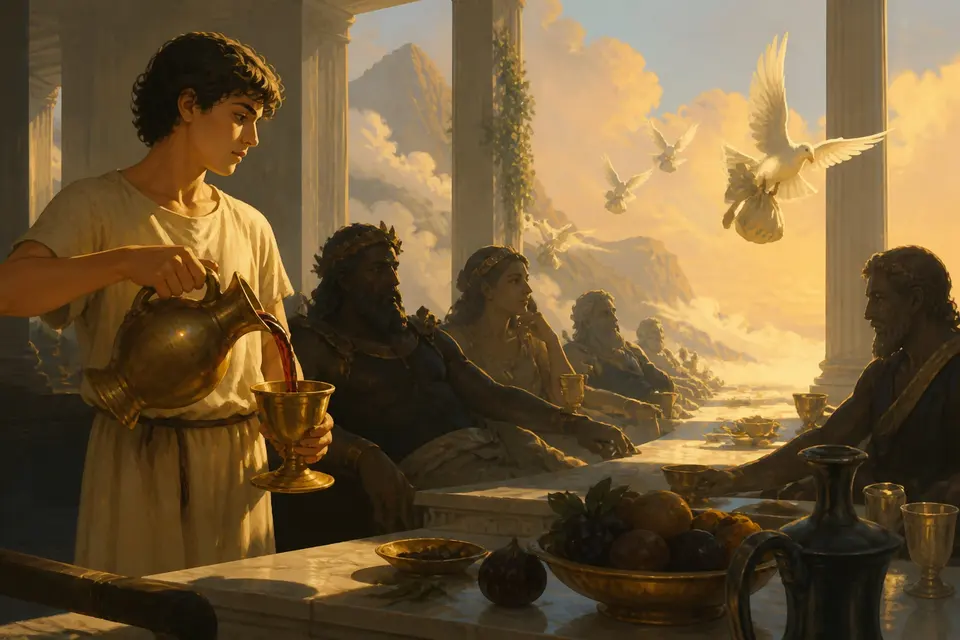
In Homer, ambrosia is the food of the gods and nectar is their drink. At the feast on Olympus, Hephaestus pours nectar for the assembled gods (Iliad 1.597-600), and Hebe pours it as they watch the fighting at Troy (Iliad 4.1-3).
The pairing is not fixed in all Greek poetry. In the poet Alcman nectar is the food, and in Sappho and the comic poet Anaxandrides ambrosia is the drink. The 1911 Encyclopaedia Britannica reports these variants. A modern scholar (Wright) has suggested that Anaxandrides, a comic poet, may be inverting the pair for a joke.
Ambrosia has other uses in Homer. It is fodder for the gods' horses, and Hera cleans herself with it and anoints herself with ambrosial oil. It also serves as a preservative rubbed on a corpse, and as a scent strong enough to cancel any other smell. In the Odyssey it covers the stink of seal skins for Menelaus' men. Athena even puts nectar and ambrosia into Achilles so that hunger will not weaken him. Doves bring ambrosia to Zeus each day, according to Homer.
Why do the gods have ichor instead of blood?
When Diomedes wounds Aphrodite in Iliad 5, what flows from her is ichor, not blood. Homer explains it in a few lines (5.339-342): the gods eat no bread and drink no flaming wine, so they are bloodless, and so they are called immortals. The chain is diet, then no blood, then the name "immortal."
Note what Homer does not say. He does not say that ambrosia turns blood into ichor. That link is a later or modern synthesis. The wound itself is not fatal: Dione wipes the ichor from Aphrodite's arm and it heals (5.416-417). Ares is wounded later in the same book. Gods can be hurt in Homer, but they do not die as men do.
Scholars read this logic in different ways. Martin Nilsson reads it as a rationalizing move: the gods must differ physically from men, so their food is different. Harry Levy cites Nilsson, and H. J. Rose, in his short study of the immortality of Homer's gods. Rose, quoted by Levy, suggests that opinions probably differed on how well the divine diet worked, since eating ambrosia even briefly could make a man immortal. The popular claim that gods are simply immortal and the food is decoration is a modern gloss. Homer ties immortality to diet.
Do the gods ever eat human food?
The clearest scene is in Odyssey 5. On Calypso's island she serves Hermes ambrosia and red nectar (5.91-94). Later she sets food before Odysseus "such as mortal men eat," while her maids bring ambrosia and nectar for her (5.196-199). Two diets sit at one table.
The boundary between gods and people is also drawn at the altar. In Hesiod's Theogony (about lines 535-557), Prometheus sets out two portions: meat and rich inner parts hidden under an ox's stomach, and white bones dressed in shining fat. Zeus chooses the bones and is angry, and that is why men burn white bones for the deathless gods while keeping the meat. Hesiod's point is that mortals eat the meat and the gods receive the offered portion. For the whole story, see Prometheus: The Titan Who Stole Fire.
Do the Greek gods drink wine?
Not in Homer's account of their diet, which says they drink no wine. When the Cyclops tastes Odysseus' wine he calls it "ambrosia and nectar" (Odyssey 9.357-359), but that is a mortal's compliment, not proof that gods drink wine.
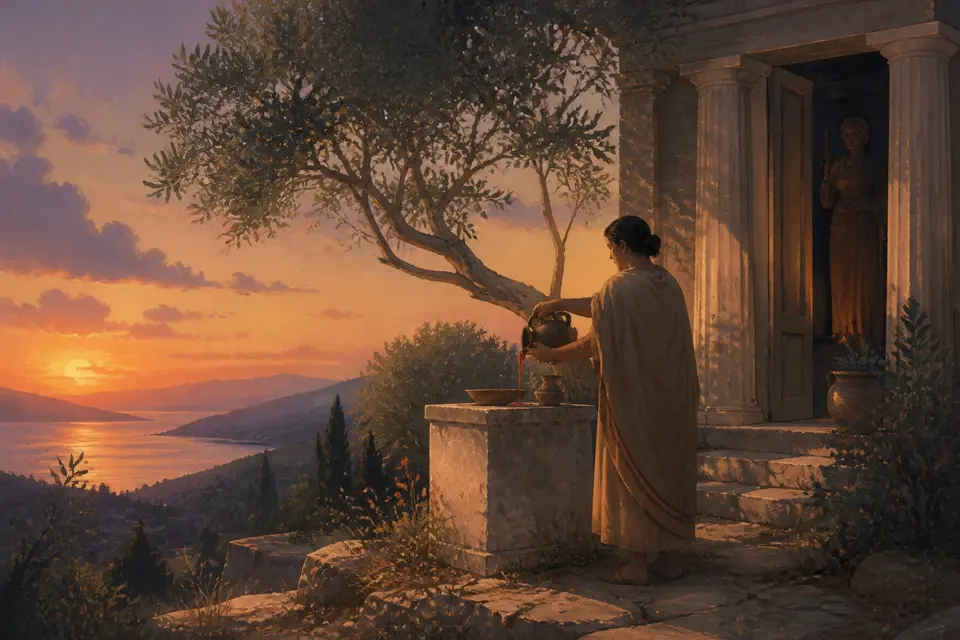
Nectar is called red in the Odyssey, and some readers have taken it to be a kind of wine. That is an interpretation, not Homer's statement. Wine offerings poured to the gods and the wine god Dionysus are a separate matter from Homer's diet logic.
What happens when a god loses ambrosia?
Hesiod gives one case. A god who swears a false oath on the river Styx lies breathless for a year and is kept from nectar and ambrosia (Theogony 793-797). That is a penalty for one perjurer, not a rule that gods weaken without ambrosia.
The food can also be given on purpose. In the Homeric Hymn to Apollo (3.123-125), Themis feeds the newborn god nectar and ambrosia. In Pindar's Pythian 9, the centaur Chiron foretells that the Horae and Earth will drip nectar and ambrosia on the infant Aristaeus' lips to make him immortal.
Pindar's Tantalus shows the risk of sharing it. In Olympian 1 (55-64), the gods had already made Tantalus incorruptible with nectar and ambrosia, and he gave them to his drinking companions. Pindar rejects the story that he fed his son Pelops to the gods. Other writers name different crimes, such as an unbridled tongue (Euripides, Orestes) or revealing the gods' mysteries (Apollodorus).
Much later, Apuleius has Psyche eat ambrosia on Olympus and marry Eros as a god. See Cupid and Psyche: The Story Behind the Word "Psychology".
What do the words ambrosia and nectar mean?
"Ambrosia" seems to come from ambrotos, "immortal," built from a- ("not") and brotos ("mortal"). It is linked to Sanskrit amṛta, and both probably come from an Indo-European form meaning "un-dying." A. W. Verrall, an older scholar, denied that the word clearly means "immortal" and preferred "fragrant."
"Nectar" is presumed to combine roots for "death" and "overcoming." That is debated, and Merriam-Webster says only that the word may have implied immortality. The idea that both were kinds of honey is Roscher's theory, reported in the 1911 Britannica. It is a guess, as is the claim that nectar is wine.
Two popular claims find no support in the Homeric passages. One is that ichor is golden and deadly to mortals. Another is that the Titans bled ichor. The Iliad says neither.
For who the gods at these feasts are, see The Twelve Olympian Gods: Who They Are and How They Are Related.
What we rely on
Ancient sources
- Homer, Iliad 1.597-600, 4.1-3, 5.339-342, 5.416-417. Translation: A. T. Murray, Loeb Classical Library (1924).
- Homer, Odyssey 5.91-94, 5.196-199, 9.357-359. Translation: Ian Johnston (online edition).
- Hesiod, Theogony 535-557 (the sacrifice at Mekone) and 793-797 (the Styx oath), with Pindar, Olympian 1.55-64 (Tantalus).
Modern scholarship
- Harry L. Levy, "Homer's Gods: a Comment on their Immortality," Greek, Roman, and Byzantine Studies.
- "Ambrosia," Encyclopaedia Britannica, 11th ed. (1911).