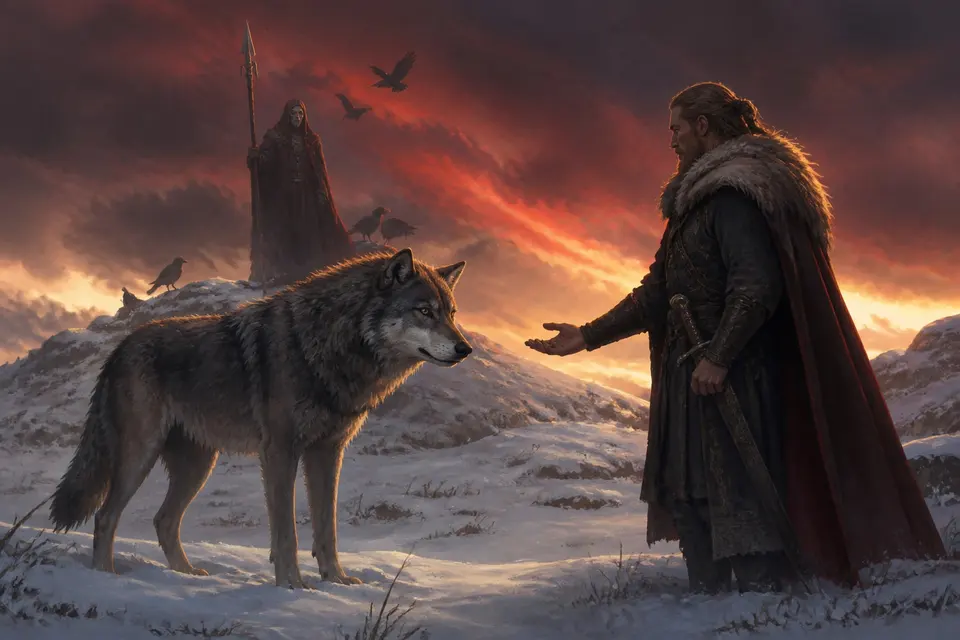
The gods are standing around a wolf, and nobody wants to put a hand in his mouth. The wolf is Fenrir, and he has agreed to be bound with a ribbon called Gleipnir on one condition: a god must hold a hand between his jaws as a pledge that nothing is wrong. Every god steps back except one. Týr slides his right hand in, the ribbon tightens, Fenrir cannot break it, and the pledge is called in. The wolf bites the hand off.
That scene is why the question "who is the Norse god of war?" has a stranger answer than it should. The answer most people expect is Odin, because he is the one-eyed ruler of the gods. The answer many reference works give is Týr. Both can be defended, and the difference tells you a lot about how the old stories divided their work.
Týr: war, law, and a promise that costs a hand
Týr is the god most often labeled the Norse god of war, and he is the one who gives a fight its rules. Scholars note that his link to both war and law is pieced together from scattered evidence rather than stated in one text. One argument is that from a Germanic point of view there was no contradiction between the two: a war could be ordered by law, and a legal oath could be sworn by a god who stood for both.
The Fenrir episode fits that reading. Týr is the god who keeps his word, and the wolf's bite is what a broken promise costs when the one keeping it is the only honest party. The story is told in Snorri Sturluson's Prose Edda, in the section called Gylfaginning. Some accounts add that Týr had helped trick the wolf, and the French scholar Georges Dumézil read that deceit as weakening Týr's standing as a god of law. The sources do not agree on every detail, and that disagreement is part of the evidence.
Týr also left a mark on the calendar. His name is the origin of the English word Tuesday. The Roman week had a day for Mars, called dies Martis, and Germanic speakers matched the Roman war god with Týr, so the old English day became Tiwesdæg, the day of Tiw, which is Týr.
Odin: the god who chooses who dies
Odin works on the other side of the battlefield. He does not fight by rules, he decides outcomes. In the sources, his Valkyries are the warrior handmaidens who select which fallen heroes deserve a place in Valhalla, the great hall in Asgard that Odin heads. The warriors chosen become the einherjar, a word usually translated as single fighters.
Not every dead warrior goes to Odin. One account says the Valkyries choose half of the slain, and the other half go to the goddess Freyja's field, Fólkvangr. The einherjar train and feast in Valhalla, and the reason is Ragnarök, the final battle, where Odin is fated to fall, swallowed by the wolf Fenrir.
So Odin's war is not the clash itself. It is victory and death as a kind of selection: who wins, who is taken, who joins the army waiting for the end.
A god of war, or two different jobs?
If you want one name, the cleanest answer is that the question hides two jobs. Týr is tied to war as something governed by oath, courage and law. Odin is tied to war as fate, frenzy and the afterlife of the fallen. Sources that call Týr the war god and sources that call Odin the war god are often describing different halves of the same thing.
Be careful with the details around Týr, because the sources disagree. Some say Odin is his father, while others make the giant Hymir his father. One account even claims he was not officially a god of law at all and that the title belonged to Forseti, a claim that conflicts with most of the other sources. Popular websites also repeat material that has no source behind it, so the safest reading stays with what the old texts and established reference works agree on.
So which one is it?
If your question is who decides the outcome of a battle and who receives the dead, the sources point to Odin. If your question is which god stands for war with rules, oaths and a price, the sources point to Týr. The Norse myths do not give one tidy title to one god, and the missing hand in the wolf's mouth is the best reminder of why.
Sources
- Týr, Encyclopaedia Britannica
- Týr (deity), EBSCO Research Starters
- Týr, New World Encyclopedia
- The Lore of Týr, Ar nDraiocht Fein
- Valkyries and Einherjar, Vikingr
- Snorri Sturluson, Prose Edda (Gylfaginning), and the Poetic Edda (Lokasenna), where the stories of Fenrir and the gods are told