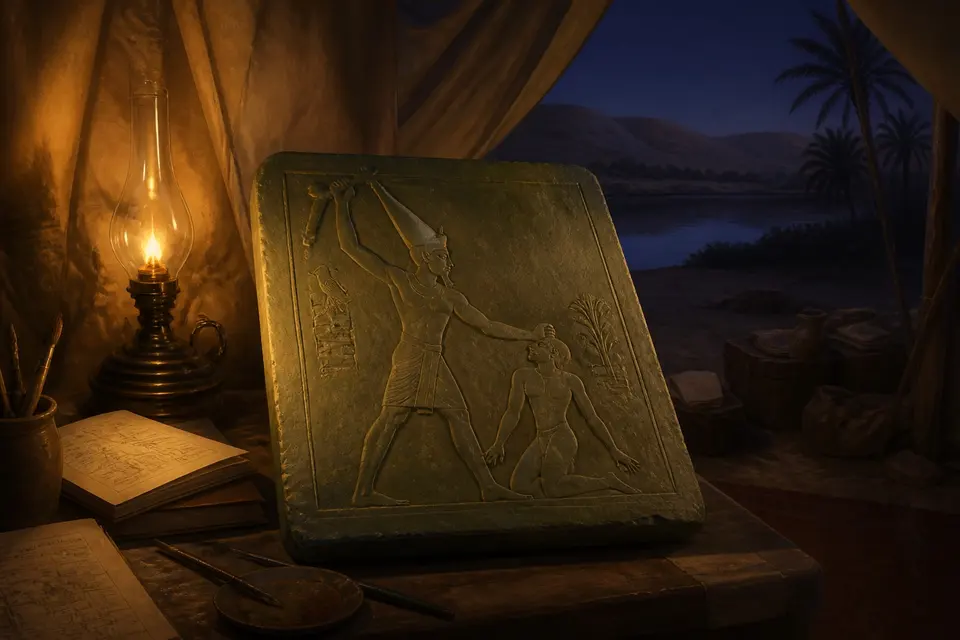
Egypt had no "pharaoh" at the start: the word came centuries later, and the earliest rulers were simply kings. The ancient king lists give Menes as the first king of the First Dynasty, while the archaeology points to Narmer. Scholars still debate whether they are the same man.
Was the first ruler even called a pharaoh?
No. The word comes from the Egyptian per ʿaa, "great house," which originally meant the royal palace. Under the New Kingdom it came to stand for the king himself, and by the 22nd Dynasty it was an epithet of respect, never his formal title. Our habit of calling every Egyptian king a pharaoh rests on the Hebrew Bible's usage.
The earliest confirmed use for a living ruler is a letter to Akhenaten (about 1353-1336 BCE), possibly preceded by an inscription referring to Thutmose III. Which of the two came first is debated. Either way, it is more than a thousand years after the First Dynasty.
The early kings had their own titles: a Horus name, a Sedge-and-Bee name (nswt-bjtj) and a Nebty name. Ordinary speech used nesu, "king." That is the word to use for this period, and it is the one this page uses. The popular image of "the pharaoh" is a later one, as the guide to the curse of the pharaohs shows.
Why do the king lists say Menes?
Two Egyptian lists open with a king called Meni (Menes). The Abydos King List names 76 kings on a wall of Seti I's temple at Abydos, and its first cartouche is Meni. The Turin Canon makes Menes the first human king, coming after the divine and demi-god rulers. For those gods, see The Egyptian Gods: Who Is Who.
Both lists date to the Nineteenth Dynasty, roughly 1,800 years after the events. They record a remembered beginning, not a contemporary record.
The Greek tradition says the same. The Greek form "Menes" that we commonly use comes from Manetho, a priest of the Ptolemaic period. The Egyptian form Meni appears much earlier, in the Nineteenth Dynasty king lists. Herodotus gives the variant "Min," which may have been influenced by the name of the god Min. Britannica calls Menes the legendary first king of unified Egypt and notes that he is credited with founding Memphis. That is the Greek-era tradition, not archaeology. Few objects name Menes, and the rare ones do not clearly mark him as the first king of the First Dynasty.
What does the Narmer Palette show?
James Quibell found the palette at Hierakonpolis in 1897-98. On one side the king wears the crown of Upper Egypt, and on the other the crown of Lower Egypt. His name is written on both sides with a catfish (nar) and a chisel (mer). The signs show how early Egyptian writing already worked; for the god later credited with it, see Thoth and the invention of writing.
The object is solid. The reading is not. That the palette records "unification" is an interpretation, and modern scholarship doubts that a single king achieved it. Its imagery is also martial, so claims that Narmer "peacefully unified" Egypt have nothing behind them. Nor is the palette a literal record of one battle.
Are Narmer and Menes the same king?
Many Egyptologists think so, but it is not settled. Flinders Petrie first matched Menes, the name in the later king lists, with Narmer, a Horus name from the contemporary monuments. That identification dates from Petrie and the early Egyptologists, not from antiquity.
A. B. Lloyd (1994) calls Narmer's succession "extremely probable," and J. Cervelló-Autuori (2003) says flatly that Menes is Narmer. Stefan Seidlmayer calls it "a fairly safe inference" that Menes was Hor-Aha, Narmer's successor. The mainstream view identifies Menes with one or the other, without certainty.
Early king-list sealings from Umm el-Qaab, the royal cemetery at Abydos, start with Narmer and then Hor-Aha. Günter Dreyer, who published these sealings, and others who follow his reading take them as showing that Narmer, not Hor-Aha, began the dynasty. Earlier scholars such as Walter Emery favoured Hor-Aha as Menes.
An Abydos seal impression shows Narmer's serekh alternating with the "mn" sign. Some read this as an abbreviation of Menes, while others read it as the name of a prince, so it does not settle the question. The Abydos list's second name, Teti, is usually matched to Hor-Aha.
Herodotus never mentions Narmer, and his silence proves nothing either way.
Did anyone rule before them?
Yes, though the label is modern. "Dynasty 0" covers the Naqada III kings, who ruled part or all of Egypt. Iry-Hor, Ka and Scorpion belong here, with Iry-Hor placed around 3170 BC. Narmer probably succeeded Ka, or possibly Scorpion.
Tomb U-j at Abydos dates to about 3300 BC. Some reference works tie it to "Scorpion I," but that is a modern inference, since no such name is found in the tomb. This is why "who was Menes?" and "who unified Egypt?" are two separate questions. Unification looks like a process rather than a single event, and earlier kings already held parts of the country.
When did the First Dynasty begin?
Sources give about 3150, 3100, 3000 and 2900 BCE. A safe summary is roughly 3200-2900 BCE. Most sources place the unification process around 3150-3100 BCE. Radiocarbon studies place the accession of Hor-Aha, the second king, at roughly 3100-3050 BCE, so a few sources place the beginning of the First Dynasty somewhat later than 3150 BCE.
So the honest answer is layered. In Egyptian memory, the first king was Menes. In the archaeology, the strongest candidate for the first king of the First Dynasty is Narmer. Neither was a pharaoh. For what the Egyptians believed their kings became after death, see the journey to the afterlife, and for the gods of myth rather than the kings of history, Isis and Osiris.
What we rely on
Ancient sources
- The Abydos King List (temple of Seti I, Nineteenth Dynasty) and the Turin Canon (Nineteenth Dynasty): both open with Meni/Menes.
- Manetho, Aegyptiaca (Ptolemaic period), which survives only in later excerpts by Africanus, Eusebius and Josephus.
- Herodotus, Histories 2.99 (the king "Min").
Modern scholarship
- A. B. Lloyd (1994) and J. Cervelló-Autuori (2003) for Narmer as Menes; Stefan Seidlmayer for Hor-Aha as Menes.
- Günter Dreyer and Werner Kaiser on the Umm el-Qaab sealings and the tomb finds at Abydos; Walter Emery for the older view that Hor-Aha was Menes.
- Britannica, "pharaoh," for the origin of the word and its later use.